Hydrafacial focuses on surface cleansing and hydration; microneedling aims to stimulate gradual skin remodelling. Congested pores, dehydration and depressed acne scars are different concerns, so one treatment does not replace the other. Hydrafacial does not rebuild structural scars, and microneedling is not a pore-extraction treatment.
Compare our Hydrafacial and microneedling service details, then use the skin assessment guide to prepare your questions. Suitability, recovery and timing should be confirmed individually; active inflammation or infection needs assessment before an elective procedure.
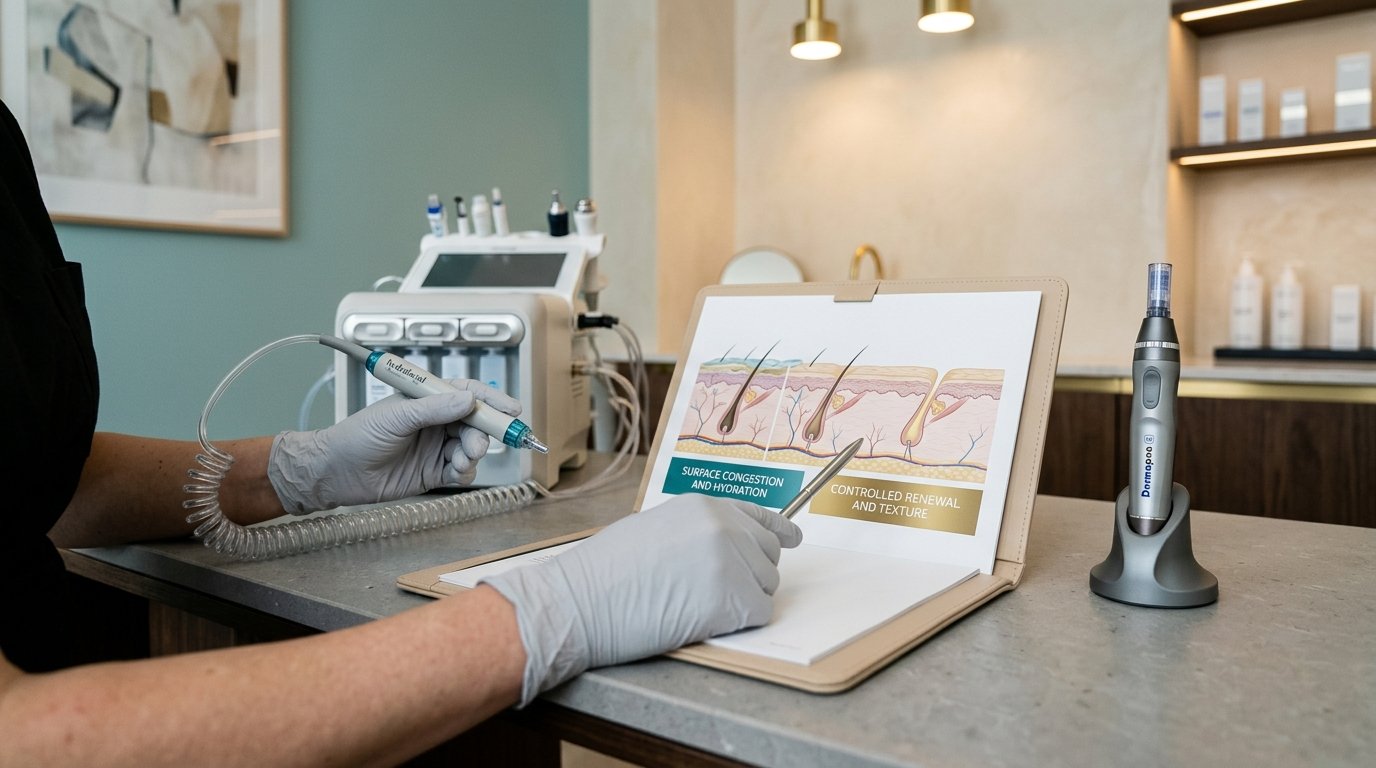
microneedling renewal; AI-generated representation, not a photograph of
Skincare Center staff or premises.
The
short answer: match the mechanism to the dominant concern
If the dominant concern is surface dullness, dehydration, easily
removable congestion or the wish for a refreshed appearance with minimal
downtime, Hydrafacial is often the more direct starting point. The
treatment works at and near the surface, where cleansing, controlled
exfoliation, suction-assisted removal and serum delivery can change how
smooth and hydrated skin looks and feels. That does not mean it cures
acne, permanently shrinks pores or corrects structural scarring.
If the dominant concern is persistent uneven texture, shallow
atrophic acne scars, fine lines or a need for gradual collagen
remodeling, professional microneedling may be the more relevant option.
The American Academy of Dermatology describes microneedling as a medical
treatment that uses tiny needles to puncture the skin and stimulate
collagen, and lists uneven texture, acne scars and large pores among
concerns dermatologists may treat. Results develop over time and
commonly require a course rather than one visit. It is not an extraction
treatment and should not be performed through uncontrolled inflammation
or infection.
When both surface congestion and structural texture are important,
the best answer may be staged care. A clinician may first stabilise acne
and the skin barrier, then address congestion, then consider
microneedling after active inflammatory lesions are controlled. A later
maintenance facial may support hydration between renewal-focused
sessions if it is appropriate for the individual. “Both” does not mean
“on the same day,” and more procedures do not automatically create a
better outcome.
First define what
“texture” means on your skin
Texture is an appearance, not a diagnosis. Under angled light,
dehydration lines, tiny closed comedones, sebaceous filaments, post-acne
depressions and normal follicular openings can all cast shadows. A
useful consultation separates what is sitting on the surface from what
is built into the skin’s structure.
Surface roughness often changes quickly with hydration, gentle
exfoliation and a consistent barrier-supportive routine. It may feel
tight after cleansing, look worse under makeup, and fluctuate with
weather or overuse of active ingredients. Congestion usually refers to
material within follicles: sebum, keratin and debris can make blackheads
or closed bumps more visible. Sebaceous filaments are normal structures
that help move sebum; they can be made less conspicuous but are not
defects that can be permanently extracted away. The distinction is
explained in more depth in our guide to blackheads
versus sebaceous filaments.
Structural unevenness behaves differently. Rolling, boxcar and
ice-pick acne scars involve changes below the outermost surface.
Enlarged-looking pores may also be influenced by oil activity,
elasticity, scar architecture and light reflection rather than a
removable “plug.” Our enlarged
pores treatment guide explains why pore visibility has several
drivers. A treatment can improve appearance without erasing the
underlying anatomy or making follicles cease to exist.
Active inflammatory acne adds another layer. Red, tender papules,
pustules, nodules or cysts are not simply texture. They may require an
acne management plan before elective resurfacing. Treating an inflamed
field aggressively can prolong irritation, and needling across infected
or highly inflamed areas may spread organisms or worsen injury. The
safest comparison begins with a clean question: is the main problem
removable surface material, dehydration, stable residual texture, active
disease, or a mixture?
What Hydrafacial actually
does
Hydrafacial is a branded form of hydradermabrasion that combines
fluid-based resurfacing with suction and topical solutions. The
manufacturer describes a spiral tip and vacuum-powered fluidics that
lift debris while solutions are delivered to the skin. In practical
terms, an appointment usually includes cleansing, exfoliation, a
controlled acid step selected for the skin, extraction and hydration.
Protocols vary, and a reputable provider should explain exactly which
steps and products are planned rather than relying on the brand name
alone.
The best evidence should be interpreted modestly. A small randomised
study published in 2008 compared six hydradermabrasion treatments with
manual application of an antioxidant serum in twenty women. The
hydradermabrasion group showed clinical and histologic changes,
including improvements reported in fine lines, pore size and
hyperpigmentation, while the serum-only group did not show comparable
changes. This is useful preliminary evidence, but it is not proof that
every protocol, device or patient will obtain the same result. The
sample was small, the treatment course was repeated, and the study did
not establish a permanent cure for congestion or scars. Readers can
review the abstract in PubMed.
For a person whose immediate priority is a cleaner-feeling surface
and hydrated finish, the mechanism makes sense. Loosened material can be
removed without manual squeezing, and humectant-rich solutions may
temporarily improve suppleness and light reflection. Because the
procedure is non-invasive, most people plan less visible recovery than
they would after a needling session. A mild pink appearance or transient
sensitivity can still occur, especially when the barrier is already
compromised or stronger exfoliating steps are used.
Hydrafacial should not be translated into exaggerated claims. Suction
cannot permanently change genetically influenced pore size. Extracting a
follicle does not stop it from filling again. Hydration can soften the
look of fine surface lines but does not equal dermal collagen
remodeling. A bright finish is not evidence that acne biology has been
cured. The treatment can be useful precisely because its role is limited
and understandable.
What microneedling actually
does
Professional microneedling uses sterile needles to create controlled
punctures at selected depths. The goal is to initiate a regulated
wound-healing response, not to scrape away debris. As the treated skin
repairs, signalling involved in collagen and elastin production can
gradually change texture. The American
Academy of Dermatology identifies acne scars, uneven texture and
tone, fine lines and large pores among the concerns dermatologists may
use microneedling to address. It also stresses that microneedling is a
medical treatment and that expertise matters.
Depth, device quality, needle configuration, pass pattern, endpoint
and infection-control practice all influence the procedure. A deeper
setting is not automatically better. Thin areas, bony areas, scar types
and skin condition require different decisions. A properly performed
treatment may cause temporary redness, warmth, tightness, pinpoint
bleeding or swelling. Cleveland Clinic notes that redness and swelling
can persist for several days and that results may take months, with
multiple sessions often required. Its overview also distinguishes
microneedling from microdermabrasion: microneedling reaches deeper and
may be more relevant for below-surface problems such as acne scars. See
the medically reviewed Cleveland
Clinic microneedling guide.
Microneedling is not a method for vacuuming comedones. It will not
remove a blackhead during the session. It is also not suitable for every
scar. Deep narrow ice-pick scars, tethered rolling scars and sharply
edged boxcar scars may need different or combined approaches after
medical assessment. Our detailed acne
scar treatment guide explains why scar classification comes before
device selection.
Home rollers and professional treatment should not be treated as
equivalents. Consumer tools generally cannot reproduce controlled depth,
sterility, technique or clinical judgment. Reuse, excessive pressure or
needling over active lesions can increase infection, pigment change and
scarring risks. A professional comparison is between a properly selected
Hydrafacial protocol and properly performed clinical microneedling—not
between a clinic facial and an improvised home needle device.
Hydrafacial
vs microneedling for texture: a practical comparison
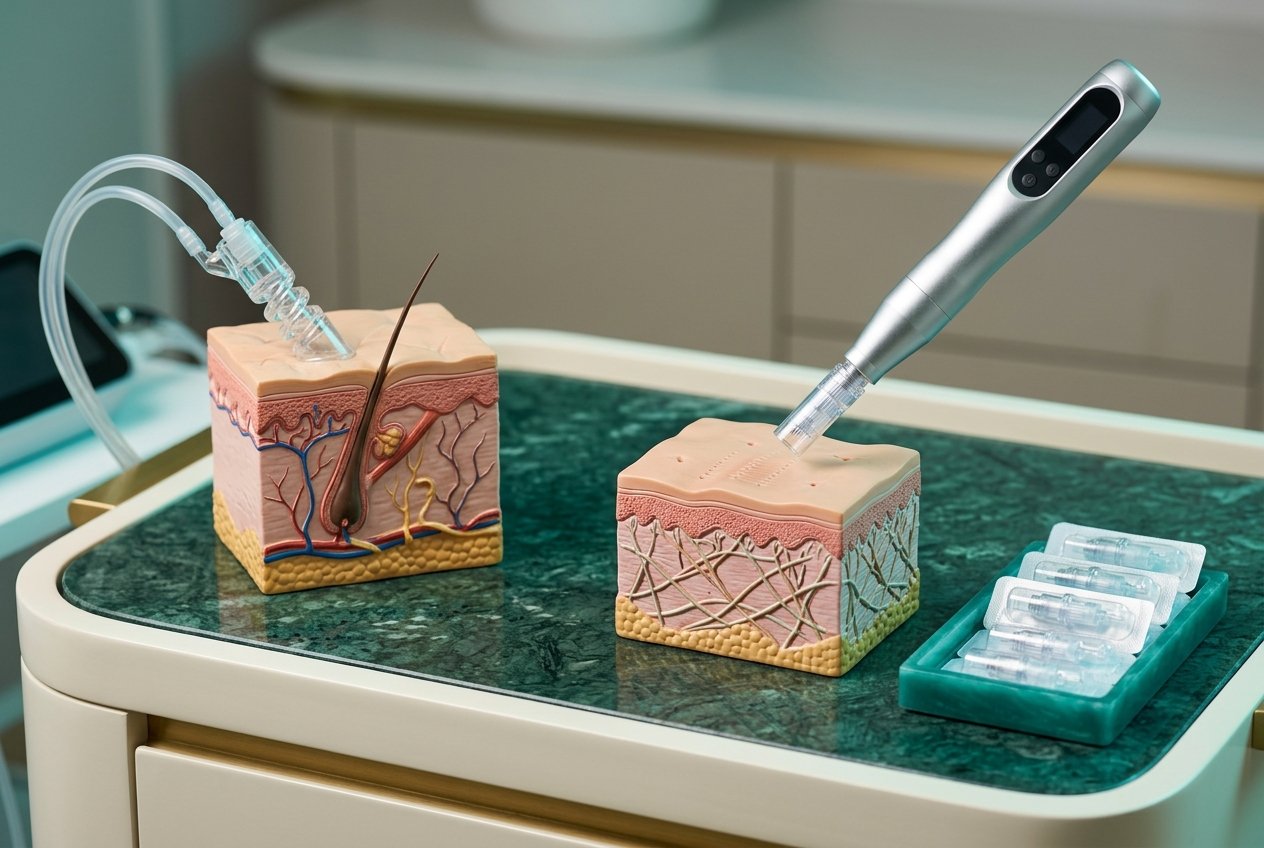
texture remodeling. AI-generated editorial image; individual suitability
requires assessment.
Primary goal
Hydrafacial primarily serves a surface-care goal: cleanse, exfoliate,
remove some loose follicular debris and replenish hydration.
Microneedling primarily serves a renewal goal: trigger a controlled
repair response for gradual improvement in structural irregularity. Both
can make skin look smoother, but they arrive there through different
pathways and on different timelines.
Best-fit concerns
Hydrafacial may be a reasonable fit for dullness, dehydration,
superficial roughness and mild congestion when the skin is calm enough
for the selected protocol. Microneedling may be considered for stable
post-acne texture, some atrophic scars, fine lines and unevenness that
does not disappear when the surface is hydrated. Neither label replaces
assessment. Rosacea-prone, eczema-prone, recently sunburned or highly
reactive skin may need a modified plan or a pause.
Sensation and anaesthesia
A Hydrafacial appointment is commonly described as a moving wet
suction sensation with variable tingling during exfoliating steps.
Topical anaesthetic is not normally the defining part of the procedure.
Microneedling uses needles and may require topical numbing depending on
the planned depth and area. Sensation can be stronger near the forehead,
cheekbones and upper lip. Comfort should never be pursued by using an
unsafe amount of numbing product or by performing a deeper treatment
than the provider can monitor.
Downtime
Hydrafacial is usually chosen when minimal visible downtime matters,
although transient redness, dryness or sensitivity can occur.
Microneedling produces an intentional inflammatory response, so redness,
warmth, swelling, dryness or flaking are expected possibilities. Social
downtime varies with depth, skin response and aftercare. Scheduling a
first microneedling session immediately before a major event is unwise
because individual recovery cannot be guaranteed.
Speed of visible change
Hydration and removal of surface debris may create an immediate
polished appearance after Hydrafacial. That quick change is valuable for
the right goal, but it can fade as the skin returns to its usual oil and
shedding cycle. Microneedling often looks temporarily red before it
looks better. Remodeling unfolds over weeks to months, and judging a
collagen-focused course within a few days is misleading.
Number of sessions
One Hydrafacial can provide a short-term refreshed effect; recurring
sessions may be used for maintenance if the skin tolerates them and the
cost fits the plan. Microneedling is commonly planned as a series spaced
far enough apart for recovery and remodeling. The exact number and
interval should be individualised. Selling an identical package to
everyone before assessing skin condition, scar type and response is a
warning sign.
Risk profile
Both treatments can cause irritation, allergic or irritant reactions,
acne flare or pigment change when poorly selected. Hydrafacial adds
concerns related to suction intensity, exfoliating solutions and
contamination if hygiene is inadequate. Microneedling adds
puncture-related risks such as bleeding, infection, prolonged
inflammation, post-inflammatory hyperpigmentation and scarring. The
probability is influenced by medical history, active disease, technique,
device hygiene and aftercare.
What each cannot do
Hydrafacial cannot rebuild a deep tethered scar, permanently close
pores or replace treatment for active acne. Microneedling cannot extract
follicular contents, guarantee scar removal or substitute for acne
control. Neither treatment can promise poreless skin, a permanent
glass-skin finish or identical outcomes across skin tones and
conditions.
Congestion:
where Hydrafacial usually has the clearer role
Congestion is often the reason people expect the two procedures to be
interchangeable. If the skin contains visible blackheads, a rough
collection of closed comedones or easily expressed surface debris, a
cleansing and extraction-focused approach is more direct than a collagen
induction procedure. A Hydrafacial treatment can combine controlled exfoliation and
suction-assisted extraction with hydration, provided the skin is
suitable on the day.
That does not mean every bump should be suctioned. Closed comedones
can be stubborn, and aggressive attempts to clear all of them in one
sitting may injure the follicle. Inflamed lesions should not be treated
like plugs. If congestion is widespread or repeatedly returns, daily
factors deserve attention: comedogenic products, inadequate removal of
water-resistant sunscreen, occlusive hair products, over-exfoliation,
hormonal influences and acne itself. A facial can support a plan, but it
is not the whole plan.
Sebaceous filaments refill because they are part of normal follicular
function. The realistic goal is to reduce their visibility, not declare
them permanently removed. Maintenance may involve gentle cleansing, a
tolerable leave-on active when medically appropriate, non-comedogenic
moisturising and sunscreen. Over-cleansing can paradoxically make
texture look worse by increasing dryness and surface irregularity.
If congestion coexists with an impaired barrier—burning, tightness,
diffuse redness or flaking—the first intervention may be simplification
rather than extraction. Even a non-invasive procedure can be too much
for actively irritated skin. Calm skin gives the provider more options
and makes the result easier to interpret.
Post-acne
texture: where microneedling may be more relevant
Once active acne is controlled, residual marks should be classified.
Flat red or brown macules are not the same as depressed scars. Redness,
pigment and loss of tissue interact with light differently and may need
different strategies. Microneedling is most often discussed for atrophic
texture because controlled injury can support gradual collagen
remodeling. It may soften transitions and make some scars less
noticeable; it does not erase all scar architecture.
Rolling scars may be tethered beneath the surface. Boxcar scars vary
in depth and edge sharpness. Ice-pick scars are narrow and deep. A pen
passing over the surface cannot be assumed to solve each pattern
equally. Some people need a multimodal medical plan, and some are not
candidates for elective needling at the time of assessment. The correct
decision may be to treat acne first, address a specific scar type with
another method, or avoid a procedure because risk outweighs likely
benefit.
Professional microneedling also requires realistic patience. The
early post-treatment phase can create temporary swelling that makes
texture look deceptively smooth. As swelling settles, the original
shadows can appear to return before remodeling becomes visible.
Standardised photographs with the same lighting, angle and distance are
more useful than daily mirror checks. Improvement is often incremental
rather than dramatic.
Skin tone does not eliminate the need for caution. Microneedling
avoids thermal energy, which can be an advantage in some contexts, but
any inflammation can contribute to post-inflammatory hyperpigmentation.
Conservative settings, careful preparation, sun protection and prompt
management of prolonged inflammation are important. “Safe for all skin
tones” should not be translated into “risk-free for every
individual.”
Enlarged-looking
pores: decide whether the driver is oil, debris or structure
Pores are openings of pilosebaceous units. Their visibility can
increase with oil, retained material, surrounding dehydration, loss of
elasticity, scar-like changes and directional light. Hydrafacial can
make pores look cleaner and temporarily less conspicuous by removing
some material and improving surface hydration. Microneedling may
gradually affect the supportive texture around some enlarged-looking
pores. Neither process removes the follicles.
This is why photographs taken immediately after extraction can
exaggerate the idea of “shrinking.” Less dark material and better
hydration change contrast, so the openings appear smaller. The effect
can be meaningful without being permanent. With microneedling, a change
should be assessed after the inflammatory phase and sufficient
remodeling time, not while swelling is masking shadows.
A useful plan may combine home care, sun protection and one procedure
selected for the dominant driver. If excess oil and visible filaments
dominate, start with oil and congestion management. If stable textural
depressions dominate, discuss renewal. If the concern is based mainly on
magnified photographs, pause: smartphone macro images can turn normal
skin anatomy into a problem that is not visible at conversational
distance.
Active acne changes the
decision
Active acne is not a minor footnote. Needling through pustules,
crusted lesions or suspected infection is inappropriate because it can
increase trauma and potentially spread microorganisms. Deep inflammatory
acne also continues to create new scar risk, so focusing only on old
scars while new lesions form is strategically backward. Acne control
comes first.
A mild, carefully selected cleansing facial may sometimes support
comfort and non-inflamed congestion, but aggressive extraction can
rupture follicles and worsen inflammation. The provider should
distinguish comedonal from inflammatory lesions and know when not to
treat. Painful nodules, rapid worsening, scarring acne or acne affecting
quality of life warrants medical evaluation.
Medication matters. Oral isotretinoin history, topical retinoids,
antibiotics, anticoagulants and products that increase sensitivity can
affect timing or aftercare. Rules around procedures and isotretinoin
have evolved and vary by procedure, so internet cutoffs should not
replace the prescribing clinician’s advice. Do not stop prescribed
medication solely to qualify for a cosmetic appointment.
Dehydration
and barrier damage can imitate bad texture
When the outer barrier lacks water or is disrupted, corneocytes shed
unevenly and small lines become more visible. Makeup catches on flakes,
pores look shadowed and skin may feel both oily and tight. A person may
conclude that a stronger resurfacing procedure is necessary when the
first need is a gentler routine.
Hydrafacial’s hydration-focused finish can improve appearance
quickly, but protocol intensity still matters. Strong acids, repeated
passes or vigorous suction can be counterproductive on sensitised skin.
A provider should reduce intensity or postpone treatment when there is
sunburn, dermatitis, open skin or significant irritation. Hydration is
not permission to exfoliate without limit.
Microneedling intentionally challenges the barrier. It should be
scheduled only when the skin is stable and aftercare can be followed.
Introducing multiple new active products immediately before or after the
procedure makes it difficult to identify the cause of irritation. A
bland, provider-approved routine and disciplined sun protection are
often more helpful than a crowded recovery shelf.
A decision
framework you can use before booking
Step 1: name the top two
concerns
Replace “I want better skin” with observable priorities: blackheads
on the nose, makeup-catching dryness, shallow cheek depressions,
post-acne brown marks, fine lines, or redness. Rank the top two. A
treatment plan becomes clearer when it is not expected to solve every
concern at once.
Step 2:
separate active disease from stable residue
New painful acne, eczema flare, herpes outbreak, infection or
unexplained rash should be evaluated before elective resurfacing. Stable
marks and scars can be discussed after the active problem is controlled.
If symptoms change from week to week, a snapshot consultation may need
follow-up rather than immediate treatment.
Step 3: identify the
depth of the problem
If texture improves markedly after moisturiser or changes with
cleansing, the issue may be mainly superficial. If depressions remain
under multiple lighting conditions and have been stable after acne,
structural change is more likely. A clinician may stretch the skin, use
side lighting and examine individual scar edges to refine the
assessment.
Step 4: decide
how much recovery is acceptable
Minimal downtime can make Hydrafacial attractive before travel or an
event, but even low-downtime care should not be booked for the first
time immediately before an important date. Microneedling requires
willingness to accept visible redness and a slower result. Work, sun
exposure, exercise habits and upcoming events affect scheduling.
Step 5: review
medical and treatment history
Disclose tendency to keloids, cold sores, bleeding issues, immune
suppression, pregnancy or breastfeeding, recent procedures, allergies,
active prescriptions and previous pigment reactions. This information is
not bureaucracy; it changes the safety calculation.
Step 6: choose a measurable
endpoint
Examples include fewer visible blackheads, less makeup-catching
roughness, softer shadowing across shallow scars, or better tolerance of
a basic routine. “Perfect skin” cannot be measured and encourages
overtreatment. Standardised photographs and a defined review date create
a more honest feedback loop.
Who may prefer Hydrafacial
Hydrafacial may suit someone seeking a non-invasive appointment
focused on cleansing, mild exfoliation and hydration. It is often
attractive when there is dullness, mild congestion, superficial
roughness or a desire for a temporary polished finish. It can also be
considered as maintenance for a person whose barrier is stable and who
understands that oil and follicular material will return.
It may be especially practical when social downtime must be minimal.
However, “no downtime” should be understood as an average expectation,
not a guarantee. Reactive skin can become red, and an exfoliating
solution can sting or trigger dryness. Patch history, previous reactions
and current product use should guide protocol strength.
Hydrafacial is less likely to satisfy someone whose main complaint is
deep or tethered acne scarring. Repeated surface treatments can improve
glow while leaving the central structural concern unchanged. If
photographs show depressed scars rather than congestion, spending the
full budget on monthly extraction treatments may delay a more
appropriate scar consultation.
Who may prefer microneedling
Microneedling may suit someone with stable uneven texture, shallow
atrophic acne scars, fine lines or enlarged-looking pores where
remodeling is a reasonable goal. The person should accept that change is
gradual, multiple visits may be recommended and recovery is more visible
than after a facial.
A suitable candidate has calm skin at the planned site, can follow
aftercare, understands sun protection and has no unaddressed
contraindication. A history of post-inflammatory pigmentation does not
automatically exclude treatment, but it warrants thoughtful settings and
monitoring. A history of keloid formation, active infection,
uncontrolled inflammatory skin disease or relevant medication may alter
or rule out the plan.
Microneedling is a poor choice for someone mainly seeking same-day
extraction or an event-ready glow. It is also inappropriate when
expectations are based on filtered images or promises of total scar
removal. The objective is usually improvement in texture, not
restoration of skin to a state with no visible pores or history.
When neither
procedure should be the first move
Neither Hydrafacial nor microneedling should be the reflex answer to
every texture concern. If there is uncontrolled acne, the priority may
be medical acne treatment. If the skin burns with water and flakes after
every active, barrier repair may come first. If a lesion bleeds, changes
shape or persists unexpectedly, it needs diagnostic assessment rather
than cosmetic resurfacing.
Body dysmorphic concerns also deserve sensitivity. When a person
examines pores for hours, repeatedly seeks procedures despite normal
findings or experiences substantial distress disproportionate to what
others can see, another procedure may not relieve the underlying burden.
Ethical care includes declining treatment and recommending appropriate
support.
Budget can also make “neither for now” the rational choice. A simple
routine with cleanser, moisturiser and broad-spectrum sunscreen may
create more reliable long-term value than an isolated procedure followed
by inconsistent care. Treatment should fit a sustainable plan rather
than compete with essential medical care.
Can Hydrafacial
and microneedling be combined?
They can appear in the same long-term plan, but timing must be
deliberate. Hydrafacial can address surface congestion and hydration;
microneedling can later address stable structural texture. Performing
two procedures together simply because they target different layers
ignores cumulative irritation and the need to observe how skin responds
to each.
A common logic is sequential: stabilise the barrier and active acne,
use a gentle cleansing approach if indicated, allow the skin to return
to baseline, then perform microneedling at a separate appointment.
Another person may complete a microneedling course and use occasional
hydration-focused facials during maintenance, with adequate spacing.
There is no universal interval. It depends on treatment intensity,
healing, products used and clinical judgment.
Spacing has diagnostic value. If irritation occurs after a stacked
session, it is difficult to know which solution, device or aftercare
step caused it. Separate appointments create clearer cause and effect.
They also reduce the temptation to treat visibly inflamed skin because a
package has already been sold.
What a safe
Hydrafacial consultation should cover
A good consultation should examine skin in normal light, ask about
sensitivity, recent sun exposure, allergies, acne treatment and previous
reactions, then explain the planned steps. The provider should state
which exfoliating solutions and boosters are being considered and why.
Vague promises that every protocol is suitable for every skin type are
not reassuring.
Hygiene should be visible: clean treatment surfaces, appropriate
disinfection, single-use components where specified and no reuse of tips
intended for one client. Suction intensity and number of passes should
be adjusted rather than treated as a toughness test. Pain, persistent
burning or blanching is a reason to stop and reassess.
The provider should also set limits. They should not promise
permanent pore closure, scar elimination or acne cure. They should
explain possible redness, dryness, breakouts or sensitivity and give
simple aftercare. A written record of products used is valuable if a
reaction develops.
What a safe
microneedling consultation should cover
Microneedling requires a more medical risk review. The practitioner
should ask about active acne, herpes, eczema or psoriasis at the site,
bleeding disorders, anticoagulants, immune status, scar history,
allergies, pregnancy-related considerations and recent procedures. They
should assess whether the concern is one that microneedling can
reasonably improve.
Device and cartridge practices matter. The cartridge should be
sterile and single use. The treatment area should be prepared with an
appropriate antiseptic, and the operator should use infection-control
measures consistent with a procedure that breaches the skin. Needle
depth and passes should be documented. A named device alone does not
guarantee safe technique.
The plan should include an endpoint and review window. Immediate
pinpoint bleeding is not a competition, and aggressive treatment is not
proof of quality. The practitioner should explain expected redness, when
makeup and exercise can resume, which products to avoid, warning signs
and how to reach the clinic if healing deviates from the expected
course.
Before Hydrafacial:
practical preparation
Arrive with an accurate list of products, particularly retinoids,
exfoliating acids, benzoyl peroxide and prescription treatments. The
clinic may advise a temporary pause based on the exact protocol and your
skin; do not invent a pause schedule from social media. Avoid deliberate
tanning or arriving with sunburn. Tell the provider about cold sores,
open wounds or recent waxing in the area.
Do not perform an at-home peel, scrub or extraction marathon to
“prepare.” That removes the buffer the treatment needs and can make a
normally tolerable solution sting. Keep the routine steady so the
provider sees the skin’s true baseline.
If the appointment is tied to an event, schedule a trial well
beforehand. Even a familiar facial can provoke an unexpected breakout or
reaction after a product change. The safest event plan is based on
observed response, not a guarantee.
After
Hydrafacial: protect the result without overworking the skin
Use a gentle cleanser, moisturiser and broad-spectrum sunscreen.
Follow the clinic’s specific guidance about when to restart retinoids,
acids or benzoyl peroxide. More exfoliation is not a way to extend the
result; it can create dryness that makes texture more visible.
Avoid picking newly visible material. Extraction may reveal redness
around a follicle, and squeezing can turn a temporary mark into
inflammation. If there is persistent swelling, blistering, marked pain,
hives or signs of infection, contact the provider or seek medical
advice.
Expect normal biology to continue. Sebum production and cell shedding
do not stop. A sustainable home routine determines how the skin behaves
between appointments, while periodic treatment may offer supportive
maintenance.
Before
microneedling: reduce avoidable risk
Provide a complete health and medication history and follow the
treating clinician’s instructions. Avoid sunburn and do not arrive with
active dermatitis, infection or an open lesion. If you have a history of
herpes outbreaks, discuss whether preventive medication is appropriate;
do not self-prescribe.
Stop experimenting with new skincare in the lead-up. Irritation from
a new acid or retinoid can postpone the session. The exact pause for
active products should come from the practitioner because concentration,
frequency, depth and skin tolerance differ.
Plan the recovery environment. Have clean pillowcases, gentle
products and sunscreen available. Avoid scheduling intense outdoor
activity, swimming or a major social event immediately after a first
treatment. Transportation and work commitments may be simple, but
visible redness can last longer than an advertisement suggests.
After
microneedling: healing is part of the treatment
The first priority is to reduce contamination and unnecessary
inflammation. Touch the area only with clean hands, use the recommended
gentle products and avoid picking flakes. Follow the provider’s timing
for cleansing, moisturiser, sunscreen, makeup, exercise, heat exposure
and active ingredients. Generic online timetables cannot account for the
depth actually used.
Temporary redness, warmth, tightness, dryness and mild swelling can
be expected. Worsening pain, pus, spreading redness, fever, blistering,
persistent bleeding or swelling that does not improve should be reported
promptly. Cleveland Clinic advises contacting a provider for bleeding
beyond twenty-four hours, blistering or swelling lasting more than a
week.
Do not judge scar improvement during swelling. Take comparison
photographs only after the skin returns to baseline and at the review
interval selected by the clinician. Collagen remodeling is slow, and
repeated treatment before recovery is complete can increase risk without
improving the final result.
Results:
immediate polish versus gradual remodeling
Hydrafacial often wins the “what can I see tomorrow?” question.
Cleaner follicles, a hydrated surface and more even light reflection can
produce a quick cosmetic improvement. The magnitude and duration depend
on baseline dehydration, oil, home care and protocol. A person with
little congestion may notice mainly softness; someone with visible
blackheads may notice a clearer surface.
Microneedling answers a different question: “what may change after
healing and remodeling?” Early redness gives way to recovery, and subtle
improvements may accumulate across a course. Scar edges can appear
softer and texture more even, but the outcome varies with scar type,
age, biology, technique and adherence. No responsible provider can
promise a particular percentage without assessment.
The two timelines should not be used to rank the procedures. Fast is
not better if the goal is structural. Slow is not more powerful if the
main issue is removable debris. The correct timescale follows the
biological target.
Cost and value:
compare plans, not single prices
Hydrafacial pricing may vary with protocol level, boosters, treatment
area and add-ons. Microneedling pricing may vary with clinician
expertise, device, depth, area, anaesthesia and whether additional
products are proposed. A low advertised price can become expensive after
unnecessary upgrades; a higher clinical fee may include assessment and
follow-up.
Ask what is included, how many sessions are being recommended, why
that number was chosen and what would cause the plan to change. For
Hydrafacial, ask whether extraction, specific solutions and aftercare
are included. For microneedling, ask whether sterile cartridges,
numbing, review and complication contact are included.
Value is the probability of addressing the actual concern safely. Six
facials are poor value if the dominant issue is tethered scarring. A
microneedling package is poor value if the person only wants temporary
hydration before photographs. A staged plan may cost more per decision
point but prevent spending on the wrong mechanism.
Questions to ask the clinic
Ask the following before committing:
- What do you think is causing the texture I see?
- Is my dominant problem congestion, dehydration, active acne,
scarring or a mixture? - Why is this procedure more appropriate than the alternative for my
first goal? - Which exact Hydrafacial steps or microneedling settings are planned,
and why? - Who performs the procedure, and what relevant training do they
have? - What makes you postpone or decline treatment?
- How are tips, handpieces and treatment surfaces cleaned or disposed
of? - What reaction is expected at twenty-four hours, three days and one
week? - Which warning signs require contact?
- How will progress be photographed and reviewed?
- What home care is essential, and which optional products can I
skip? - If the first session does not help, what is the decision rule for
changing course?
A provider who welcomes these questions is more useful than one who
answers with a package name. The consultation should reduce uncertainty,
not pressure you to buy immediately.
Myths vs facts
Myth: Hydrafacial
permanently closes pores
Fact: Pores are anatomical openings. Removing dark
material and improving hydration can make them less conspicuous, but the
follicle remains. Oil production, genetics, elasticity and routine
influence how visible it becomes again.
Myth:
Microneedling cleans clogged pores from the inside
Fact: Microneedling creates controlled microinjury
to stimulate repair. It is not an extraction procedure. Needling over
active inflamed acne can be inappropriate.
Myth:
The treatment with more redness is working harder
Fact: Redness reflects inflammation, not guaranteed
benefit. Excessive injury can increase pigment and scarring risk. The
correct endpoint is based on indication, skin and technique.
Myth:
One deep microneedling session is better than a conservative course
Fact: More depth adds risk and may not match the
concern. Remodeling requires time. Settings and intervals should be
individualised.
Myth: A
Hydrafacial is only a fancy face wash
Fact: A professional protocol combines controlled
fluid-based resurfacing, suction and topical delivery. It can create
meaningful surface changes, although evidence and claims should remain
proportionate.
Myth: Microneedling
removes every acne scar
Fact: Scar types respond differently. Deep ice-pick,
sharply edged or tethered scars may need other approaches. Improvement,
not complete erasure, is the realistic frame.
Myth: No downtime means no
risk
Fact: Non-invasive procedures can still irritate
skin, trigger allergy, worsen dermatitis or cause problems when hygiene
is poor. Low downtime is not zero risk.
Myth: If pores refill,
the facial failed
Fact: Follicles continue normal oil and keratin
production. A temporary reduction in visible congestion can still be a
successful outcome when it was honestly presented as temporary.
Myth:
Home microneedling is the same treatment at a lower price
Fact: Consumer devices do not reproduce clinical
assessment, sterile single-use cartridges, controlled depth and
professional technique. Improper use can spread infection and cause
scars or pigment change.
Myth: Everyone
should combine both procedures
Fact: Some people need one, some need a staged
sequence and some need neither. Combining treatments without a reason
increases cost and cumulative irritation.
Frequently asked questions
1. Is
Hydrafacial or microneedling better for blackheads?
Hydrafacial is generally the more direct option because its
cleansing, exfoliation and suction-assisted steps can remove some loose
material. Microneedling does not extract blackheads. Persistent or
inflamed acne still needs a broader plan, and aggressive extraction
should be avoided.
2. Which is better for acne
scars?
Professional microneedling is more relevant for some stable atrophic
acne scars because it aims at gradual remodeling. Hydrafacial may
improve surface brightness and hydration but cannot rebuild depressed
scar architecture. Scar type and active acne status should be assessed
first.
3. Which
treatment is better for enlarged-looking pores?
It depends on the driver. Hydrafacial may make debris-filled pores
look cleaner quickly. Microneedling may be considered when supportive
texture and elasticity are part of the appearance. Neither permanently
closes pores.
4. Can I have
Hydrafacial when I have active acne?
Possibly, but not every acne pattern or protocol is suitable.
Non-inflamed congestion may tolerate gentle care, while painful
pustules, nodules, open lesions or suspected infection need medical
assessment and avoidance of aggressive extraction.
5. Can I have
microneedling over active acne?
Needling through active inflamed or infected lesions is generally
avoided because trauma may worsen inflammation and spread
microorganisms. The clinician should stabilise active disease and
reassess residual scars later.
6. Which gives faster results?
Hydrafacial often gives faster visible surface polish and hydration.
Microneedling results are slower because healing and collagen remodeling
take weeks to months. Faster is not better unless the goal is
superficial.
7. Which has more downtime?
Microneedling usually has more visible recovery, including redness,
warmth, tightness, dryness or swelling. Hydrafacial usually has minimal
downtime, but sensitive skin can still react.
8. Does Hydrafacial hurt?
Most people describe wet suction, movement and mild tingling rather
than pain. Strong burning, marked pain or persistent blanching should be
reported immediately so the protocol can be stopped or adjusted.
9. Does microneedling hurt?
Sensation varies by area, depth and numbing. It can feel scratchy,
warm or sharp, especially over bony areas. Comfort measures should be
supervised and must not substitute for conservative technique.
10. How many
Hydrafacial sessions do I need?
One session may create a temporary refreshed effect. Maintenance
frequency depends on skin response, goals, routine and budget. There is
no medically necessary monthly schedule for everyone.
11. How many
microneedling sessions do I need?
Many plans use a series, but the number depends on scar type, depth,
response and risk. A clinician should review progress between sessions
rather than selling an inflexible package before treatment begins.
12. Can the
treatments be done on the same day?
They should not be automatically stacked. Combined irritation can
complicate healing and obscure which step caused a reaction. If both are
appropriate, a clinician should select safe timing based on intensity
and recovery.
13. Which is safer for
darker skin tones?
Both can be used thoughtfully across skin tones, but neither is
risk-free. Microneedling does not rely on heat, yet inflammation can
still cause post-inflammatory hyperpigmentation. Conservative technique
and sun protection matter.
14. Can Hydrafacial
remove sebaceous filaments?
It can reduce their visible contents temporarily, but sebaceous
filaments are normal and refill. The goal is controlled visibility, not
permanent removal.
15. Can microneedling cure
acne?
No. Microneedling is not a primary acne cure. It may be considered
for residual texture after active acne is controlled. Ongoing acne
should be managed separately.
16. Will Hydrafacial
improve pitted scars?
It may make the surrounding surface look hydrated and bright, but it
does not reconstruct deep pits or release tethered scars. A
scar-specific consultation is more appropriate.
17. Will microneedling
make pores disappear?
No. It may soften the appearance of some enlarged-looking pores over
time, but follicles remain. Claims of poreless skin are unrealistic.
18. Can I wear makeup after
Hydrafacial?
Many people can, but following the provider’s specific advice is
better, especially if the skin is pink or sensitive. Clean applicators
and non-irritating products reduce avoidable problems.
19. When can I wear
makeup after microneedling?
Follow the clinician’s timing because the barrier has been
intentionally disrupted and treatment depth varies. Applying makeup too
early can introduce irritants or microorganisms.
20. Can I exercise after
either treatment?
Heat and sweat can aggravate freshly treated skin. Restrictions are
usually more important after microneedling. Use the practitioner’s
procedure-specific guidance rather than a universal online rule.
21. Can I use
retinol before and after treatment?
Your provider should advise based on the product, frequency, skin and
procedure intensity. Do not stop a prescription without consulting the
prescriber, and do not restart simply because the surface looks
calm.
22. Is
Hydrafacial appropriate before a wedding or event?
It is often selected for low downtime, but first-time treatment
immediately before an important event is risky. Have a trial far enough
in advance to observe your own response.
23. How long do
Hydrafacial results last?
The hydrated finish and reduction in visible debris are temporary.
Duration varies with oil production, climate, products and routine.
Maintenance should be based on benefit and tolerance, not pressure.
24. How long do
microneedling results last?
Remodeling can be longer-lasting than a surface hydration effect, but
ageing, acne and sun exposure continue. Results vary and maintenance may
be discussed after a completed course and review.
25. Can microneedling
cause hyperpigmentation?
Yes, especially if treatment is too aggressive, inflammation persists
or sun protection is inadequate. Careful patient selection, technique
and aftercare reduce but do not eliminate risk.
26. Can Hydrafacial cause a
breakout?
Some people notice temporary breakouts or irritation after changes in
exfoliation and products. A significant, painful or persistent eruption
should not be dismissed as mandatory “purging”; contact the
provider.
27. What if my texture
is mainly dehydration?
Repairing the barrier and improving daily hydration may be the
highest-value first step. A gentle Hydrafacial may provide temporary
support, while microneedling would add unnecessary injury if no
structural target exists.
28. What if I
have both congestion and acne scars?
Use a staged plan. Control active acne and irritation, address
congestion without aggressive trauma, then reassess stable scars.
Microneedling can be considered later if appropriate. Trying to solve
everything in one appointment can increase risk.
29. Is a Dermapen the
same as microneedling?
Dermapen is a device brand used for microneedling. The outcome still
depends on cartridge authenticity, sterility, settings, operator skill,
assessment and aftercare. A brand name is not a substitute for clinical
quality.
30. How do I
know whether a clinic is overpromising?
Be cautious if it guarantees permanent pore closure, scar removal,
identical results, zero risk or a fixed package for everyone. Good
providers explain limits, alternatives, downtime, hygiene and reasons to
postpone.
Building a
sensible sequence for mixed concerns
For a person with oily congestion, active breakouts and old cheek
scars, the sequence might begin with acne assessment and a simplified
routine. Once inflammation is controlled, a gentle extraction-focused
appointment may help non-inflamed congestion. After the skin returns to
baseline, scar type can be assessed for microneedling or another
modality. Each stage has a question and an endpoint.
For a person with dry, rough skin and no scars, the sequence may
never include microneedling. Barrier care and occasional
hydration-focused treatment may be sufficient. For a person with calm
skin and stable rolling scars but little congestion, Hydrafacial may be
optional rather than a prerequisite. The framework prevents a
fashionable procedure from replacing diagnosis.
At Skincare Center, relevant options include Hydrafacial in Istanbul for cleansing and hydration-focused care and microneedling
in Istanbul for selected renewal goals. These links describe
services, but suitability still depends on assessment. A consultation
should be able to recommend one, a sequence, an alternative or no
procedure without treating that flexibility as failure. If you are comparing the facial pathways themselves, see our Hydrafacial, Hydrafacial + Glow Care and Nexja Premium comparison.
The evidence gap
should shape expectations
Hydrafacial has plausible mechanisms, manufacturer documentation and
a limited clinical literature. The small hydradermabrasion study cited
above is encouraging but does not answer every modern protocol question.
Product formulations, device generations, comparators and patient
populations vary. Marketing claims should not be treated as if they all
came from large independent trials.
Microneedling has broader clinical use and literature across
indications, but studies differ in devices, depths, intervals, scar
scales and combinations. A result from microneedling plus another
intervention cannot automatically be attributed to needling alone.
Reviews support its role for selected scars and rejuvenation, while
still acknowledging heterogeneity and the need for better
standardisation.
Evidence-based consent does not require pretending the evidence is
perfect. It requires matching the strength of the claim to the strength
of the data. “May improve” and “is used for” are more honest than “will
erase.” Patient factors and operator technique remain major
variables.
Red flags after treatment
After either treatment, contact the provider if symptoms are more
intense or longer-lasting than the aftercare plan described. Urgent
medical assessment may be appropriate for rapidly spreading redness,
severe pain, fever, pus, extensive blistering, facial swelling affecting
breathing or vision, or signs of a serious allergic reaction.
After microneedling specifically, persistent bleeding, worsening
swelling, grouped blisters suggestive of herpes, or crusting with
increasing tenderness deserves prompt attention. After Hydrafacial,
severe burning, hives, blistering or marked swelling is not a normal
price of exfoliation.
Do not cover a concerning reaction with strong acids, retinoids,
essential oils or home remedies. Photograph the area in consistent
light, record products applied and contact the treating clinic. Clear
documentation helps distinguish irritation, allergy, infection and an
acne flare.
Final verdict
The most useful way to compare Hydrafacial vs microneedling
for texture is to stop asking which treatment is stronger and
ask which problem is dominant. Hydrafacial is principally a
surface-cleansing, extraction and hydration option. It is often the
logical first choice for mild congestion, dullness and dehydration when
minimal downtime matters. Microneedling is principally a controlled
renewal procedure. It may be the logical choice for stable uneven
texture and selected atrophic scars when the person accepts recovery and
a gradual course.
Congestion and scarring can coexist, so the answer may be a sequence.
Stabilise active acne and barrier problems, address removable surface
concerns conservatively, then reassess structural texture. Keep sessions
far enough apart to observe healing and avoid cumulative irritation.
Demand sterile practice, clear product and device information, realistic
limits, and a plan for complications.
Neither treatment creates poreless skin or guarantees scar removal.
The best outcome is not the most dramatic same-day photograph; it is a
measurable improvement produced by the right mechanism, with risk kept
proportionate and the skin’s long-term health protected.
One final practical rule is to review the result against the original
goal, not against a new imperfection discovered under magnification. If
the goal was fewer visible blackheads and the nose looks clearer at
normal distance, that can be a successful Hydrafacial outcome even
though follicles remain. If the goal was softer shadowing across shallow
scars and standardised photographs show a gradual change after healing,
that can be a successful microneedling outcome even though the skin is
not perfectly flat. Moving the target after every appointment encourages
unnecessary escalation.
Keep a simple record of the procedure date, products used, settings
when available, recovery symptoms and photographs. This helps a new
clinician understand what was tried and protects against repeating a
poorly tolerated protocol. It also makes maintenance decisions more
rational: repeat what produced a meaningful, durable benefit with
acceptable recovery; modify or stop what did not. Skin care is not a
loyalty test to a device. It is an ongoing process of selecting the
least intensive intervention that can reasonably address the current
concern.
How photography can
distort the comparison
Before-and-after photographs are useful only when they are
standardised. Hydration, facial expression, focal length, white balance,
makeup and the direction of light can alter the appearance of pores and
shallow scars. A ring light aimed directly at the face reduces shadows
and can make any texture look smoother; side lighting does the opposite.
A post-treatment image taken while microneedling swelling is still
present may make depressed scars look temporarily filled, while a
Hydrafacial “after” photographed with dewy serum on the surface can
intensify glow.
Ask whether the images were taken with the same camera, lens,
distance, angle and lighting, and whether the after photograph shows a
realistic review interval. Look for the same skin position and neutral
expression. Images supplied by a device company can illustrate
possibilities but do not predict an individual outcome at a particular
clinic. Filters, skin-smoothing settings and compressed social-media
video are not clinical documentation.
For your own record, take photographs before starting a new treatment
course in indirect daylight or a consistent indoor setup. Use the rear
camera at the same distance, turn off beauty modes and avoid
magnification that exceeds normal viewing. Repeat only at planned
checkpoints. This reduces the emotional noise of daily comparison and
helps the practitioner distinguish true change from hydration, swelling
or light.
Why
practitioner judgment matters more than a fashionable device
Both procedures are delivered through equipment, but equipment does
not diagnose skin. The important decisions happen before the handpiece
touches the face: defining the concern, screening contraindications,
selecting intensity, knowing which areas to avoid and planning recovery.
Two clinics using the same device can produce different experiences
because assessment, hygiene and technique differ.
For Hydrafacial, judgment includes choosing tips, suction,
exfoliating solutions, passes and optional boosters. A protocol designed
for resilient oily skin may be excessive for a recently sensitised
barrier. Repeating extraction over one stubborn area can cause bruising
or inflammation. The ability to stop, reduce intensity or skip a step is
part of good care.
For microneedling, judgment includes selecting depth by region and
indication, maintaining even contact, recognising endpoints and avoiding
active lesions. Treating the forehead, cheeks and upper lip with one
aggressive setting ignores differences in tissue thickness and support.
A practitioner should also recognise when a scar is tethered or too deep
for needling alone. The safest provider is not necessarily the one who
advertises the deepest setting; it is the one who can explain why each
setting is proportionate.
Skin-tone
considerations without simplistic promises
People with more melanin often seek treatments that avoid the pigment
risks associated with uncontrolled inflammation or certain energy
devices. Microneedling can be an important option because it does not
depend on a light-target interaction, but it still creates inflammation.
Post-inflammatory hyperpigmentation can follow irritation in any skin
tone and may be more visible or persistent in richly pigmented skin.
Conservative treatment, control of active acne and strong
photoprotection remain essential.
Hydrafacial is also widely used across skin tones, yet acid choice,
strength, contact time and suction should not be assumed universal. A
previous history of dark marks after minor irritation is relevant. The
provider may choose fewer passes, gentler exfoliation or a barrier-first
plan. Fragrance, botanical extracts and boosters can cause reactions
independent of skin tone.
Consent should describe both the expected short-term colour change
and the possibility of prolonged pigment alteration. Baseline
photographs should capture the true tone rather than an overexposed
version. If a clinic uses “safe for all skin types” to dismiss
individual history, that phrase is not functioning as reassurance; it is
replacing assessment.
Seasonal and travel
planning in Istanbul
Istanbul’s seasons can change how recovery feels. Summer brings
stronger ultraviolet exposure, heat, sweating and outdoor schedules;
winter can bring cold wind, indoor heating and dehydration. These
conditions do not create an absolute season for every procedure, but
they affect aftercare and the practicality of avoiding irritation.
After microneedling, someone who must spend long hours outdoors,
swim, use a sauna or travel immediately may struggle to protect healing
skin. A shaded commute and reliable broad-spectrum sunscreen help, but
sunscreen is not a licence for deliberate sun exposure. After
Hydrafacial, a person with wind-chapped or sunburned skin may need
postponement or a gentler protocol rather than trying to “repair” the
damage through more exfoliation.
Medical tourism adds timing questions. A traveller should not
schedule an invasive procedure immediately before a flight without
understanding swelling, hygiene and access to follow-up. They should
know whom to contact after leaving Istanbul and receive written
aftercare in a language they understand. Building a plan around adequate
observation is safer than compressing several procedures into the final
day of a trip.
The role of home
care between appointments
Procedures sit on top of daily behaviour. A gentle cleanser removes
accumulated sunscreen, makeup and excess oil without leaving the face
tight. A suitable moisturiser supports barrier function, and
broad-spectrum sunscreen reduces ultraviolet-driven inflammation and
pigment change. These basics help both congestion and texture by keeping
the surface more stable and protecting any procedural gain.
Additional active ingredients should solve a defined problem.
Salicylic acid may be used in some congestion routines; retinoids can
support acne and texture management; azelaic acid may be relevant for
acne, redness or pigment in selected people. Each can irritate when
introduced too quickly. Prescription products require medical direction,
and the timing around a procedure should be agreed with the treating
professional.
Avoid the cycle of scrubbing because the skin feels rough, becoming
irritated, then booking another treatment to correct the irritation. A
calm routine makes procedural response easier to evaluate. Keep notes on
new products and reactions. If the clinic recommends a large bundle, ask
which items are essential, which are optional and what lower-cost
equivalents would meet the same functional need.
How to interpret a
treatment package
A package should express a clinical hypothesis, not merely a sales
quantity. For example: “three microneedling sessions are proposed
because the main concern is stable shallow rolling texture; response
will be reviewed with standardised photographs before the third
session.” That is different from “everyone needs six.” The first
statement can change when the evidence changes.
For Hydrafacial, a maintenance plan should state what recurring
problem it is intended to manage and how benefit will be assessed. If
congestion returns in a week, the answer may be home-care or acne review
rather than increasingly frequent suction. If the skin remains
comfortable and the person values the temporary finish, spaced
maintenance may be reasonable.
Read cancellation, adverse-event and follow-up terms. Ask whether
unused sessions can be converted or stopped if the clinician decides the
treatment is no longer appropriate. Pressure to prepay before
examination, limited-time fear tactics and refusal to disclose the exact
procedure are red flags. A good plan protects the option to pause.
A sample goal-based pathway
Imagine a person whose nose and chin show blackheads, whose cheeks
feel rough under makeup and whose temples contain several old shallow
acne scars. The first week is not a race to perform everything. The
clinician reviews acne activity, products, medications, scar history and
pigment response. A simplified routine is used if the barrier is
irritated.
When the skin is stable, a gentle Hydrafacial may be chosen for the
blackheads and surface dehydration. The outcome is reviewed after the
immediate glow has settled: were blackheads less visible, did roughness
improve, and was there any flare? The temple scars are photographed but
are not judged as a Hydrafacial target.
If acne remains controlled and the person wants further improvement
in the scars, a separate microneedling consultation defines scar type
and discusses alternatives. A conservative first session is performed
only if suitable. Recovery is documented, and the next session is not
scheduled until the skin is healed and the planned interval has passed.
This pathway is slower than stacking treatments, but every step answers
a distinct question and preserves the option to stop.
The same logic can lead elsewhere. If examination reveals mainly
dehydration and normal follicles, home care may replace the facial. If
the scars are deep or tethered, another scar strategy may be
recommended. If inflammatory acne returns, remodeling is paused and
disease control resumes. Personalisation is the willingness to change
course, not the addition of more products.
Follow-up:
the appointment is not finished when you leave the room
A high-quality treatment includes a way to review recovery and
outcome. After Hydrafacial, follow-up may be simple: the clinic should
still be reachable if marked irritation, swelling or an unexpected acne
flare appears. After microneedling, the pathway should be more explicit
because the barrier has been breached. You should know which photographs
to send, which symptoms are expected and who makes the decision if
healing is delayed.
At review, separate three questions. First, was the procedure
tolerated safely? Second, did it improve the target concern after the
appropriate interval? Third, is another session justified? A person can
tolerate treatment without benefiting enough to repeat it. Conversely, a
useful improvement does not mean the next session should be deeper.
Consistency may be safer than escalation.
Record changes in home care, medication, sun exposure and acne
activity between sessions. These variables can explain a different
response. If a new inflammatory outbreak appears, postponing
scar-focused microneedling is a clinical decision, not a lost
opportunity. If Hydrafacial repeatedly leaves the skin tight or flaky,
modifying acid strength, suction or frequency is more sensible than
adding another hydrating booster to an overly aggressive protocol.
Long-term plans should include an exit condition. Examples are
reaching a satisfactory plateau, experiencing a reaction, failing to see
measurable improvement after an agreed review, or deciding that cost and
recovery outweigh benefit. Cosmetic care is elective. Stopping at the
right time is part of successful treatment.
Why
“detox,” “purging” and “collagen boost” need careful language
Marketing vocabulary can blur the difference between an observable
effect and an undefined promise. Skin does not need a vacuum facial to
remove systemic toxins; the liver, kidneys and other organs handle those
functions. Hydrafacial can remove some surface debris and improve
hydration, but calling that “detoxification” adds a biological claim the
procedure does not need.
Likewise, a breakout after treatment should not automatically be
labelled purging. True acne changes can occur when certain ingredients
alter cell turnover, but irritation, occlusion, follicular trauma or
coincidental acne can also cause lesions. Painful, spreading or
persistent eruptions deserve assessment rather than reassurance that
worsening is necessary.
Microneedling is often said to “boost collagen.” The phrase is
broadly connected to its repair mechanism, but it should not become a
numerical guarantee. Collagen organisation, scar architecture and
visible appearance are not interchangeable measurements. The meaningful
endpoint is a change that the patient and clinician can see and document
after healing, not the mere fact that a wound response occurred.
Comparing
alternatives when neither option fully fits
Congestion may respond to an acne-focused routine, professional
comedone management or medical treatment rather than a branded facial.
Pigment may require diagnosis and a plan that differs from scar
remodeling. Red vascular marks, melasma and sun damage have different
drivers even when they all contribute to uneven tone. Treating the wrong
category can waste time or provoke inflammation.
Acne scars may be managed with several modalities, chosen by scar
type, skin tone, risk and clinician expertise. A deep narrow scar may
not respond like a broad shallow depression. Tethered scars may require
release before surface-focused remodeling can show its full value.
Energy-based procedures, peels, focal techniques or combinations may be
discussed in a medical setting. Their mention is not a recommendation
for everyone; it illustrates why a device-versus-device question
sometimes needs to expand into a diagnosis-first consultation.
The least intensive reasonable option remains a sound principle. If
moisturiser, sunscreen and acne control solve most of the visible
problem, there is no obligation to progress to procedures. If a
procedure is appropriate, start with a plan that can be adjusted based
on evidence from your own skin.
Sources and medical
review references
- American Academy of Dermatology Association. Microneedling
can fade scars, uneven skin tone, and more. Accessed 14 October
2026. - Cleveland Clinic. Microneedling:
What It Is, Uses, Benefits & Results. Medically reviewed 23 May
2022; accessed 14 October 2026. - Freedman BM. Hydradermabrasion: an
innovative modality for nonablative facial rejuvenation. Journal of
Cosmetic Dermatology. 2008;7(4):275–280. - Hydrafacial. What
is hydradermabrasion by Hydrafacial?. Manufacturer explanation;
accessed 14 October 2026. - Hydrafacial. Vortex-Fusion
technology for professionals. Manufacturer information; accessed 14
October 2026.
Medical note: This article provides general education and cannot
diagnose a skin condition or establish individual suitability. Treatment
decisions should follow an in-person assessment by an appropriately
qualified professional. Seek urgent medical care for severe or rapidly
worsening symptoms.