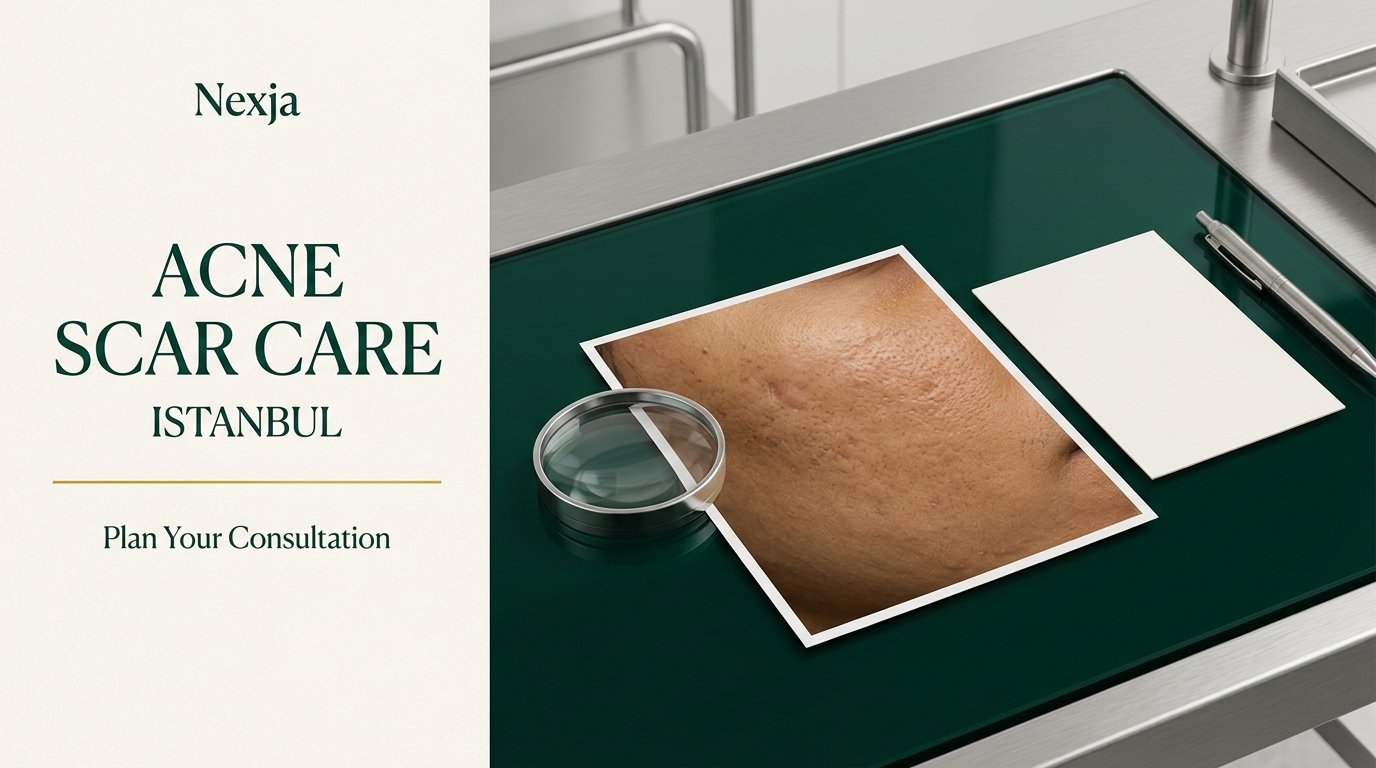
Quick answer: how should you choose acne scar treatment in Istanbul?
Choose acne scar treatment in Istanbul by starting with an assessment of the scars, the current condition of your skin and the clinician responsible for your care. A useful recommendation explains which feature it aims to change, why that method fits, what improvement is realistic and how recovery will be managed. A device name or a discounted package cannot answer those questions on its own.
The first distinction is between a change in skin contour and a flat colour mark, as well as active acne. Depressed scars, raised scars and post-acne discolouration can appear together, but they do not automatically need the same intervention. Dermatologists may consider several treatment families, sometimes in stages. The American Academy of Dermatology describes this individual approach in its guide to acne scar consultation and treatment.
For someone comparing providers, the most useful starting points are:
- Ask what kind of scarring is present and which areas the recommendation addresses.
- Establish whether active acne or another skin condition needs medical attention first.
- Discuss your history of pigmentation, unusual scarring and previous procedures.
- Compare the full plan, including recovery, review appointments and possible additional treatment; if you are weighing two common modalities, use this detailed microneedling vs fractional CO2 laser for acne scars comparison.
- Confirm the exact service, device where relevant, practitioner and follow-up arrangements before paying.
- Treat improvement as the goal; do not build a decision around a promise of completely unmarked skin.
This guide explains the main options and the questions that make a consultation more productive. It covers medical scar procedures as an educational overview, alongside the role and limits of professional skincare. Mentioning an option here does not mean that Nexja provides it. For Nexja's currently described service, see the dedicated microneedling in Istanbul page.
What are you actually trying to improve?
Start by describing the feature that bothers you in everyday life. “Acne scars” is a useful search term, but it can hide several different concerns: a shadow on one cheek, a small deep pit, a raised area on the jaw or flat marks that remain after a breakout. A consultation becomes more useful when that broad phrase becomes a specific question.
You do not need to arrive with a diagnosis. You might say, “I notice these indentations in side lighting,” or, “The colour bothers me more than the texture.” Those observations help the practitioner understand your priorities without requiring you to classify every mark.
Separate your main goal from secondary preferences
Choose one primary goal and, if necessary, one secondary goal. For example, your main concern might be cheek contour, while your secondary preference is a plan compatible with a public-facing job. Another person might prioritise a small group of scars and accept a longer recovery, while leaving the rest of the face alone.
That distinction matters when a package includes several services. An extra treatment is useful only if its purpose matches something you want to address. A facial that improves comfort or surface appearance might be welcome, but it should not be counted as correction of a deeper structural scar unless the recommendation explains that connection.
Try completing these sentences before an appointment:
- “The area I most want assessed is…”
- “The change I would find worthwhile is…”
- “The recovery restriction I would find hardest is…”
- “The outcome I do not want promised to me without evidence is…”
These are conversation prompts, not a scoring system. Their value is that they make your priorities visible before the discussion turns to products, devices or appointment bundles.
Define a worthwhile result without demanding perfection
A worthwhile result should describe a change you could recognise under ordinary conditions. You might hope for less noticeable shadows, a more even overall impression or a particular scar becoming less distracting. Agree how that goal will be reviewed.
Avoid setting the only acceptable endpoint as a filtered photograph. A filter can change colour, contrast, texture and facial shape at once. A real procedure has a defined target and limitations. Comparing those two things makes even a thoughtful treatment plan difficult to judge.
It is also reasonable to decide that the likely benefit is not worth the inconvenience or cost for you. An informed consultation should leave room for that conclusion. You are seeking help with a concern, not accepting an obligation to proceed.
Which types of acne scars change the treatment discussion?
The broad division is between depressed and raised scars. Depressed, or atrophic, scars sit below the surrounding surface; raised scars project above it. Within the depressed group, clinicians commonly describe ice-pick, boxcar and rolling patterns. These labels describe shape, but an examination is still needed to understand an individual scar.
DermNet's overview of acne scarring describes ice-pick scars as narrow and deep, boxcar scars as wider depressions with defined edges, and rolling scars as broader depressions with sloping edges. Several patterns can coexist.
| Observation to discuss | Common descriptive category | Useful consultation question |
|---|---|---|
| A small, narrow depression | Ice-pick pattern | Does this need a focused approach rather than general surface treatment? |
| A wider depression with a clear edge | Boxcar pattern | Which part of the scar is the proposed method intended to change? |
| Broad unevenness or shallow waves | Rolling pattern | Is there underlying attachment that should influence the plan? |
| A firm area above the surrounding skin | Raised scar | Should this be assessed through a different medical pathway? |
| A flat area with a colour difference | Post-acne mark or another pigment/vascular concern | Is colour the main target rather than contour? |
| New tender bumps alongside older scars | Active acne and scarring may coexist | What needs attention before a scar procedure is considered? |
This table helps you ask better questions. It cannot determine the correct treatment from a mirror check or a photograph.
Why does one face often need more than one explanation?
A single photograph can encourage a single label. In practice, the area you call “my acne scars” may contain several features. A practitioner should be able to point out which are being discussed and explain whether the proposed plan addresses all of them or only a selected group.
Ask for the treatment area to be described in plain language. “The shallow texture across the cheeks” is more informative than “full-face rejuvenation” if your aim is scar improvement. Similarly, a plan for several isolated depressions should not be presented as though it will necessarily change every visible irregularity.
The benefit of this mapping is clarity. It helps you understand why two people with acne scars could reasonably receive different recommendations, and why the next step for one cheek might differ from the next step for another area.
Are older scars automatically too late to assess?
No. Age alone should not end the conversation. The question is what the scar is like now, what has already been tried and whether the likely benefit of another intervention fits your goals.
Bring approximate dates rather than trying to reconstruct a perfect history. Tell the clinician when acne was most active, whether the appearance has changed recently and whether previous treatment affected the areas that concern you. If an old scar has become painful, enlarged or otherwise changed, mention that explicitly instead of assuming the change is simply part of the original acne.
The practical next step is an assessment of the current feature. A promise that “old scars are always easy” is no more helpful than an automatic dismissal that nothing can be considered.
How do scars form, and why is “more collagen” an incomplete answer?
Acne can damage the structures that support the skin, and the healing response can leave either depressed or raised tissue. The American Academy of Dermatology explains that too little collagen during healing can leave depressions, while excess collagen can produce raised scars. Picking or squeezing inflamed lesions can increase the chance of scarring. See its explanation of acne scar causes.
This is why a general promise to “boost collagen” is not a complete treatment explanation. It tells you something about an intended biological response, but not necessarily whether that response addresses your scar's shape, attachment, depth or location.
Ask for the missing link between mechanism and your goal
A treatment description should connect three things: the feature being targeted, the action of the procedure and the change you might reasonably expect. If one of those is missing, ask for it.
For example, “This treatment supports skin renewal” is a broad statement. A more useful consultation would explain which assessed area is suitable, why this option was chosen over a focused procedure or observation, and what would count as a meaningful response.
You do not need a technical lecture. A short explanation in ordinary language is enough if it makes the reasoning clear. If the explanation remains vague after you ask, it is reasonable to take time before booking.
Why can an impressive machine still be the wrong starting point?
Technology is a tool within a plan. Choosing a device first and fitting every concern to it reverses the useful order of decisions.
When comparing recommendations, ask whether the provider considered a different treatment family or referral. The answer may still favour the offered service, but it should explain why. Being able to discuss limits is valuable: it gives you a clearer picture of what your purchase includes and what it does not.
A well-presented device, a familiar brand and a polished room can all influence your first impression. None replaces a clear account of the scar problem and the person responsible for treating it.
What should a meaningful acne scar assessment include?
A meaningful assessment should produce a decision you can understand, even if that decision is to postpone treatment or seek a medical opinion. It should combine your concerns, a relevant history, examination and discussion of realistic options.
The appointment should not depend entirely on a computer image. Photographs and analysis tools can support documentation, but a person still needs to interpret the findings and decide whether the concern falls within their scope of practice.
Bring a concise history that changes decisions
Prepare a short list of previous treatments, prescription medicines, products that caused reactions and any unusual healing. Include procedures performed elsewhere, even if they seemed minor or happened a long time ago. If possible, bring the treatment name and approximate date rather than only a marketing label.
Also describe practical commitments: a wedding, regular outdoor work, travel, sport or difficulty attending repeat visits. These facts do not dictate the medical decision, but they help determine whether a proposed schedule is realistic.
You can organise your notes into four lines: current concern, relevant history, previous treatment response and upcoming constraints. This makes the discussion easier to follow and reduces the chance that an important point emerges only after a procedure has been booked.
Expect an explanation of what is known and uncertain
Some questions can be answered at the first appointment; others may need a medical assessment, previous records or an in-person review after an initial remote discussion. Uncertainty should be named.
Useful language might be: “This appears to be the main concern, but I would want a dermatologist to assess the raised area,” or, “We need the record of the earlier procedure before recommending another intervention.” Such statements help you understand the next step.
Be cautious about a consultation that sounds precise while relying on very little information. A confident number of sessions is not the same as a well-supported recommendation.
Ask what will be documented
Before starting, ask whether the record will include the area treated, the intended goal, the actual procedure and relevant device or product details. You should also know how to obtain your aftercare instructions and how to contact the responsible provider.
For follow-up photographs, agree that lighting, angle and expression should be comparable. Keep the purpose focused on your care. Permission to use a photograph in a treatment record and permission to use it in marketing are different decisions; ask how each is handled.
A usable record is particularly valuable if you move, travel or later seek a second opinion. It should help another clinician understand what happened without having to guess from a social-media description.
When does medical assessment need to come before a scar procedure?
Medical assessment takes priority when there are active inflammatory lesions, possible infection, an unexplained changing lesion or a concern that cannot confidently be identified as a stable acne scar. A routine cosmetic appointment should not be used to bypass those questions.
The AAD's microneedling guidance identifies situations in which treatment should wait, including infection and certain active acne lesions. Its guidance also emphasises a pre-treatment discussion and examination. For the sequencing question, see when acne scar care can be considered alongside active acne.
This does not mean that every blemish creates the same restriction for every procedure. It means that the person recommending treatment must assess the current condition, rather than treating “acne scars” as an automatic indication to proceed.
What should you disclose before suitability is decided?
Tell the clinician about medicines, recent isotretinoin use, pregnancy or breastfeeding, cold sores, bleeding problems, impaired healing, immune-related conditions and a tendency to develop unusual scars. Include relevant allergies and previous reactions to anaesthetic or skincare products.
Disclosure is not the same as receiving a blanket prohibition. The importance of each factor depends on the intervention and your circumstances. Do not stop prescribed medicines or adopt an online waiting period on your own; ask the prescribing clinician and treating practitioner to coordinate advice.
You should leave knowing who makes the suitability decision. An administrative booking confirmation is not medical clearance, and a general questionnaire does not replace review of an answer that needs attention.
What if you mainly want reassurance about a new mark?
Say that at the beginning. A new or changing area deserves an explanation before it becomes part of a treatment package.
Bring a timeline: when it appeared, whether it hurts or itches, whether it has changed and what you have applied. Avoid repeatedly experimenting with stronger products while waiting for clarification.
The useful outcome of that visit may be understanding what the mark is and which professional should assess it. That is a legitimate result, even when no cosmetic procedure is performed.
How do the main acne scar treatment families differ?
The most useful comparison is by purpose. Some approaches work across a surface area; others target a particular depression, attachment or raised scar. The following overview is a discussion aid, not a personalised prescription or a list of services confirmed at Nexja.
| Treatment family | Main question it addresses | What to clarify before choosing |
|---|---|---|
| Conventional microneedling | Could controlled needling help the assessed texture concern? | Suitability, device, practitioner, expected scope and review plan |
| Laser resurfacing | Is a laser approach appropriate for this scar pattern and skin history? | Exact technology, clinical reasoning, recovery and risk management |
| Subcision | Is underlying tethering relevant? | Medical assessment, location, alternatives and follow-up |
| Focused chemical reconstruction | Would selected scars benefit from a targeted chemical technique? | Exact procedure, clinician experience and pigment considerations |
| Punch or other scar surgery | Does a particular scar need a focused surgical approach? | Trade-offs, wound care and the expected remaining mark |
| Fillers | Is volume support relevant to selected depressions? | Product, anatomy, duration, risks and maintenance |
| Raised-scar treatment | Is the problem excess or abnormal scar tissue? | Diagnosis, symptom goals and recurrence planning |
| Supportive skincare | What helps comfort, routine and the surrounding skin? | Its supportive role and what it cannot change structurally |
Do not use the table to rank procedures from weakest to strongest. A method can be technically intensive yet poorly matched to your particular objective. The sections below explain what to ask about each family without turning the comparison into a universal winner.
What can conventional microneedling contribute to a scar plan?
Nexja · TECHNOLOGY PERSPECTIVE
Understand the device. Discuss the plan.
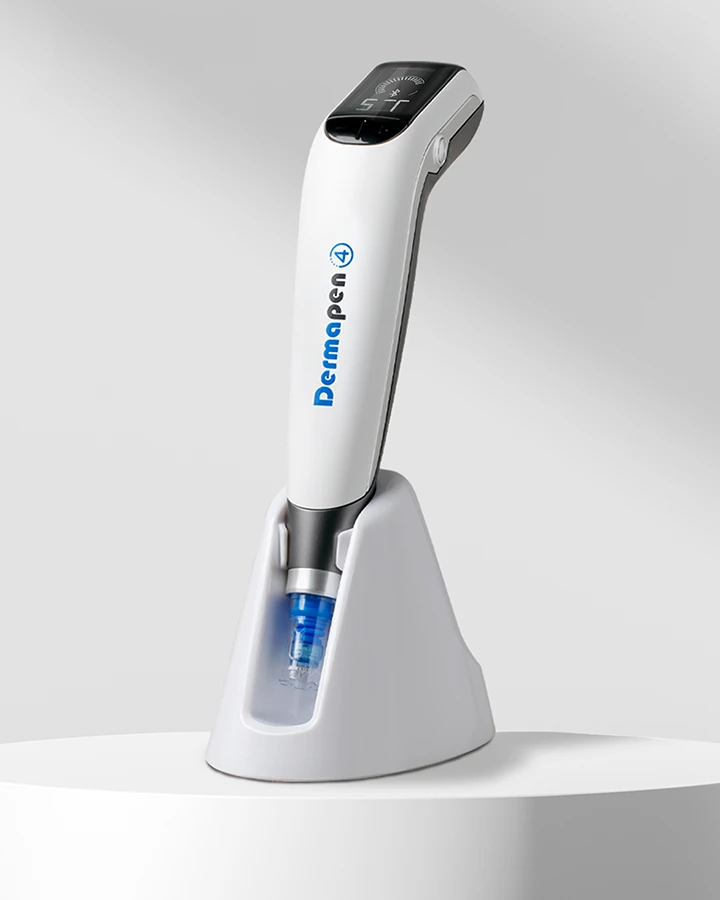
A device name is one part of an individual scar assessment.
Conventional microneedling uses fine needles to create controlled punctures in the skin. It may be considered for selected acne-scar concerns after suitability has been assessed. The word “conventional” matters: this procedure does not automatically include radiofrequency energy, an injected product or every treatment advertised with a similar name.
A randomised clinical trial of needling for acne scars reported improvement in scar scores at a later follow-up. That supports discussing needling as an option; it does not establish a guaranteed response for every scar pattern, device or clinic protocol.
What should the provider explain about the proposed course?
Ask which scars are expected to respond, what the first stage includes and when the response will be reviewed. A course should have a reason beyond the fact that a bundle is available.
Clarify whether the quoted visit includes consultation, preparation, the procedure and aftercare guidance. Ask how a new health issue, delayed recovery or a change in your goals would affect the remaining appointments. These details matter more to your experience than a headline session count.
The consultation should also explain the limits of the approach. If the practitioner believes that a particular depression needs a different medical procedure, that should be clear before you commit to a broad course aimed at the surrounding texture.
What about cartridges, products and add-ons?
Ask which device will be used, how consumables are handled and what each additional product is intended to do. The FDA's microneedling information advises using a new needle cartridge for each patient and session. It also distinguishes device authorisation from approval to deliver other substances into the skin.
These are United States regulatory statements, not confirmation of Turkish authorisation or a particular Nexja protocol. For your appointment, the exact device, product, intended use and local requirements need their own explanation.
A product's reputation is not a substitute for that discussion. If an optional ingredient is suggested, ask what changes when it is included, what evidence applies and whether you can consider the procedure without the add-on.
Is radiofrequency microneedling the same procedure?
No. Radiofrequency microneedling adds energy delivery through needle electrodes, producing heat in tissue. That creates a different clinical discussion from conventional mechanical needling.
The FDA's October 2025 safety communication on RF microneedling reports serious complications associated with certain uses, including burns, scarring, fat loss and nerve injury. The notice is not a statement that every treatment causes these outcomes. It is a reason to identify the exact procedure and discuss its benefits, risks and operator experience carefully.
If two quotations both say “microneedling,” confirm whether they describe the same technology. Ask for the full name in writing. Do not compare price or recovery assumptions until that is clear.
This guide does not verify RF microneedling as a Nexja service. If a provider offers it, ask who will perform it, why it fits your scar concern and how complications would be assessed. Avoid treating the addition of energy as an automatic upgrade.
Where does laser resurfacing fit?
Laser resurfacing may be considered for selected scar concerns, but “laser” is a broad category rather than a complete treatment specification. The relevant questions include the exact technology, why it suits the assessed scars and skin history, and what recovery the proposed protocol requires.
The AAD's guidance on laser treatment for scars stresses the importance of medical consultation and practitioner expertise. It also explains that laser treatment can make scars less noticeable without erasing them.
What does “fractional CO2” tell you, and what does it leave out?
It identifies a laser treatment family. It does not tell you the complete plan, the operator's qualifications, the treated area or your individual recovery experience.
If fractional CO2 is proposed, ask the clinician to explain the intended role in the plan and the alternative options. You do not need to select machine settings yourself. You do need to understand what the treatment is meant to change, what care will be necessary and whether your commitments allow for that care.
A comparison with microneedling should therefore remain conditional. One cannot be declared universally better simply because it is more intensive, more expensive or more often mentioned online. A broader medical plan may also involve something other than either of those options.
Why should evidence about one laser not be applied to every laser?
An individual study tests a particular intervention in a particular group. For example, a randomised split-face study of fractional Er:YAG laser and microneedling found different outcomes and downtime between the two study treatments. Er:YAG is not CO2, and that study is not a direct comparison of every clinic's current protocol.
When a provider cites research, ask which technology and patient group were studied. This keeps the discussion tied to the actual recommendation rather than turning a general scientific reference into a promise.
Nexja's exact CO2 device, service arrangements and practitioner details are not established by its microneedling page. Confirm any such offering directly rather than assuming that every option in an educational guide is available at the same location.
When might subcision be discussed?
Subcision is a medical procedure that releases fibrous attachments beneath selected depressed scars. Its purpose differs from treating the surface alone. DermNet's subcision explanation describes this release of tethering and notes that selection depends on the scar and the patient's circumstances.
This is a specialist discussion, not something to attempt with a home tool. Potential problems include bruising or a collection of blood, infection, pigment change and an unsatisfactory response. The clinician should explain the relevant risks for the planned area.
What should you ask if tethering is mentioned?
Ask the clinician to show which area is being described and explain why release is relevant. The phrase should help you understand the recommendation, not become another piece of jargon you feel obliged to accept.
It is useful to ask whether the proposed procedure is intended as a standalone step or part of a sequence. If another treatment may follow, clarify whether that decision can wait until the first response is reviewed.
For a focused concern, also ask how the extent of treatment was chosen. A discussion about several specific scars should identify those scars. You should not be left unsure whether the quotation refers to a small area, one cheek or a broader intervention.
What is focused chemical reconstruction, and how is it different from a facial peel?
A focused chemical technique such as TCA CROSS targets selected scars, rather than simply applying a general facial exfoliation. It belongs in an appropriately qualified clinical assessment and should not be reproduced at home.
DermNet's TCA CROSS guidance describes the use of trichloroacetic acid in a localised procedure and identifies risks including irritation, pigmentation changes and damage beyond the intended area. Complete resolution is not an assured outcome.
A product containing an acid, or a service called a peel, should not be assumed to provide the same intervention. Concentration, application method, treatment target and clinical judgement matter.
How should you compare a peel recommendation?
Ask for the actual procedure name and its role. Is the aim a colour concern, surface appearance, selected scars or support between other treatments? Those are different reasons for choosing a service.
Also ask what will happen if your skin is not ready on the day. A clear plan for postponement is useful when the appointment requires travel or time away from work.
There is no need to turn this into a discussion of do-it-yourself strengths or application instructions. The decision you need to make is whether the professional recommendation is appropriate, understandable and supported by a recovery plan you can follow.
Why might a clinician discuss punch techniques or scar surgery?
A focused surgical approach can be considered for certain individual scars. The objective may be to remove or reposition a particular scar area, accepting a different, potentially less noticeable mark in its place.
The NHS Wales acne information describes punch excision, elevation and grafting as different techniques used for selected acne scars. These are not interchangeable with a facial or a full-face resurfacing session.
The key consultation question is the trade-off: what feature is expected to improve, what new wound or mark will result and what follow-up is needed? Ask the clinician to describe that in the context of the exact scar being considered.
If there are only a few prominent scars, a focused consultation may be especially useful for understanding the options. It does not mean surgery is necessarily the answer. It means that a localised concern deserves a localised explanation instead of an automatic recommendation to treat the entire face.
Can fillers be part of acne scar treatment?
Fillers may be considered for selected contour deficiencies, but they are medical implants rather than skincare creams. The product, anatomy, suitability and practitioner experience are central to the decision.
The FDA's dermal filler guidance explains that effects vary by material and that some products are absorbed over time. It also identifies serious risks from accidental injection into a blood vessel, including tissue damage and visual complications. Its approval information concerns the United States, not proof of availability or approval in Türkiye.
Before proceeding, ask for the exact product, the expected duration, the follow-up arrangement and the plan if a problem occurs. Discuss whether future maintenance is likely to be relevant to your budget.
A filler should not be selected simply because it appears to offer an immediate change in a photograph. Ask why volume support is appropriate for the assessed scar and how it relates to other possible approaches. This guide does not confirm filler treatment as a Nexja service.
How are raised scars approached differently?
Raised scars need their own diagnosis and management plan. A routine proposal intended for depressed texture should not be assumed to fit a firm, raised area.
For keloids, a dermatologist may discuss options such as injections, selected laser treatment or silicone-based measures, often as part of a combined plan. Recurrence can remain a concern. The AAD's keloid treatment guidance explains why treatment may involve more than one method.
Your goal may include comfort as well as appearance. Tell the clinician if the area itches, hurts, restricts movement or has grown. Describe previous treatment and whether the scar returned.
The important distinction is that “scar treatment” does not have a single biological direction. A recommendation should respond to the type of scar actually present. If the appearance is uncertain, a medical assessment should establish what is being treated before any cosmetic plan is built around it.
What can skincare and facials contribute without overstating their role?
Supportive skincare can be part of the overall experience, but its role should be clearly labelled. A routine may support comfort, cleansing or an agreed pigmentation goal. It should not be sold as though every cream or facial can reproduce the effect of a procedure aimed at deeper scar structure.
Ask which part of your concern a product is intended to address. “For the surrounding skin,” “for a separate colour concern” and “for the recovery routine” are different explanations. A useful recommendation makes that distinction understandable.
How should you assess a cream or serum recommendation?
Start with the purpose and instructions. Ask when it should be used, whether it belongs in the immediate recovery period or later routine, and which of your existing products it replaces.
A long shopping list can make adherence harder. If several products are proposed, ask which are essential to the plan and which are optional preferences. Bring your current routine so that the discussion can identify unnecessary overlap.
Do not assume that a cream shown beside a device in a promotional image is intended to enter the skin during that procedure. The actual product and route need to be explained separately. Packaging, professional branding and price do not settle suitability.
What about exosomes, PRP and other advertised additions?
Ask for a separate explanation of each addition. What exactly is the product or procedure, how is it used, what evidence applies to the proposed combination, and what local requirements govern it?
A study involving one preparation or protocol does not establish an equivalent result for a different branded offering. Nor does an add-on remove the need to choose the underlying scar treatment carefully.
You can request time to review the information. A treatment decision does not become more personalised merely because more components have been added. Each component should have a defined role, and the plan should remain understandable if optional elements are removed.
How should skin tone and pigment history affect planning?
Your history of dark marks after inflammation or skin procedures deserves explicit discussion. It should influence the assessment rather than being reduced to a reassuring statement that one treatment is suitable for everyone.
Post-inflammatory hyperpigmentation can follow skin inflammation or injury and can be more persistent in darker skin. Procedures can sometimes aggravate it. DermNet explains these considerations in its guide to post-inflammatory hyperpigmentation.
Tell the clinician what happened after previous spots, cuts, burns or treatments. Also mention recent tanning and any diagnosis of melasma or another pigmentation disorder. These details help the clinician separate the scar goal from the risk of creating a new colour concern.
Ask for an individual plan rather than a skin-colour slogan
A useful explanation connects your history to the specific recommendation. Ask whether the practitioner has experience with similar concerns and how they would respond if unwanted pigment change occurred.
Do not interpret a general claim about a technology as a personal assurance. “Suitable for a range of skin tones” is not the same statement as “this exact procedure is appropriate for you today.”
If a test area is proposed, ask what it can and cannot tell you and when it will be reviewed. Treat it as one part of clinical judgement, not a guarantee that every later response will be identical.
Keep the competing goals visible
Sometimes the treatment that appears most attractive for contour needs to be weighed against pigment history, recovery and your preferences. Ask the clinician to make those competing considerations explicit.
You may choose a staged plan, a different method, a medical referral or more time to decide. What matters is that the trade-off is discussed before treatment. A result should not be assessed only by whether texture changed if the overall experience also includes a new concern that matters to you.
How many sessions should a scar plan include?
The number should follow the assessment, not precede it. A proposed course needs a reason for its length, a review point and a clear explanation of what would lead to continuing, changing or stopping.
Separate an initial plan from a guaranteed endpoint. A clinician may propose a first stage and then reassess. That is different from selling a fixed number of visits with an implied promise that every scar will be resolved when the package ends.
Before paying, clarify whether the quotation describes a trial of one approach, an anticipated complete course or the first part of a longer sequence. Ask what happens to unused appointments if the plan changes for clinical reasons.
What makes a review appointment useful?
A review should compare the agreed goal with the current situation. It should consider your experience as well as photographs: how recovery went, whether the care instructions were manageable and whether the original priorities remain the same.
Useful questions include: “Which areas changed?”, “Which areas did not?”, and “Does that change the next recommendation?” A review that only books the next session misses an opportunity to adjust the plan.
Agree when an assessment of results is meaningful. The interval should come from the treating clinician and the actual procedure. Do not let a promotional photograph taken immediately afterwards become the only measure of success.
When is a combination plan worth discussing?
A combination plan is worth discussing when the components have different, clear purposes. It should not simply be a way to add more services to the same visit.
A randomised study of microneedling, a specific chemical peel and their combination found differences between the studied approaches. That finding is specific to the protocol and participants; it does not validate every combination marketed under similar names.
Ask which part of the concern each component addresses, whether the treatments must be combined and whether they should be separated in time. Also ask what would be lost by starting with one element and reviewing before adding another.
This approach lets you understand the plan as a set of reasons rather than a list of impressive terms. More components can mean more decisions, instructions and costs, so their contribution should be clear.
How should you plan preparation, recovery and everyday life?
Plan around the exact intervention and written instructions. “Downtime” is too broad a word to do all the work: it may refer to visible redness, discomfort, wound care, restrictions on activities or the period before you feel comfortable at an event.
Ask the provider to explain these separately. You may be willing to appear on a video call with visible changes but unable to manage a complicated care routine while travelling. Someone else may have flexible time but little tolerance for uncertainty before an important event.
The AAD's acne scar aftercare guidance emphasises following individual instructions, gentle care, sun protection and allowing time for results. The details still need to come from the person treating you.
Get preparation instructions before the treatment day
Ask when the consultation should happen and what information needs to be reviewed beforehand. If you are told to modify a skincare routine, request the product names and timing in writing.
Do not independently stop a prescribed medicine because a generic internet list mentions it. Ask the clinician who prescribed it to coordinate any changes with the practitioner planning the procedure.
Make practical arrangements early: transport, time away from work, necessary supplies and someone to contact if you have questions. If the plan depends on circumstances you cannot manage, raise that before paying for a procedure date.
Ask for a recovery plan you can actually use
A useful plan distinguishes what is expected from what should prompt contact. It should say who to call, how to reach them outside ordinary appointment hours and where to seek urgent help if necessary.
Have the instructions available somewhere you can access without relying on memory. If they are delivered digitally, confirm that you can open them before leaving. If the language is unfamiliar, ask for a version or explanation you understand.
Avoid collecting several contradictory routines from social media after the procedure. When advice conflicts, contact the treating team with the specific question. Explain exactly what you have used and when, rather than trying to compensate by adding another product.
What should you ask about makeup, exercise, shaving and heat?
Ask when each can resume for your procedure and how that decision depends on healing. Do not assume that instructions for a gentle facial also apply to microneedling, focused scar surgery or resurfacing.
Be specific about your routine. “Exercise” might mean a short walk or a high-intensity class; “work” might mean a desk job or an outdoor shift. A practitioner can give more useful guidance when they know what you actually plan to do.
In Istanbul, a hammam, sauna visit or a day of sightseeing may be part of a holiday itinerary. Mention these plans before treatment. The appropriate timing should follow the procedure and recovery instructions, rather than being fitted around a prepaid activity afterwards.
What if recovery does not follow the expected course?
Contact the treating clinician if symptoms are worsening, unexpectedly persistent or outside the written instructions. Do not diagnose a problem from a comparison photograph alone.
Severe pain, rapidly increasing swelling, spreading redness, pus, fever or concerning skin changes need prompt medical assessment. The NHS skin infection guidance explains why painful, hot, swollen skin needs prompt attention. Breathing difficulty or sudden visual symptoms require emergency help; see the NHS advice on severe allergic reactions and the FDA's filler safety information. A cosmetic follow-up message should not delay urgent care.
At a less urgent level, ask for clarification when something simply does not make sense. Reporting a concern early is not being difficult. It gives the responsible professional the information needed to decide whether reassurance, a review or another action is appropriate.
How can you judge results without being misled by photographs?
Use agreed goals and comparable observations over time. A photograph can be useful, but its meaning depends on how it was taken and what it is being used to show.
Notice whether the lighting, camera angle, facial expression, makeup and distance are similar. A change in side lighting can alter shadows; a brighter image can alter the impression of colour. This does not automatically mean a photograph is dishonest, but it limits the comparison you can make.
Ask the clinician to explain what they are evaluating. Texture, colour, scar height and your own satisfaction are different outcomes. A plan should not quietly change its success measure after treatment.
Build a simple follow-up record
Keep the treatment date, the name of the procedure, the written instructions and a short account of your experience together. If you take photographs, follow the method agreed with the clinician instead of repeatedly changing conditions.
A short note can be more useful than dozens of anxious daily pictures. Record questions you want answered at review, such as whether a particular area was included or when the next assessment is due.
This is not a request to monitor your face constantly. The purpose is to preserve enough information for a useful conversation while allowing you to return attention to ordinary life.
What should you do if the result feels disappointing?
Return to the original goal and ask for a structured review. Was the expected change clearly defined? Has the agreed review interval passed? Was the target the same area you are now evaluating?
Ask what the clinician believes happened and what evidence supports the next recommendation. Continuing the same intervention, changing approach and pausing are different choices; each should have a rationale.
You may also seek a second opinion, especially before a substantially different procedure. Bring your records so the next clinician can distinguish the original scar concern from the effects and recovery of earlier treatment.
How can you read research without turning it into a personal promise?
Look for the intervention studied, the participants, the comparison and the timing of assessment. Ask whether the study measured photographs, a scar scale, patient satisfaction or another outcome.
A report of improvement is not automatically a forecast for you. An average can conceal differences between participants, and a favourable comparison with one alternative does not settle every possible choice.
Use research to improve the consultation question: “How does this evidence relate to the treatment you are proposing for my scars?” That question is more useful than asking a practitioner to guarantee that you will match the most striking result in an advertisement.
How do you choose an acne scar provider in Istanbul?
Choose a provider through the quality of assessment, relevant qualifications, treatment-specific experience and the continuity of care offered. Location and presentation matter, but they should support those essentials.
A website may introduce the service; the consultation needs to explain who is responsible for your case. Ask for the practitioner's name, professional role and experience with the actual procedure. For medical scar procedures, confirm that the practitioner and setting are appropriately qualified and authorised for the work proposed.
Do not infer qualifications from the word “clinic,” a uniform, a device photograph or an international brand logo. Ask direct questions and obtain answers you can understand.
Compare consultations using the same questions
Use a short, consistent set of questions when speaking to different providers:
- What are the main features you have identified in my scars?
- Which of those would this plan address?
- Why do you recommend this approach rather than the main alternatives?
- Who would perform each part of the treatment?
- What recovery and follow-up would I need?
- What would make you postpone or change the plan?
- What is included in the quoted cost?
- What happens if I need help after leaving Istanbul?
The purpose is comparison, not an examination the provider must perform for you in a particular script. Look for thoughtful answers that engage with your circumstances.
What does a useful second opinion add?
A second opinion can clarify disagreement about the target, the sequence or the likely benefit. It is especially helpful when the proposed intervention is more extensive than you expected or when earlier treatment has not addressed your main concern.
Present the same history and goals to each clinician. Otherwise, different answers may simply reflect different information. Bring existing records and explain what remains uncertain.
You do not have to keep collecting opinions until someone promises the result you want. The aim is a clearer decision. If uncertainty remains, choosing more time is a valid outcome.
How much should reviews and social media influence you?
Reviews can help you understand communication, organisation and the general experience of previous visitors. They cannot establish that a particular procedure is suitable for your skin.
Look for concrete descriptions rather than relying only on a rating. Was the explanation clear? Were questions answered? Was follow-up accessible? These details may help you prepare your own questions.
Treat spectacular transformations separately from evidence about routine care. Ask whether images show the same conditions and whether the result is representative. Never assume that a named device or an attractive visual proves an individual clinical outcome.
What affects the cost of acne scar treatment in Istanbul?
The relevant cost is the cost of an appropriate plan, not simply the lowest advertised session. Treatment type, the area addressed, the practitioner, the number of stages, consumables, review visits and aftercare can all affect a quotation.
Ask for an itemised explanation. You should understand whether consultation, preparation, products, medical review and any optional additions are included. A quote becomes easier to compare when the same components are visible.
No fixed Nexja price is given here because your decision should be based on the current service scope and individual plan. The Nexja microneedling service page is the appropriate starting point for current service information and enquiries.
Compare total commitments, not isolated numbers
Two offers with the same headline price may describe different services. One might include a review; another might be a procedure-only appointment. A multi-visit package may still leave travel, accommodation or additional products outside the quotation.
Ask what costs could arise if the plan changes. Clarify cancellation, postponement and refund terms before paying. These are practical questions that protect your ability to make a considered decision.
For a visitor, also account for the cost of returning for a review if needed. A lower initial quote may be less useful if the follow-up arrangement is difficult to access from home.
Should you buy a course at the first consultation?
Only if you understand the recommendation and feel ready to commit. There is no need to purchase a full course simply to demonstrate that you are serious about improvement.
You can ask for the proposal in writing and review it later. If a course is recommended, ask whether future sessions are conditional on your response and what happens if the clinician advises stopping.
Avoid allowing an expiring offer to become the main reason for a medical decision. A plan should remain understandable and appropriate when its promotional language is removed.
How should Istanbul residents, expats and visitors plan differently?
The clinical assessment remains individual, but continuity of care may differ. A resident may be able to attend repeat reviews more easily; an international visitor needs a clear arrangement for care after departure.
For residents, discuss how the plan fits work, commuting and existing medical care. For expats, confirm the language used for consent, instructions and follow-up. For visitors, establish which decisions can be made remotely and which require an in-person examination.
Nexja's contact and location information places the centre in Fatih, Istanbul. Confirm the current address and appointment arrangements directly before travelling. Do not choose a scar procedure solely because it fits neatly between tourist activities.
What can a remote enquiry reasonably accomplish?
A remote enquiry can clarify the services described, the consultation process and what records to bring. Photographs may help a provider understand the broad concern, but they should not be treated as a complete substitute for examination.
Ask whether the estimate is provisional and what could change after assessment. Keep a distinction between a booking discussion and a confirmed treatment plan.
If you are arranging travel, obtain written clarification of whether the visit is for consultation only or may include treatment if appropriate. That prevents a commercial itinerary from creating pressure to proceed despite new information.
What should be agreed before you leave the city?
Know who will answer follow-up questions, how information can be shared securely and what to do if an in-person assessment becomes necessary after you return home.
Request a clear treatment record and instructions you can show to another clinician. Ask whether the provider will communicate with your local clinician if needed, and what arrangements are realistically available.
Do not rely on an assumed guarantee that flying or sightseeing will be suitable after any procedure. Discuss the actual travel dates and treatment. A consultation without an immediate intervention may be the more workable choice when the necessary recovery or review cannot fit your visit.
How should you plan outdoor activities and events?
Tell the provider about the activities that matter to you, including outdoor tours, a wedding, professional photographs or a conference. Ask for advice based on the proposed treatment rather than a generic “back to normal” statement.
Build flexibility into the itinerary where possible. A treatment that requires you to ignore its own aftercare instructions to enjoy the trip is poorly timed for that trip, even if it might be appropriate at another point.
The useful question is not simply, “Can I fit it in?” It is, “Can I complete the assessment, treatment and follow-up responsibly within these arrangements?”
Myths vs facts: what is actually true about choosing scar treatment?
Myth 1: there must be one best treatment for every acne scar
Fact: a useful recommendation starts with the assessed problem.
Why: a method selected for one feature may not address another. Ask the provider to connect the recommendation to your priority area. A universal ranking is less helpful than a clear explanation of the choice for you.
Myth 2: the most expensive device guarantees the best result
Fact: a device name does not complete a treatment plan.
Why: the decision also involves suitability, the practitioner, the procedure actually performed and follow-up. Price can help you compare costs, but it should not stand in for those explanations or be treated as a prediction of your outcome.
Myth 3: every post-acne mark needs resurfacing
Fact: colour and contour are different treatment questions.
Why: a flat mark should not automatically be managed as a depression. Ask what has been identified before comparing methods. If the main target is uncertain, clarification is more useful than choosing an intervention from a photograph.
Myth 4: a package with more steps is automatically more personalised
Fact: personalisation requires reasons for the steps.
Why: ask what each component contributes and which parts are optional. A short plan that fits your priorities can be easier to understand and follow than a longer one with unexplained additions.
Myth 5: every “microneedling” advertisement describes the same thing
Fact: the name can appear alongside different technologies and combinations.
Why: conventional needling and RF microneedling should be identified separately. Obtain the exact procedure name before comparing quotations. Similar marketing language does not establish equivalent treatment, recovery or risk.
Myth 6: a treatment photo shows exactly what you can expect
Fact: an image documents one presentation under particular conditions.
Why: it cannot supply your assessment or predict your response. Ask how photographs were taken, what procedure was performed and when the result was recorded. Use them to support questions rather than as a personal contract.
Myth 7: “no downtime” means there are no instructions to follow
Fact: the phrase needs clarification.
Why: ask separately about appearance, comfort, skincare, activities and review. Even when an appointment is marketed as convenient, you still need to understand what the provider expects you to do afterwards.
Myth 8: you must decide during the consultation
Fact: you can take time to consider a proposal.
Why: a written plan lets you review the target, costs and commitments away from sales pressure. Unless there is a separate urgent medical concern, the choice to purchase elective treatment should allow considered consent.
Myth 9: buying skincare proves that a structural scar is being treated
Fact: the product's role needs to be stated.
Why: support for comfort, surface appearance or a colour concern is different from a procedure targeting scar structure. Ask what the recommendation is expected to contribute, rather than interpreting every item as a scar-correction treatment.
Myth 10: travelling home ends the provider's role
Fact: follow-up should be discussed before the procedure.
Why: visitors need to know how questions will be handled and when local medical care may be needed. A clear handover and accessible records are part of planning, not details to discover after departure.
Myth 11: an AI skin score can select the procedure on its own
Fact: digital analysis can support a conversation and documentation.
Why: a score does not replace a relevant history, examination or qualified clinical judgement. Ask what the information represents and how it changes the recommendation. More screen graphics do not automatically mean more useful assessment.
Myth 12: declining treatment means the consultation was wasted
Fact: an informed decision to wait can be a useful outcome.
Why: you may learn that your timing, budget or expectations do not fit the proposed plan. Understanding that before a procedure protects your ability to choose deliberately and return when the circumstances are more suitable.
How does the Nexja approach fit within this decision?
Nexja's published microneedling service describes Dermapen technology, AI-supported skin analysis, personalised planning and QR access to an analysis report. These details can help you prepare questions about the consultation and documentation process. The page does not identify a specific Dermapen model, so confirm the actual device directly.
For service details, use the existing Nexja microneedling page. A general guide to acne scar options should support that enquiry while keeping the wider medical choices distinct.
The Nexja Experience is the progression from consultation and assessment to planning, treatment and aftercare. In a scar discussion, its practical value is the connection between those stages: the concern you describe should remain visible in the recommendation and the later review.
Ask how the assessment will be explained, what the planned service can reasonably address and when another medical opinion is appropriate. QR access can make records convenient to revisit, but it is not a diagnosis or proof that a device has measured every aspect of a scar.
A useful next step is a focused enquiry describing your concern and asking what assessment is needed. It should not require you to choose a device or product before anyone has evaluated the skin.
Your next step: turn the search into a clear consultation brief
Before contacting a provider, write a short brief with your priority area, previous procedures, relevant medicines and practical constraints. Add the questions you most need answered, including who will treat you and how follow-up will work.
Then compare the proposal against that brief. Does it address your concern? Does it explain the alternatives and limits? Can you realistically follow the plan? Are the costs and responsibilities clear?
Acne scar treatment in Istanbul is a decision about a whole course of care. The most useful outcome of your search is an understandable plan, appropriate professional assessment and a next step you can choose with realistic expectations.
Frequently Asked Questions
1. What is the best first appointment for acne scar treatment in Istanbul?
Start with an assessment appropriate to the concern, rather than booking a device session by name. Explain the area you want evaluated and ask who will assess it. If you are considering a medical scar procedure or have an uncertain lesion, arrange qualified medical evaluation before committing to treatment.
2. Do I need to know my scar type before booking?
No. Describing what you notice is enough to begin an enquiry. Tell the provider whether your concern is an indentation, a raised area, colour or a combination. The assessment should clarify the category and explain how it affects the options.
3. Can I send photographs for an initial opinion?
Yes, if the provider offers a suitable way to receive them. Ask how the images will be used and stored. A remote discussion can help plan the appointment, but it should not be mistaken for a complete examination or an unconditional promise of treatment.
4. Should I ask for a dermatologist even if I want a cosmetic improvement?
For medical scar procedures or diagnostic uncertainty, a dermatologist or another appropriately qualified medical specialist is a sensible starting point. Wanting an aesthetic change does not remove the need for medical judgement. Ask the provider to explain the professional role responsible for your proposed care.
5. Is every indentation an acne scar?
No. Appearance alone does not establish the cause. Explain the history and mention any area that is new, changing or different from your usual marks. If the cause is unclear, seek assessment before assuming that a standard acne-scar package is appropriate.
6. Can old acne scars still be discussed with a clinician?
Yes. An assessment can consider the current scar and your goals even when acne occurred years ago. Bring information about earlier procedures and responses. The age of the scar alone should not be used to promise success or dismiss the possibility of a useful consultation.
7. Does microneedling remove every type of acne scar?
No such promise is justified. Ask which assessed areas the recommendation is intended to address and what its limits are. A course aimed at a broad texture concern should not quietly imply that every deep or raised feature will respond in the same way.
8. How can I tell whether an advertised service includes RF?
Ask directly and request the full procedure name in writing. Conventional microneedling and RF microneedling are different discussions. Do not infer the answer from a photograph, a short social-media caption or the fact that both services mention needles.
9. Should I choose CO2 because it sounds stronger?
No. Intensity is not a substitute for suitability. Ask why the proposed technology fits the scar concern, what alternatives were considered and what recovery is involved. This guide does not establish a particular CO2 device or treatment service at Nexja.
10. Does mentioning subcision mean I definitely need it?
No. It means that the clinician should explain whether underlying attachment is relevant to your assessed scars. Ask which areas they mean and how that changes the plan. A term heard online is a reason to ask a question, not a self-diagnosis.
11. Is TCA CROSS the same as buying an acid peel?
No. It is a focused professional technique with its own selection and risk considerations. A retail exfoliant does not reproduce that clinical decision or controlled application. Do not attempt to recreate a scar procedure with stronger products at home.
12. Are fillers permanent solutions for acne scars?
Not necessarily. Duration and future management depend on the exact material and treatment. Ask what product is proposed, why it is appropriate and whether maintenance or removal could become relevant. A decision about an injectable should include risks and follow-up, not only immediate appearance.
13. What should I do about a raised or growing scar?
Arrange medical assessment and describe any growth, pain, itch or previous treatment. Raised scars need a different discussion from depressed texture, and an uncertain changing area should be identified before cosmetic treatment. Do not assume that a routine resurfacing recommendation applies.
14. Will a facial replace a medical scar procedure?
A supportive facial should not be presented as equivalent to every medical scar intervention. Ask what the service is meant to improve. Comfort, cleansing and surrounding skin appearance can be worthwhile goals, but they should remain distinct from a claim to change deeper scar structure.
15. Should I bring the names of my current skincare products?
Yes. Bring the names or clear photographs of the packaging, including prescription products. That makes it easier to discuss overlap, previous reactions and preparation instructions. Do not change prescribed treatment without advice from the clinician responsible for it.
16. Why does my history of dark marks matter?
Tell the clinician if spots, injuries or procedures have left persistent dark marks. That history belongs in the risk discussion and may affect the recommendation. Ask how the plan will balance the scar goal with your pigment concerns rather than accepting a blanket assurance.
17. Can a treatment course be adjusted after it starts?
Ask for that possibility to be explained before purchase. A plan should identify review points and what would lead to continuing, changing or stopping. Also clarify the financial arrangements if clinical advice changes, including how unused appointments would be handled.
18. How soon should I judge whether the treatment worked?
Use the review interval agreed for the actual procedure. Immediate photographs should not be the only measure. Confirm which outcome will be assessed, how comparisons will be made and when it is reasonable to decide whether the next step should change.
19. How do I compare two very different recommendations?
First confirm that both providers assessed the same concern and received the same history. Then compare the target, rationale, practitioner, recovery and follow-up. If the disagreement remains important, take the written plans and records to an independent qualified clinician.
20. Is a device brand enough to establish quality?
No. A brand name identifies only part of the proposed service. You still need to understand the actual device, intended use, practitioner and care plan. Ask for specific information rather than treating a familiar logo as a complete quality assessment.
21. What should an acne scar treatment quotation include?
Request the treatment area, procedure, anticipated stages and what is included in the price. Ask about consultation, review, products, optional additions and changes to the plan. For visitors, include the practical cost of follow-up and any return arrangements in your comparison.
22. Can I have a consultation without treatment that day?
Ask the provider to book the appointment on that basis. A consultation can help you understand the concern and options without committing immediately. This is particularly useful if you need time to consider costs, obtain medical records or coordinate with another clinician.
23. Should I book treatment immediately before a wedding or photographs?
Discuss the event date before choosing the procedure. Ask about appearance, recovery and uncertainty for that specific plan. A fixed event is a reason to allow careful timing, not a reason to compress assessment and follow-up into the shortest available gap.
24. Can I combine treatment with a short Istanbul holiday?
Possibly, but the visit must accommodate assessment, appropriate care and follow-up. Tell the provider your arrival and departure dates and planned activities. If those arrangements do not support the proposed procedure, a consultation-only visit or a later treatment date may be more practical.
25. Does staying near the provider solve the follow-up question?
No. Proximity can make attendance easier, but it does not explain who will assess a concern or what happens after departure. Obtain the contact and review arrangements explicitly. Choose accommodation and travel around a workable care plan rather than assuming convenience provides one.
26. What if I need instructions in English?
Confirm language arrangements before booking, including consultation, consent, written aftercare and later questions. Understanding a promotional website is not the same as understanding individual instructions. Ask for clarification whenever a term or instruction is unclear.
27. Can I use a QR skin report as a medical diagnosis?
No. Ask what the report contains and how the findings were interpreted. Digital access can make records easier to revisit, but an analysis output does not replace a medical examination or establish that every proposed procedure is suitable for you.
28. What if I do not want my photographs used in advertising?
State that clearly before images are taken and ask how your preference is recorded. Clarify the distinction between documentation for your care and promotional use. You should understand the purpose and handling of photographs rather than assuming one permission covers every use.
29. What should I do if symptoms worsen after treatment?
Contact the responsible clinician promptly and follow the urgent-care advice in your instructions. Painful, hot, increasingly swollen skin can need urgent assessment, as explained in the NHS guidance on skin infection. Breathing difficulty or sudden visual symptoms need emergency help rather than waiting for a routine reply.
30. What information should I include when contacting Nexja?
Briefly describe the area and concern, relevant previous procedures, current treatment and any travel or event deadline. Ask what assessment is appropriate and who would be responsible for the proposed service. Use the Nexja contact information to confirm current arrangements before attending.