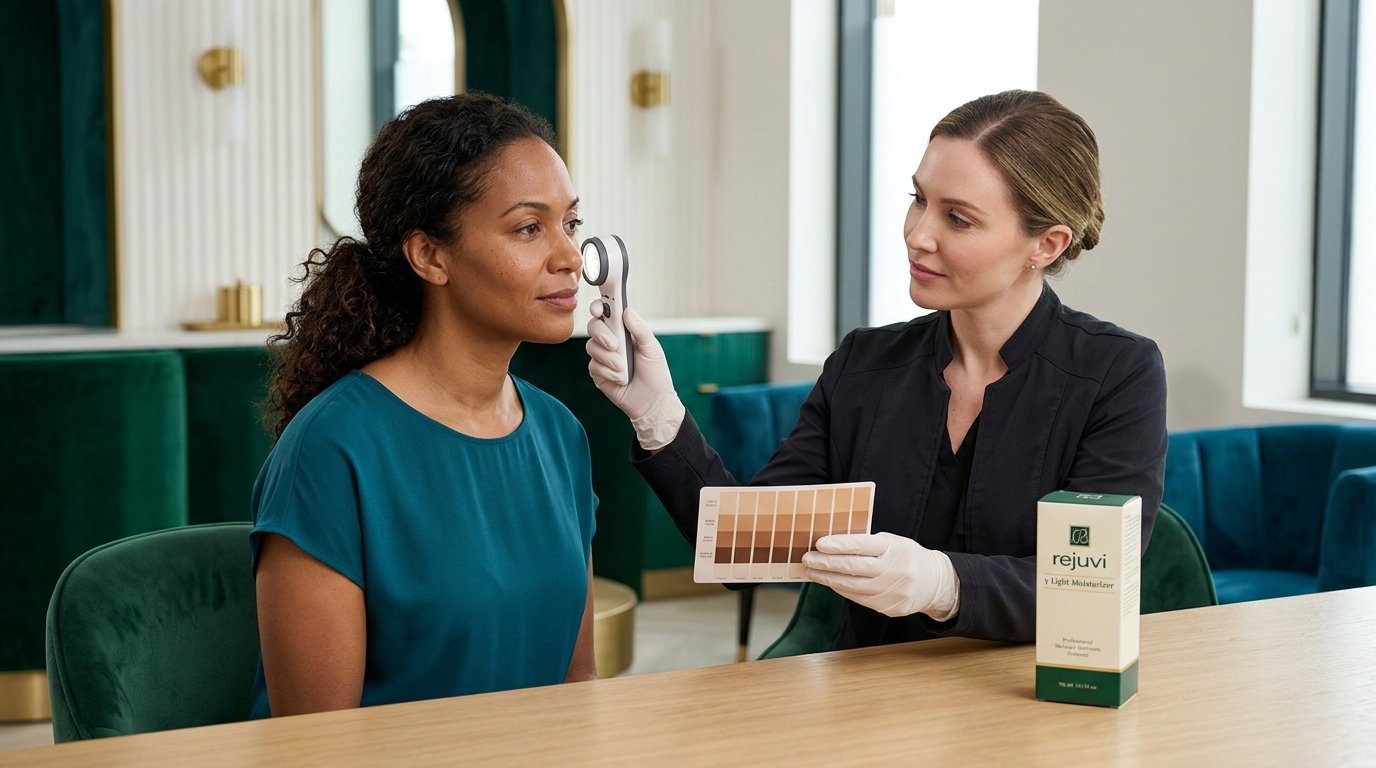
Post inflammatory hyperpigmentation after skin treatments is more likely when inflammation is intense, prolonged or poorly matched to the person’s pigment response. Skin tone matters, but it is only one part of a careful risk assessment. This guide explains how tone, prior reactions, diagnosis, treatment intensity, sun exposure and aftercare change the chance of dark marks—and what to ask before proceeding.
Medical note: This article provides general education. It does not diagnose a pigmented lesion, prescribe treatment or replace care from a dermatologist or other appropriately qualified professional.
Key points
- PIH can affect every skin tone, but it is often more frequent, visible and persistent in medium-to-deep tones.
- Personal history of marks after acne, injury or procedures is a powerful risk clue.
- Diagnosis comes before treatment: melasma, scars, redness and suspicious lesions require different decisions.
- Peel depth, needle technique, wavelength, fluence, density, cooling and combined treatments all influence inflammation.
- Appropriate preparation, sun protection and early review of warning signs can reduce avoidable complications.
The short answer: skin tone changes the risk conversation, not the right to treatment
Skin treatments work by creating a controlled change in the skin. Cleansing may loosen compacted material; a peel may accelerate shedding; microneedling creates microscopic channels; and light, laser or heat-based devices deliver energy to selected targets. The same repair response that makes a procedure useful can also activate pigment production. That is why post inflammatory hyperpigmentation after skin treatments is not a rare side note but a central part of responsible treatment planning.
People with medium, olive, brown or deeper skin tones often have melanocytes that respond more strongly or persistently to inflammation, even though the number of melanocytes is broadly similar across skin tones. More available melanin and more reactive pigment pathways can make a temporary injury visible for longer. This does not mean every darker-skinned person will develop a mark, or that lighter skin cannot develop one. It means the threshold for unnecessary inflammation may be lower and the consequences may be more noticeable or longer lasting.
The practical conclusion is not “darker skin cannot be treated.” It is that diagnosis, device choice, peel depth, energy, passes, interval, preparation and aftercare must be individualized. Conservative does not mean ineffective. A staged plan can create a useful endpoint while protecting the skin from an avoidable pigment cycle.
Post inflammatory hyperpigmentation after skin treatments: the key mechanism
Post-inflammatory hyperpigmentation, usually shortened to PIH, is a flat area of extra pigment that appears after inflammation or injury. Acne, eczema, picking, burns, friction, aggressive exfoliation and professional procedures can all be triggers. DermNet explains that injury in the epidermis or dermis can lead to melanin being deposited in epidermal cells or deeper in the dermis. The depth helps explain why some marks look tan or brown while others appear grey-brown, blue-grey or slate coloured.
PIH is pigment, not a textural scar. A flat brown mark after a spot is different from an ice-pick, rolling or boxcar acne scar. It is also different from persistent redness, bruising, a crust, infection, a burn or loss of pigment. This distinction changes what should happen next. Treating every dark area as surface pigment can lead to repeated exfoliation or energy delivery when the skin instead needs time, barrier support, medical assessment or a different diagnosis.
PIH often fades, but the timetable varies. Epidermal pigment may gradually improve over months; dermal pigment can be slower and more resistant. Ongoing acne, dermatitis, scratching, sun exposure or repeated procedures can keep creating new pigment while old pigment is fading. The first treatment principle is therefore to stop the source of inflammation where possible.
Why darker skin can show a stronger pigment response
Melanin is a protective pigment, and darker skin contains larger, more widely distributed melanosomes. When inflammatory signals stimulate pigment production, the visible result may be more pronounced because the pigment system is already active and efficient. Reviews of PIH in skin of colour consistently describe greater frequency, severity and persistence in higher phototypes, while also warning against treating all people within a racial or ethnic label as biologically identical.
Inflammation communicates with melanocytes through mediators released by keratinocytes and immune cells. Procedures that generate heat, mechanical injury, chemical irritation or prolonged redness can amplify this signalling. If the epidermal barrier is already impaired, a standard protocol may feel and behave like an aggressive one. That is why a history of stinging, eczema, recent sunburn, retinoid irritation or previous treatment marks matters as much as a colour category.
Risk is a probability, not a prediction. Two people with similar visible skin tone can have different histories, underlying conditions, sun exposure and response to prior procedures. A careful clinician uses tone as one variable in a wider assessment rather than as a shortcut.
Skin tone, Fitzpatrick phototype and ethnicity are not interchangeable
The Fitzpatrick scale was developed to describe how skin tends to burn or tan after ultraviolet exposure. It can be useful, particularly when planning light or laser settings, but it is not a complete measurement of constitutive skin colour, ethnicity, undertone or pigment reactivity. Self-reported phototype can also be inaccurate when someone focuses on current tan, rarely spends time in the sun or has mixed responses on different body areas.
Visible tone describes what the practitioner sees today. Ethnicity may suggest population-level patterns but cannot determine an individual protocol. Recent tanning, melasma, PIH history, medication, hormonal factors and the treatment site can all alter risk. A face protected by sunscreen may respond differently from frequently exposed cheeks or a friction-prone body area.
A good consultation therefore avoids statements such as “your skin is type IV, so this setting is safe.” It asks how the skin has reacted to acne, scratches, waxing, peels, lasers and sun. It records baseline colour under consistent light and considers a test spot when an energy-based treatment has meaningful uncertainty.
The most important predictor may be your own history
Previous pigment after acne, insect bites, burns, hair removal, injections or cosmetic procedures is valuable evidence. A person who develops months-long marks after minor inflammation may need a slower sequence than someone of a similar tone whose skin resolves quickly. Previous hypopigmentation, blistering or keloid-like scarring is equally important because the next procedure should not repeat the same injury pattern.
Ask what actually happened after the earlier treatment: Was there expected redness for two days, or progressive pain and crusting? Did pigment appear immediately, or one to three weeks later? Was the treated area exposed to sun? Were strong acids, retinoids or scrubs restarted too soon? Did the mark follow the whole treated field or only overlapping passes? These details help separate inherent reactivity from preventable protocol and aftercare problems.
Photographs taken in neutral light can make the history more reliable. Social-media filters, changing bathroom lighting and seasonal tanning can hide subtle worsening. A baseline record supports safer decisions and prevents a normal temporary darkening from being confused with a permanent result.
Not every dark patch is PIH
Melasma, solar lentigines, freckles, lichen planus pigmentosus, drug-related pigmentation, contact dermatitis and some medical conditions can resemble PIH. A new, changing, irregular, bleeding or symptomatic pigmented lesion should not be covered with a cosmetic treatment plan before medical evaluation. The same caution applies when the colour pattern is unusual, widespread or accompanied by systemic symptoms.
Melasma deserves special attention because heat, visible light, ultraviolet exposure, hormones and inflammation can all influence it. A procedure that improves one discrete sun spot may aggravate a melasma pattern. DermNet notes that peels and lasers may be used cautiously for melasma but can worsen it or provoke PIH. Diagnosis therefore comes before selecting a device.
Our broader guide to pigmentation treatment assessment in Istanbul explains how dark spots, uneven tone and different pigment patterns are separated before options are discussed. The present article has a narrower purpose: estimating the chance that a treatment itself could leave a dark mark.
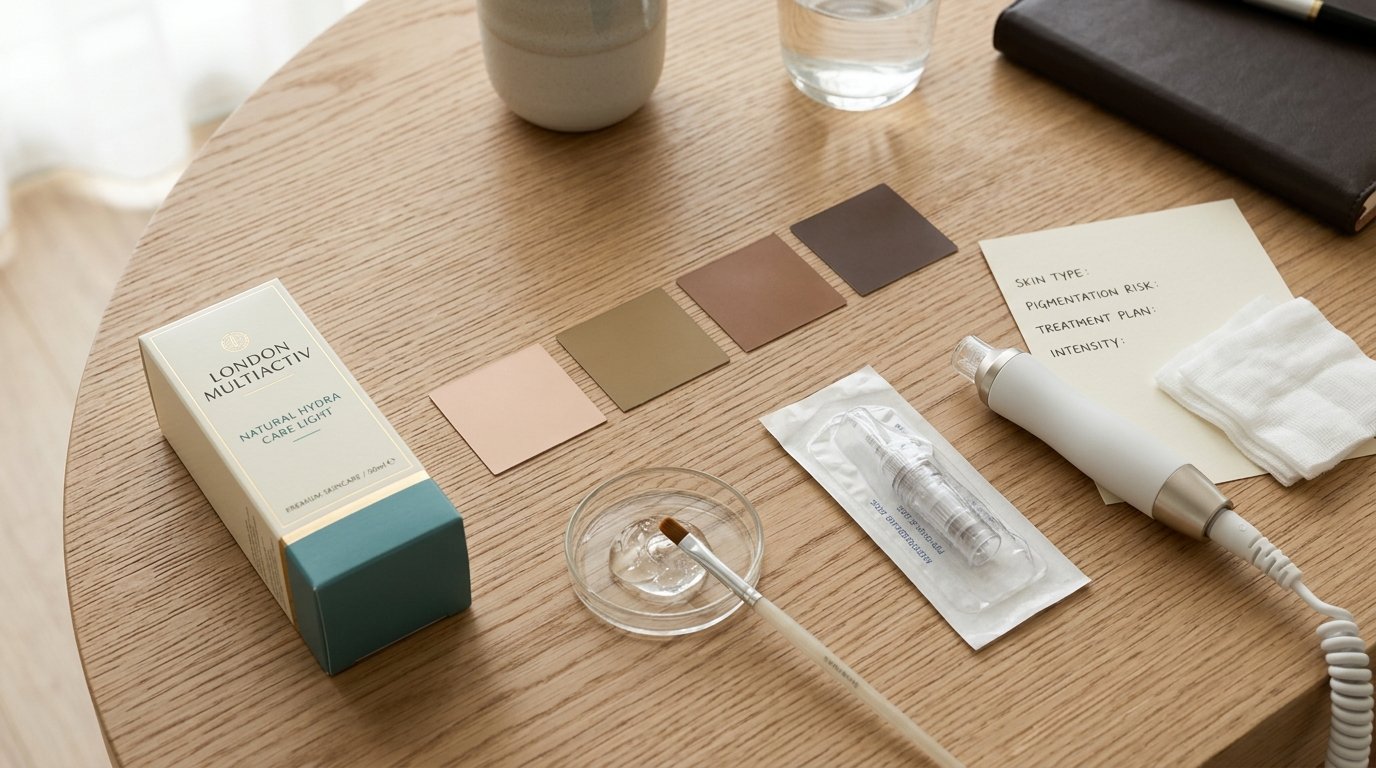
How treatment intensity changes risk
A useful mental model is the “inflammatory budget.” Every treatment uses some of that budget through friction, acid concentration, needle depth, heat, light absorption or tissue removal. Skin condition, recent sun and home-care irritation determine how much budget is available. Combining several aggressive steps on the same day can exceed it even when each step would be acceptable alone.
Depth and density matter. A superficial, evenly applied peel is not equivalent to a deeper peel. Microneedling at modest depth is not equivalent to repeated passes until pinpoint bleeding across every zone. Fractional laser density, pulse duration, spot size, fluence and cooling all influence the thermal burden. More intensity can sometimes create more change, but it also creates more inflammation and a longer recovery window.
The safest endpoint is procedure-specific. “No pain, no gain” is not a valid pigment strategy. Severe burning, grey or white discoloration, blistering, unexpected swelling or escalating pain are warning signs, not evidence that a treatment is working better.
Chemical peels: concentration is only one part of the equation
Peel risk depends on the agent, concentration, pH, vehicle, number of layers, contact time, application uniformity, skin preparation and neutralisation. A low percentage product with a very low pH can behave differently from a higher percentage buffered formula. Occlusion, vigorous degreasing and overlapping application can intensify penetration.
In pigment-prone skin, superficial peels are generally considered before medium or deep injury, and only when the diagnosis and skin condition support them. Existing irritation, active dermatitis, open lesions, recent waxing or uncontrolled acne can make an otherwise routine peel unpredictable. Pretreatment may be appropriate in medical practice, but prescription agents such as hydroquinone or retinoids should not be improvised without clinician guidance.
Our comparison of BBL and chemical peels for pigmentation explains why the visible colour alone does not choose between light and exfoliation. The relevant question is which target is present and how much inflammation the person can safely tolerate.
Microneedling: lower pigment risk does not mean zero risk
Microneedling does not rely on a pigment-seeking wavelength or bulk thermal injury, which is one reason it is often considered across a wide range of skin tones. The American Academy of Dermatology and Cleveland Clinic describe it as useful for several textural concerns and note its role for darker skin. However, any procedure that punctures skin can still cause PIH if depth, pressure, passes, sterility or aftercare are inappropriate.
Risk rises when needling is performed over active infection, inflamed acne, uncontrolled dermatitis, recent sunburn or a compromised barrier. Applying unapproved substances through fresh channels can add irritation or allergy. Excessive pressure, repeated stamping and aggressive same-day combinations can turn controlled micro-injury into unnecessary inflammation.
For acne scars, compare goals and trade-offs in our guide to microneedling versus fractional CO2 laser. The correct choice depends on scar type, downtime, pigment risk and operator experience rather than a universal ranking.
Laser, IPL and BBL: why melanin changes energy planning
Light-based devices depend on selective absorption. Melanin can compete for energy that was intended for another target. In darker or recently tanned skin, epidermal melanin may absorb more energy, increasing the chance of excess heat, burns, PIH or hypopigmentation. DermNet’s laser guidance for skin of colour highlights this competitive chromophore effect.
Device name alone cannot establish safety. Wavelength, pulse duration, fluence, spot size, cooling, filter, density, passes and operator technique interact. IPL and BBL cover ranges of wavelengths rather than behaving like a single laser. A treatment advertised as gentle can still be unsuitable for a specific tone, tan, diagnosis or setting.
Test spots can reduce uncertainty but do not guarantee that a full-face treatment will behave identically. The test must be performed with the intended settings and observed long enough for delayed pigment change. Immediate absence of blistering is not the same as a negative PIH test.
Fractional CO2 and other resurfacing procedures
Ablative fractional CO2 creates columns of controlled thermal injury. It can be valuable for selected scars and texture concerns, but the inflammatory and recovery burden is higher than with non-ablative or non-energy options. Darker phototypes may be treated by experienced clinicians using appropriate parameters, yet the margin for error can be narrower and PIH remains a recognised complication.
Density is often as important as energy. Closely spaced columns can create more cumulative heat and a longer inflammatory phase. Multiple passes, treatment overlap and inadequate cooling can increase risk. The goal is not to copy a protocol used on lighter skin; it is to achieve an appropriate fractional effect for the individual.
A history of PIH does not automatically prohibit resurfacing, but it strengthens the case for diagnosis, conservative parameters, medical oversight, sun control and a staged plan. When the expected benefit is modest and the pigment cost could be substantial, a different modality or a delay may be the better decision.
Hydrafacial, cleansing and low-downtime facials
Non-ablative facials generally have a lower pigment risk than resurfacing, but they are not risk-free. Strong suction, prolonged abrasion, aggressive extractions, concentrated acids or several exfoliating steps can create inflammation. A person with active dermatitis or a disrupted barrier may react to a protocol that is comfortable for someone else.
The absence of visible peeling does not prove that the skin was not irritated. Tightness, persistent heat, stinging with water or rapidly increasing redness suggest that the barrier needs support. More exfoliation should not be used to “clean up” the reaction.
Low-downtime care is most useful when it matches the concern. Congestion, dehydration and surface dullness do not require the same steps. A pre-treatment analysis helps select a proportionate protocol and records what should be avoided.
Hair removal, waxing and friction-related procedures
Waxing, threading, epilation, shaving irritation and laser hair removal can all provoke dark marks when they create inflammation. The risk is higher when the skin is tanned, when energy settings are not matched to skin and hair, when wax is too hot, or when repeated passes damage the same area. Folliculitis and ingrown hairs can continue the pigment cycle after the procedure.
For laser hair removal, the operator must account for epidermal melanin while targeting melanin in the hair. Wavelength and cooling matter, and recent sun exposure should be disclosed. For mechanical hair removal, technique, clean tools and post-treatment friction reduction matter.
If a dark mark follows every episode of hair removal, the solution is not simply a stronger brightening product. The trigger, method and aftercare should be reviewed so new inflammation stops.
Pre-treatment screening: what should be asked
A useful screen covers prior PIH or hypopigmentation, keloid tendency, eczema, psoriasis, rosacea-like symptoms, melasma, herpes history, active acne, infections, medications, pregnancy, recent procedures, tanning and current products. Prescription retinoids, exfoliating acids, bleaching agents, steroids and photosensitising medicines may alter timing or response. The person should disclose them rather than stopping prescribed treatment independently.
The practitioner should inspect the barrier, current colour, active lesions and treatment area. Standardised photographs and a professional skin analysis can document surface findings, but no camera replaces diagnosis. A cosmetic assessment must stay within its professional scope and refer suspicious lesions or active disease for medical review.
A plan should state the target, expected endpoint, likely downtime, pigment risk, alternatives and what would cause postponement. Consent is meaningful when it includes the possibility of PIH, not only desired results.
When postponing is safer than treating today
Recent tanning or sunburn is a strong reason to pause many energy and resurfacing procedures. So are active infection, open skin, uncontrolled dermatitis, severe irritation, a new unexplained rash, painful cystic acne in the treatment field and inability to follow sun protection. The exact delay depends on the procedure and clinical assessment.
Travel, outdoor events and inability to obtain aftercare products can also change timing. A technically suitable treatment may be practically unsuitable if the next week includes intense sun, swimming, sauna, heavy exercise or makeup that cannot be avoided during recovery.
Postponement is not failure. It is a risk-control decision. Treating inflamed or recently tanned skin to meet a calendar date can create a longer pigment problem than the original concern.
Preparation: calm skin is a better starting point
Preparation should reduce avoidable irritation and improve consistency. That usually means gentle cleansing, reliable moisturisation and broad-spectrum sun protection. It may include clinician-directed pigment-modulating therapy for selected people, but a universal “pre-peel” routine is inappropriate because ingredients, timing and contraindications differ.
Do not add several new acids, retinoids or brighteners shortly before treatment. A reaction to a new product can be mistaken for procedure sensitivity. Scrubs, picking, waxing and intentional tanning add inflammation. Stable, boring skin care is often the better preparation.
Tinted sunscreen containing iron oxides may be discussed when visible light worsens melasma or pigmentation, particularly in darker skin tones. The AAD emphasises sun protection and notes the usefulness of tinted products for people concerned about dark spots. Product choice still needs to suit the individual and local medical advice.
Aftercare: reduce inflammation without over-treating
Immediate aftercare should follow the exact procedure instructions. Common principles include gentle cleansing, bland moisturisation, avoiding picking and protecting from ultraviolet exposure. Heat, friction, vigorous exercise, sauna, swimming and makeup may be restricted for a period depending on the treatment. A rule copied from another procedure may be wrong for yours.
Do not try to prevent PIH by applying every brightening active to fresh skin. Acids, retinoids, strong vitamin C formulas, benzoyl peroxide and fragranced products can sting or prolong inflammation. Reintroduction should be based on recovery and professional instructions.
Contact the treating provider if pain increases, swelling is severe, blisters appear, discharge develops, redness spreads, or colour changes are sharply demarcated. Early assessment may prevent a manageable reaction from becoming a prolonged problem.
Sun and visible light: why protection affects the outcome
Ultraviolet exposure can darken new PIH and slow fading. Exposure is not limited to beach days; commuting, windows, outdoor meals and incidental walking contribute. Broad-spectrum sunscreen, adequate application, reapplication and physical shade are therefore part of treatment, not an optional cosmetic add-on.
Visible light may contribute to pigmentation in susceptible skin, especially melasma and deeper tones. Tinted sunscreens with iron oxides can improve visible-light protection. Hats and scheduling around unavoidable outdoor exposure add practical protection.
Sun protection does not erase every risk. It works alongside appropriate settings, calm aftercare and control of the underlying inflammation.
How to think about “safe for all skin tones” claims
“Safe for all skin tones” should mean that a device or method can be adapted by trained professionals after assessment. It should not mean one preset, one peel time or one number of passes for everyone. Marketing language cannot replace wavelength physics, diagnosis or a documented treatment history.
Ask what the provider changes for darker or recently tanned skin, how they identify melasma, what their test-spot policy is, how they manage PIH, and which warning signs require review. A credible answer includes limits and alternatives rather than promising zero risk.
Before-and-after photographs can be helpful only when lighting, angle and timing are comparable and when the cases resemble the concern and skin tone being discussed. They do not guarantee an individual result.
What to do if a dark mark appears
First, stop creating more inflammation. Pause unapproved exfoliation, picking and repeated procedures. Use the aftercare recommended for the treatment and arrange assessment. A professional should determine whether the change is expected temporary darkening, PIH, a burn, melasma flare, bruising, infection or another problem.
Treatment depends on depth, cause, skin tolerance and medical history. Options discussed in dermatology literature include sun protection and topical agents such as azelaic acid, retinoids, hydroquinone and other pigment-modulating ingredients. Some are prescription treatments, some can irritate, and some are unsuitable in pregnancy or for prolonged unsupervised use. This article cannot select a medication.
Procedures can sometimes help persistent PIH, but they can also worsen it. A rushed second peel or laser session is not automatically corrective. The 2024 systematic review of PIH treatment in skin of colour found evidence across topical and procedural approaches but also highlighted variability and the need for caution.
A practical decision framework before booking
Start with the problem, not the device. Is the target texture, a scar, congestion, a vascular mark, melasma, sun damage or PIH? Next, identify the minimum effective level of injury likely to improve it. Then consider individual modifiers: tone, tan, prior PIH, active inflammation, medications, season, recovery capacity and operator experience.
Compare benefit, uncertainty and cost of a complication. A high-intensity treatment may offer a larger single-session change but require more downtime and carry more pigment risk. A series of gentler treatments may be slower but easier to monitor. Sometimes the best first step is treating acne or dermatitis so the skin stops generating new marks.
For people comparing scar procedures, our acne scar treatment planning guide separates scar type from colour. For pigment procedures, the BBL-versus-peel guide explains modality differences. The purpose of cross-linking is to keep each decision in its correct clinical context rather than presenting one treatment as universally best.
Questions to bring to a consultation
Ask: What is the working diagnosis? Is the target pigment, redness or texture? Why is this procedure suitable for my current skin condition and tone? What settings or depth will be adjusted? Is a test spot useful? What is the expected redness, swelling, crusting or darkening timeline? Which products should be paused and restarted, and who decides?
Also ask how the provider handles unexpected pigment change, whether review is included, and when medical referral is required. Confirm who performs the treatment and their experience with similar skin tones. For energy devices, ask for the actual device category and why its parameters fit the target; brand recognition alone is not enough.
Finally, discuss your real calendar. Sun exposure, travel, weddings, exercise and inability to avoid heat can make the timing wrong even when the treatment itself is reasonable.
Reading inflammation in different skin tones
Inflammation is not always bright red. In deeper tones it may appear violaceous, grey, brown, dusky or simply darker than baseline. Heat, tenderness, swelling, tightness and altered texture may be more reliable than colour alone. Practitioners should be trained to recognise these presentations so that a reaction is not underestimated and treatment is not repeated too soon. Consistent photographs and patient-reported symptoms add context.
Why combinations require extra caution
Combining dermaplaning, acids, extraction, needling and energy on one visit can produce a cumulative injury greater than any individual step. Combination treatment should have a clear rationale, not exist merely because several devices are available. In pigment-prone skin, staged visits make it easier to identify which intervention helped or harmed and allow the barrier to recover.
The role of operator experience
Technology does not compensate for poor selection or technique. Experience includes recognising contraindications, adapting settings, avoiding overlap, controlling cooling, documenting endpoints and knowing when to stop. It also includes managing complications without minimising them. People with higher pigment risk should ask specifically about experience with comparable tones and concerns.
Expectation setting and informed consent
PIH risk cannot be reduced to a percentage that applies to everyone. Consent should describe expected temporary changes, possible prolonged pigment, alternative approaches and the actions required if recovery deviates from plan. Realistic expectations reduce pressure to over-treat and make early follow-up more likely.
Why repeated irritation defeats pigment care
A mark cannot fade efficiently while the area is repeatedly inflamed by acne, picking, friction, harsh products or frequent procedures. The most effective pigment plan may initially look uneventful: control the trigger, repair the barrier, protect from light and wait for stable skin. This is active treatment planning, not neglect.
Photography and outcome tracking
Use the same camera, distance, angle and neutral lighting where possible. Avoid filters and automatic beauty modes. Record dates, products, symptoms and sun exposure. Pigment often changes slowly, and objective comparison prevents unnecessary escalation when daily mirror checks feel discouraging.
Special considerations for the neck and chest
The neck and chest can be more reactive and may heal differently from the face. Friction, perfume, jewellery and sun exposure add variables. Settings or peel times used on facial skin should not be copied automatically. Conservative testing and aftercare are especially important in these areas.
Pregnancy, hormones and pigment instability
Hormonal changes can increase pigment activity and melasma susceptibility. Some topical medicines and elective procedures may be unsuitable during pregnancy or breastfeeding. Timing and treatment must be discussed with qualified clinicians; a cosmetic article cannot clear a procedure or ingredient for an individual.
The difference between prevention and treatment
Prevention aims to minimise unnecessary inflammation and light exposure before pigment forms. Treatment addresses established pigment after the diagnosis and trigger are understood. Starting a strong corrective procedure during an active reaction confuses these stages and can worsen the problem.
A staged escalation model
Begin with the least inflammatory intervention that plausibly addresses the target. Observe recovery, document response and increase intensity only when the benefit justifies it. A staged model respects biological variation and makes complications easier to trace, while still allowing meaningful treatment over time.
A note on language and respectful assessment
Skin tone should be discussed accurately without turning identity into a contraindication. Terms such as skin of colour describe broad groups and are useful in research, but they contain wide biological and cultural variation. The consultation should use the person’s own history and the observed treatment site, explain why pigment risk is being considered, and avoid implying that deeper skin is defective or untreatable. Respectful assessment also means showing representative educational images, recognising inflammation in different tones and documenting uncertainty. When evidence for a specific device or parameter is limited in a population, that limitation should be stated. Transparency supports informed decisions and helps the person weigh a slower plan against a higher-risk intervention without pressure.
How skin tone affects what recovery looks like
Recovery instructions often use redness as the main signal, but redness can be subtle in deeper skin. Swelling, warmth, tenderness, shine, tightness, darkening and a change in texture may communicate more. A person should be told what is expected for the exact procedure and what is outside that range. Temporary bronzing or patterned dots may be expected after some devices, while rapidly expanding dusky colour, blistering or severe pain is not. Providers should avoid comparing every patient with photographs of very light skin because the visible endpoints can differ. The person’s baseline photographs, symptoms and functional changes are more useful. Recovery also evolves: immediate warmth may settle, then pigment may become visible after several days. A follow-up plan should therefore include delayed change rather than ending when the person leaves the clinic. Clear written instructions reduce the temptation to scrub, peel or apply strong actives when the skin looks darker. Those actions can convert a temporary response into ongoing inflammation.
Why undertone and surface colour are not enough
Warm, cool and olive undertones are aesthetic descriptions, not complete treatment settings. Surface colour can also change with lighting, foundation, tanning, anaemia, vascular tone and recent inflammation. Devices should not be programmed from a makeup shade or a photograph alone. The treatment site must be examined directly, cosmetics removed and recent exposure discussed. Some systems use melanin readers or imaging, but measurements still require interpretation and do not diagnose the cause of pigment. A cheek with melasma, a jaw with acne marks and a neck exposed to friction may need different decisions on the same person. The safest approach combines observation, history, device-specific knowledge and conservative testing where appropriate. This is why online advice that labels an entire ethnic group as “safe” or “unsafe” for a named procedure is inadequate. Individual biology and the exact protocol matter more than a broad identity category.
Building a recovery-first treatment plan
A recovery-first plan begins by asking what the skin must do after treatment. It must restore barrier function, control inflammation and process altered tissue without repeated injury. The plan then chooses an intensity that the person can realistically support. Someone who cannot avoid sun, heat, sweat or friction during the required window may need a different date or modality. The aftercare list should be short, specific and compatible with allergies and current prescriptions. Follow-up should occur soon enough to identify an abnormal course. If the first session heals evenly, later sessions can be adjusted; if it produces prolonged inflammation, repeating the same settings is not evidence-based persistence. Outcomes should be judged after the appropriate biological interval, not by adding treatment whenever progress seems slow. This staged approach protects pigment while preserving the possibility of meaningful improvement.
Procedure-risk matrix: superficial enzyme and acid exfoliation
Enzyme products and superficial acids are often grouped together, but their effects are not identical. Enzymes can loosen surface keratin without the same free-acid profile as an alpha- or beta-hydroxy peel, while acid behaviour changes with pH, concentration, vehicle and time. A person who tolerated a retail cleanser containing an acid has not automatically demonstrated tolerance to a professional peel. In pigment-prone skin, the aim is even application and a predictable superficial endpoint, not the most visible frosting or shedding. Areas around the nose, mouth and eyes may respond differently because of barrier condition, movement and product pooling. Petroleum protection, careful timing and neutralisation may be part of a professional protocol. Afterward, tightness and mild flaking may be expected for some formulas, but increasing heat, pain, sharp borders or blistering should prompt review. The risk decision also depends on why exfoliation is proposed. Treating rough surface scale is different from trying to erase melasma or a deep grey-brown mark. When the target is unclear, adding peel strength increases uncertainty rather than precision.
Procedure-risk matrix: manual exfoliation, dermaplaning and extraction
Mechanical procedures create risk through friction and pressure rather than chemical penetration. A smooth blade pass on intact skin is different from repeated scraping over inflamed follicles. Extractions can be useful for selected comedones, but squeezing an inflamed papule or probing deeply can rupture follicular contents and intensify the very inflammation that produces a mark. Skin tone does not determine whether extraction is permitted; lesion type and technique do. The practitioner should distinguish a blackhead from a sebaceous filament and should stop when material does not release without force. After mechanical treatment, the person should avoid picking, abrasive towels and immediate layering of strong actives. If pinpoint bleeding, raw areas or prolonged tenderness develop, the recovery plan needs to reflect actual injury rather than the marketing name of a “facial.” Repeated monthly trauma to the same dark mark is particularly counterproductive. Documentation should record where extractions occurred so that later pigment can be traced to a specific event instead of being misclassified as spontaneous worsening.
Procedure-risk matrix: radiofrequency, ultrasound and heat-based care
Not every energy treatment targets melanin directly. Radiofrequency and focused ultrasound use other forms of energy, yet heat and inflammation can still influence pigment-prone skin. Risk depends on tissue depth, surface contact, coupling, pulse stacking, cooling, treatment duration and whether the device is designed for the stated use. Pain that rises sharply, hot spots or patterned surface injury are not normal endpoints to ignore. Melasma-prone individuals may be sensitive to heat even when the epidermis looks intact. That does not mean all heat-based treatment is forbidden, but it makes diagnosis and thermal control important. Combining heat with a peel or needling on the same day should have a clear clinical rationale and a conservative cumulative plan. Post-treatment instructions need to address additional heat from sauna, very hot showers, strenuous exercise and direct sun. If a person reports that previous heat procedures triggered patchy pigmentation, that history should meaningfully change the next recommendation rather than being dismissed because a different brand of device is offered.
Procedure-risk matrix: vascular and pigment-targeting light
Red and brown marks are not interchangeable targets. Vascular devices aim at haemoglobin, while pigment devices aim at melanin or pigment particles, and broadband systems may use filters across a range of wavelengths. In darker skin, epidermal melanin sits between the handpiece and the intended target, so parameter selection and cooling are critical. A practitioner should decide whether a flat mark is red, brown, grey or mixed and whether it represents PIH, post-inflammatory erythema, melasma or a lesion needing diagnosis. Treating redness with a pigment setting, or pigment with an inappropriate vascular assumption, can add heat without solving the target. Recent tanning further reduces contrast between epidermis and unwanted pigment. Test spots, when appropriate, should be photographed and reviewed for delayed darkening as well as immediate reaction. The conversation should include the possibility that no energy treatment is the best first step. Topical care, control of inflammation or time may provide a safer starting point.
Procedure-risk matrix: acne procedures and active breakouts
Active acne creates two overlapping risks: the disease itself can produce PIH, and an aggressive procedure can add inflammation. Comedonal acne, inflamed papules, nodules and cysts do not receive the same approach. Deep painful lesions may require dermatology care before cosmetic scar or pigment procedures are considered. Needling across infected or highly inflamed lesions can spread irritation and increase trauma. Strong peels may help selected acne patterns under appropriate supervision but can also disrupt a compromised barrier. The sequence should be explicit: reduce new lesions, minimise picking and friction, then reassess residual colour and scars. Otherwise a person may believe a pigment treatment has failed when new acne continues to create marks. Product history matters because benzoyl peroxide, retinoids and acids can leave skin dry or reactive before a procedure. A clinician-directed pause may be appropriate, but abrupt unsupervised changes can worsen acne. The safest plan balances disease control with barrier stability instead of pursuing a perfectly clear treatment field at any cost.
Procedure-risk matrix: treatment around the eyes and mouth
Periorbital and perioral skin can be sensitive, mobile and exposed to cosmetics, saliva, masks and friction. Dark circles also have multiple causes: pigment, visible vessels, shadowing, anatomy and dermatitis may overlap. A peel or light treatment cannot correct every cause, and over-treating thin skin can leave irritation more visible. Around the mouth, lip licking, dental products, hair removal and contact dermatitis may maintain pigment. Before treatment, identify active scaling, fissures or stinging and review recent waxing or threading. Protective margins and procedure-specific eye protection are essential for energy treatments. Aftercare products should be bland and appropriate for the site; fragrance or migrating actives can create a secondary reaction. If pigment has an unusual distribution or accompanies persistent rash, medical assessment is more useful than repeating cosmetic brightening. A good plan treats the driver and accepts that structural shadow or vascular colour may remain even if epidermal pigment improves.
Procedure-risk matrix: the neck, underarms and friction-prone areas
Body folds and friction zones develop pigment for reasons that may include rubbing, shaving, folliculitis, deodorant reactions, eczema and metabolic conditions. The colour may not be simple PIH, and a cosmetic peel should not be the automatic answer. Neck and underarm skin experience movement and occlusion, so recovery can be affected by clothing, sweat and products. A treatment tolerated on the cheek may be too aggressive in a fold. Before proceeding, review the pattern, texture and symptoms and consider whether medical evaluation is warranted, particularly when pigmentation is velvety, widespread or changing. Reduce the repeated trigger where possible: friction, close shaving, picking or an irritating deodorant. When a professional procedure is appropriate, conservative area-specific application and realistic expectations are important. Aftercare should account for sweat and the practical difficulty of avoiding movement. Trying to accelerate results with frequent sessions can create a cycle in which irritation continually renews the pigment.
Risk modifiers: barrier disease, allergy and sensitivity
Eczema, allergic contact dermatitis and irritant reactions can all lower the skin’s tolerance. A person may describe “sensitive skin” without a diagnosis, so the consultation should ask what happens, where it occurs, how long it lasts and which products trigger it. Burning with water, persistent scaling, cracks and active itch suggest that the barrier is not ready for elective injury. Fragrance, preservatives, adhesives, topical antibiotics and botanical extracts can cause contact reactions; “natural” is not the same as non-sensitising. Patch testing for allergy is a medical diagnostic process and should not be confused with a cosmetic product dab or device test spot. When dermatitis is active, controlling it comes before treating the colour it left behind. Once stable, the procedure and aftercare should use the fewest necessary products, introduced one at a time. If a post-treatment eruption appears, adding multiple soothing products makes the culprit harder to identify and may compound the reaction.
Risk modifiers: medication and photosensitivity
Medication review is not a formality. Some medicines and supplements can affect photosensitivity, bleeding, wound healing, immune response or pigment. Isotretinoin history, topical retinoids, antibiotics, anticoagulants, immunosuppressants and hormonal treatments may influence planning, but rules vary by procedure and current evidence. The correct action is not to stop medication without the prescriber. It is to disclose the medicine, dose, reason and timing so qualified professionals can assess it. Topical products matter too: retinoids, acids, benzoyl peroxide and bleaching agents can irritate if combined carelessly with procedures. Herbal products and essential oils can also cause phototoxic or allergic reactions. A written pre-treatment list reduces memory errors. If the provider cannot explain why a medicine is relevant or how long a pause is required, medical clarification is safer than guessing. The same applies after treatment: pain, infection or pigment should not be self-treated with leftover prescription products.
Risk modifiers: seasons, travel and daily routine
Season is a proxy for exposure, not an absolute safety rule. Autumn in Istanbul may reduce intense midday sun compared with summer, but ultraviolet exposure continues, and travel to a sunnier destination can change the plan overnight. Snow, water and high altitude can increase exposure. A person who works outdoors has a different practical risk from someone who can remain indoors during recovery. Commutes, window-side work and regular walking should be included in the conversation. Daily routine also affects heat, sweat and friction: athletes, sauna users, swimmers and people required to wear masks or helmets may need different timing. A procedure immediately before a beach holiday, wedding or long flight may create avoidable conflict with aftercare. The safest calendar leaves room for normal recovery and for review if something unexpected develops. When adequate protection is impossible, postponement often costs less than treating a persistent pigment complication.
Risk communication: useful numbers versus false precision
People often ask for the exact percentage chance of PIH. Studies use different procedures, devices, parameters, populations, definitions and follow-up periods, so one number rarely transfers cleanly to an individual. A precise-looking percentage can create false reassurance. Better communication describes relative risk factors and the steps used to reduce them. The provider can explain that deeper tone, recent tan, prior PIH, active inflammation and higher treatment intensity raise concern, while stable skin, appropriate parameters, protection and follow-up reduce avoidable risk. Consent should also distinguish expected temporary darkening from a complication. For example, pigment debris may look darker before shedding after some targeted treatments, while progressive patchy darkening after excessive inflammation may need review. Written timelines and photographs help. The person should know whom to contact and should not be told simply to wait when symptoms are worsening.
Choosing a provider for pigment-prone skin
Look for evidence of structured assessment rather than a list of machines. The provider should ask about diagnosis, previous reactions, tanning, products and medication; explain why a specific modality fits the target; and document settings or peel details. Experience with a range of skin tones is relevant, but claims should be supported by thoughtful answers and comparable cases rather than vague confidence. The clinic should have a plan for test spots, follow-up and referral. Hygiene, eye protection and device maintenance remain essential and are not replaced by pigment expertise. Be cautious when every concern receives the same package, when stronger is always presented as better, or when a guarantee of no PIH is offered. A trustworthy consultation can recommend a gentler alternative, medical review or no treatment today. That restraint is part of expertise. The desired result should be discussed alongside the acceptable downtime and the consequences of a pigment complication for the individual’s work, travel and wellbeing.
Bottom line
Skin tone affects the probability and visibility of post-treatment dark marks, but it is never the only variable. Prior pigment response, diagnosis, active inflammation, treatment intensity, operator experience, sun exposure and aftercare all shape the outcome. Higher melanin content can narrow the margin for avoidable inflammation, especially with heat- and light-based procedures.
Good planning replaces blanket exclusions with individual risk control: confirm the target, stabilise the skin, use appropriate parameters, consider testing, protect from light and review unexpected changes early. The safest treatment is not necessarily the weakest; it is the one with a justified endpoint and a recovery plan matched to the person.
This article is general education. It cannot diagnose a lesion, prescribe medication or determine whether a procedure is suitable. New, changing or symptomatic pigmented lesions and significant post-procedure reactions require assessment by an appropriately qualified medical professional.
Myths vs facts
Myth: Darker skin should never have professional treatments
Fact: Many procedures can be performed, but protocols must be adapted and the indication must be sound. The correct decision is based on diagnosis, treatment variables and individual history rather than a slogan or a single colour category.
Myth: Only lasers cause PIH
Fact: Acne, peels, extractions, waxing, friction and any inflammatory injury can cause it. The correct decision is based on diagnosis, treatment variables and individual history rather than a slogan or a single colour category.
Myth: A stronger treatment always works faster
Fact: More inflammation can create more pigment and delay the desired result. The correct decision is based on diagnosis, treatment variables and individual history rather than a slogan or a single colour category.
Myth: Fitzpatrick type tells the whole story
Fact: Phototype helps, but history, tan, diagnosis, barrier condition and treatment site also matter. The correct decision is based on diagnosis, treatment variables and individual history rather than a slogan or a single colour category.
Myth: No immediate burn means there will be no PIH
Fact: Pigment can appear days or weeks after a seemingly calm procedure. The correct decision is based on diagnosis, treatment variables and individual history rather than a slogan or a single colour category.
Myth: Microneedling has zero pigment risk
Fact: It avoids pigment-targeting energy but can still cause PIH when overly aggressive or poorly timed. The correct decision is based on diagnosis, treatment variables and individual history rather than a slogan or a single colour category.
Myth: A test spot guarantees safety
Fact: It reduces uncertainty but cannot reproduce every full-treatment variable. The correct decision is based on diagnosis, treatment variables and individual history rather than a slogan or a single colour category.
Myth: All brown marks are PIH
Fact: Melasma, sun spots, medication effects and lesions can look similar. The correct decision is based on diagnosis, treatment variables and individual history rather than a slogan or a single colour category.
Myth: Peeling proves a peel is effective
Fact: Visible shedding is not required for every useful superficial treatment and is not a quality score. The correct decision is based on diagnosis, treatment variables and individual history rather than a slogan or a single colour category.
Myth: Brightening acids should be restarted immediately
Fact: Freshly treated skin may be irritated by actives; restart timing is procedure-specific. The correct decision is based on diagnosis, treatment variables and individual history rather than a slogan or a single colour category.
Myth: Sunscreen alone prevents every mark
Fact: It is important, but settings, inflammation control and diagnosis remain essential. The correct decision is based on diagnosis, treatment variables and individual history rather than a slogan or a single colour category.
Myth: PIH is always permanent
Fact: Many marks fade, although deeper pigment may take longer and ongoing triggers can prolong it. The correct decision is based on diagnosis, treatment variables and individual history rather than a slogan or a single colour category.
Frequently asked questions
Can light skin develop PIH after a treatment?
Yes. Any skin tone can develop PIH after inflammation, burns, acne or procedures. The average risk and visibility may be higher in more melanated skin, but individual history matters more than a simple colour label. If the change is new, severe, painful or uncertain, seek individual assessment instead of escalating home treatment.
Does darker skin always mean a higher Fitzpatrick type?
Not necessarily. Fitzpatrick typing describes burn and tan response, while visible tone and ancestry describe different things. A clinician should assess all of them rather than infer one from another. If the change is new, severe, painful or uncertain, seek individual assessment instead of escalating home treatment.
How soon can PIH appear after a procedure?
It can become noticeable after the initial redness settles, sometimes within days and sometimes over the following weeks. Delayed appearance is one reason a test spot needs adequate observation time. If the change is new, severe, painful or uncertain, seek individual assessment instead of escalating home treatment.
How long does post-treatment PIH last?
It varies with pigment depth, ongoing inflammation, sun exposure and treatment. Epidermal marks may improve over months, while dermal pigment can be slower. A fixed guarantee is not realistic. If the change is new, severe, painful or uncertain, seek individual assessment instead of escalating home treatment.
Can a chemical peel prevent PIH?
A carefully selected superficial peel may help some existing epidermal pigmentation, but a peel also creates inflammation and can cause PIH. It should not be used as a universal preventive step. If the change is new, severe, painful or uncertain, seek individual assessment instead of escalating home treatment.
Is microneedling safer than laser for dark skin?
Microneedling avoids a pigment-targeting wavelength and is often considered across skin tones, but depth, passes, active disease and aftercare still matter. The safer choice depends on the target and operator. If the change is new, severe, painful or uncertain, seek individual assessment instead of escalating home treatment.
Is fractional CO2 suitable for darker skin?
It may be considered by experienced medical professionals using adapted parameters, but PIH risk is recognised and the benefit must justify the recovery burden. It is not a casual one-setting treatment. If the change is new, severe, painful or uncertain, seek individual assessment instead of escalating home treatment.
Can IPL or BBL be used on olive or brown skin?
Suitability depends on device, filters, settings, tan, diagnosis and experience. Epidermal melanin can compete for light energy, so assessment and sometimes testing are important. If the change is new, severe, painful or uncertain, seek individual assessment instead of escalating home treatment.
Does a recent tan matter if I do not burn?
Yes. A tan means more active epidermal melanin and may increase energy absorption and pigment risk. Disclose recent sun or tanning even if there was no burn. If the change is new, severe, painful or uncertain, seek individual assessment instead of escalating home treatment.
Should I stop retinoids before treatment?
Possibly, depending on the procedure, product, strength and medical reason for use. Do not stop a prescription independently; follow the treating clinician’s written plan. If the change is new, severe, painful or uncertain, seek individual assessment instead of escalating home treatment.
Can I use hydroquinone before a procedure?
Hydroquinone is a medical pigment treatment in many settings and may be used in selected pretreatment plans. It is not appropriate for everyone and should not be self-prescribed from this article. If the change is new, severe, painful or uncertain, seek individual assessment instead of escalating home treatment.
What does a test spot show?
It shows how a small area responds to chosen settings under similar conditions. It can reveal excessive immediate or delayed reaction, but it cannot eliminate all risk for a larger treatment. If the change is new, severe, painful or uncertain, seek individual assessment instead of escalating home treatment.
Why did my marks worsen after a “gentle” facial?
Strong suction, extractions, friction, acids, allergy or an already impaired barrier can create inflammation even without obvious peeling. The reaction and exact steps should be reviewed. If the change is new, severe, painful or uncertain, seek individual assessment instead of escalating home treatment.
Can extractions cause dark marks?
Yes. Forceful or repeated extraction can injure follicles and surrounding skin. Treating active inflammation and using proportionate technique reduces avoidable trauma. If the change is new, severe, painful or uncertain, seek individual assessment instead of escalating home treatment.
Does skin temperature affect pigment risk?
Heat can intensify inflammation and can aggravate some pigment conditions. Device cooling, environmental heat and post-treatment activities may therefore matter. If the change is new, severe, painful or uncertain, seek individual assessment instead of escalating home treatment.
Is redness the same as PIH?
No. Redness is vascular or inflammatory colour; PIH is excess melanin. They can coexist, and different skin tones may display inflammation differently. If the change is new, severe, painful or uncertain, seek individual assessment instead of escalating home treatment.
Can PIH become hypopigmentation?
They are different outcomes. Excessive injury can sometimes cause loss of pigment as well as darkening. White or sharply lighter areas after treatment require professional review. If the change is new, severe, painful or uncertain, seek individual assessment instead of escalating home treatment.
What sunscreen is best after a treatment?
Use the product and timing recommended for the procedure. In general, broad-spectrum protection that the person can apply adequately is important; tinted iron-oxide formulas may add visible-light protection for some pigment concerns. If the change is new, severe, painful or uncertain, seek individual assessment instead of escalating home treatment.
Can makeup hide PIH during recovery?
Cosmetic camouflage may help once the skin is intact and makeup is allowed. Applying makeup too early to open, weeping or highly irritated skin can interfere with recovery. If the change is new, severe, painful or uncertain, seek individual assessment instead of escalating home treatment.
Should I exfoliate a dark mark so it fades faster?
Not without guidance. Over-exfoliation can renew inflammation and deepen the pigment cycle. The first step is to establish what the mark is and whether the barrier has recovered. If the change is new, severe, painful or uncertain, seek individual assessment instead of escalating home treatment.
Are home peels safe for pigment-prone skin?
Unsupervised acids can be misapplied, layered or left on too long. Pigment-prone or reactive skin warrants particular caution, and stronger products should not be treated as routine home care. If the change is new, severe, painful or uncertain, seek individual assessment instead of escalating home treatment.
Can PIH happen after injectables?
Needle entry, bruising, irritation or a local reaction can leave temporary colour in some people. Persistent, painful or unusual changes should be assessed by the treating medical professional. If the change is new, severe, painful or uncertain, seek individual assessment instead of escalating home treatment.
Does acne need control before pigment procedures?
Often the source of new inflammation should be controlled first. Otherwise new marks may continue appearing while old ones are treated. The sequence depends on the acne and proposed procedure. If the change is new, severe, painful or uncertain, seek individual assessment instead of escalating home treatment.
Can melasma be mistaken for post-treatment PIH?
Yes. A treatment may reveal or aggravate a melasma pattern, and the two can coexist. Distribution, history and triggers help distinguish them. If the change is new, severe, painful or uncertain, seek individual assessment instead of escalating home treatment.
Is one aggressive session better than several gentle sessions?
Not automatically. A larger single injury may carry more downtime and pigment risk. Staging allows response to be assessed before intensity increases. If the change is new, severe, painful or uncertain, seek individual assessment instead of escalating home treatment.
What warning signs need urgent review?
Escalating pain, blistering, spreading redness, discharge, fever, severe swelling, grey or white areas, eye symptoms or rapidly worsening colour warrant prompt contact with the provider or medical care. If the change is new, severe, painful or uncertain, seek individual assessment instead of escalating home treatment.
Can a provider guarantee no dark marks?
No responsible provider can guarantee zero PIH. They can reduce risk through selection, technique, preparation, informed consent and follow-up. If the change is new, severe, painful or uncertain, seek individual assessment instead of escalating home treatment.
Why do some marks look blue-grey?
Pigment deeper in the dermis can scatter light differently, producing grey or blue-grey colour. Deeper pigment is often slower to improve and should not be treated as a simple surface stain. If the change is new, severe, painful or uncertain, seek individual assessment instead of escalating home treatment.
Does the body area change risk?
Yes. Healing, friction, follicle density, sun exposure and skin thickness vary by site. A facial protocol should not automatically be copied to the neck, chest or body. If the change is new, severe, painful or uncertain, seek individual assessment instead of escalating home treatment.
What is the best first step if I have a history of PIH?
Bring photographs and details of previous reactions, stabilise active inflammation, disclose products and medicines, and request an individual assessment before choosing a procedure. If the change is new, severe, painful or uncertain, seek individual assessment instead of escalating home treatment.
Evidence and further reading
- American Academy of Dermatology. How to fade dark spots in darker skin tones. Accessed 19 October 2026.
- DermNet. Postinflammatory hyperpigmentation. Accessed 19 October 2026.
- DermNet. Laser therapy in skin of colour. Accessed 19 October 2026.
- DermNet. Melasma. Accessed 19 October 2026.
- Davis and Callender. Postinflammatory Hyperpigmentation: review in skin of color. Accessed 19 October 2026.
- Mar et al.. Treatment of PIH in skin of colour: systematic review. Accessed 19 October 2026.
- Mar et al.. Prevention of PIH in skin of colour: systematic review. Accessed 19 October 2026.
- American Academy of Dermatology. Microneedling can fade scars and uneven tone. Accessed 19 October 2026.
- American Society for Dermatologic Surgery. Microneedling overview. Accessed 19 October 2026.
- Cleveland Clinic. Microneedling: uses, benefits and recovery. Accessed 19 October 2026.
Medical note: Treatment availability, professional scope and product regulation vary by jurisdiction. New or changing pigmented lesions should be medically assessed before cosmetic treatment.