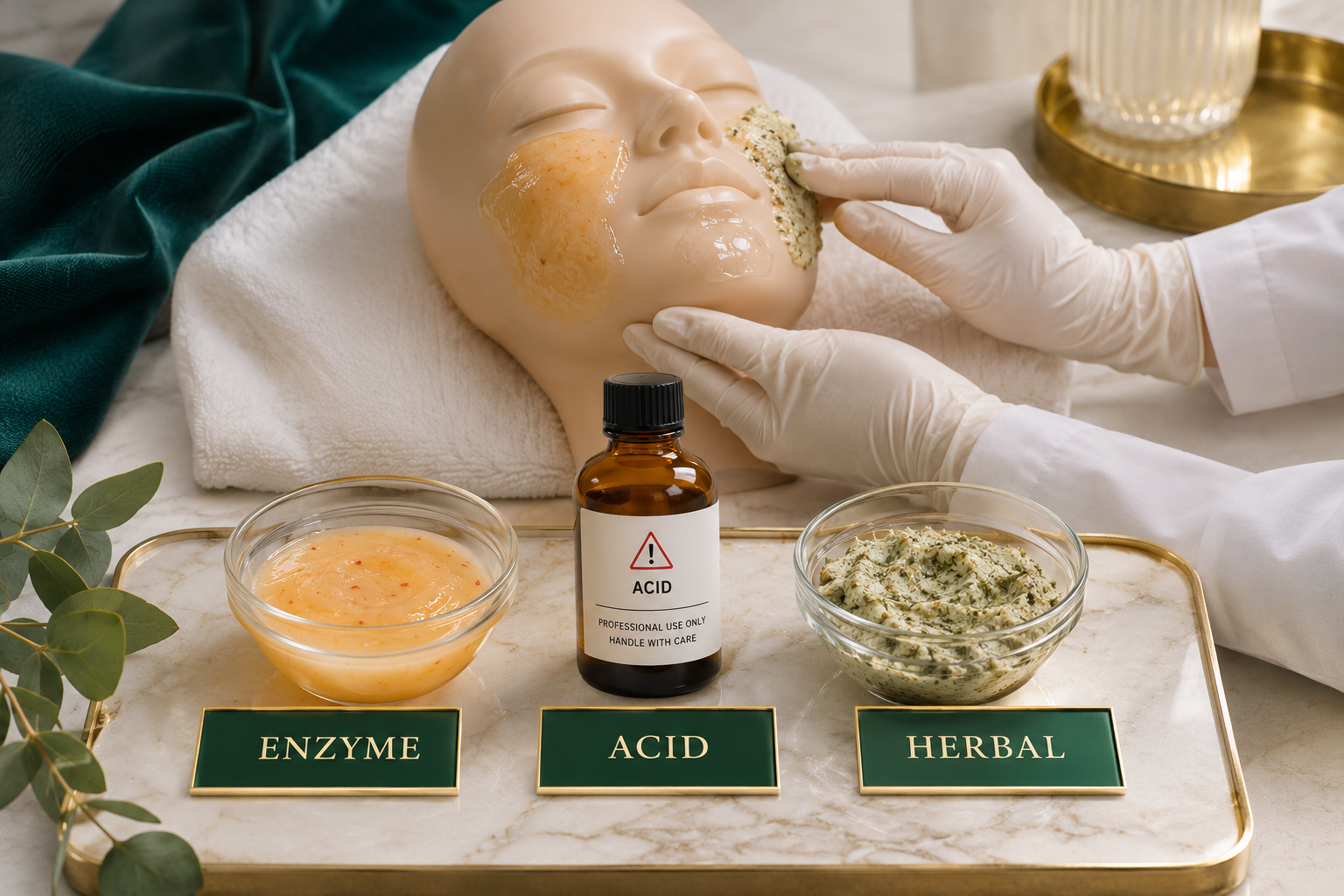
Professional Peels Compared: Enzyme, Acid and Herbal Options is a decision guide for people comparing exfoliation in a professional setting. It is educational and does not diagnose a condition or recommend a specific peel. If you have persistent acne, melasma, eczema, rosacea, infection, a changing lesion, severe sensitivity or a history of abnormal scarring, seek assessment from an appropriately qualified medical professional.
The short answer: peel families are not interchangeable
The phrase types of professional facial peels describes several very different professional strategies, not one treatment with three marketing names. Enzyme exfoliation relies mainly on proteolytic activity at the surface. Acid peels use carefully selected chemical agents, concentration, pH, vehicle, contact time and layering to create a controlled effect. Herbal or plant-based professional systems are protocol families whose action can combine physical stimulation, botanical ingredients and staged aftercare. The useful question is therefore not “Which peel is strongest?” but “Which controlled response fits the concern, skin history, pigment risk and recovery window?”
A peel can be gentle in one formulation and surprisingly active in another. Percentage alone does not tell you the depth or risk. A buffered acid at one pH may behave differently from the same named acid in another vehicle. An enzyme mask can still irritate compromised skin. A branded herbal protocol can range from a no-peel refresh to a visibly peeling programme. Names are clues; the complete protocol determines what the skin experiences.
This guide compares the families without promising that one label predicts results. It also separates cosmetic surface care from medical-depth peeling. Deep peels, high-strength acids and treatment of disease belong in appropriately licensed medical hands. A consultation should identify the concern, active inflammation, current products and medicines, previous reactions, cold-sore history, scar tendency, skin tone, sun exposure and the practical ability to follow aftercare.
A practical comparison at a glance
Enzyme options are usually considered when the immediate aim is controlled surface softening and a smoother feel with limited planned shedding. Acid options offer the widest range: superficial approaches may target congestion, dullness or uneven tone, while medium and deep medical peels create progressively greater injury and recovery. Herbal systems cannot be judged as a single depth; their effect depends on the exact brand protocol, massage, dose, session variant and home-care sequence.
The families may overlap in the concerns they are marketed for, but they do not reach the same structures or carry identical evidence. An enzyme treatment may improve the look of surface roughness without changing an established scar. A superficial acid series may support acne or pigment plans but cannot replace diagnosis and first-line therapy. A herbal programme may create a strong sensory or peeling response, yet visible flaking is not a reliable measure of long-term benefit.
A good provider explains the planned depth, not only the ingredient story. You should know whether the goal is a cosmetic facial, a superficial chemical peel, or a medical procedure; what is expected during the session; how long redness or shedding may last; which warning signs require contact; and how the plan changes if the skin is already irritated on the day.
What “professional peel” should mean
Professional should describe assessment, control and accountability. It should mean that the practitioner can identify common reasons to pause, understands the product and endpoint, uses a protocol appropriate to local scope of practice, provides written aftercare and has a route for managing an adverse reaction. It should not be shorthand for “high percentage,” dramatic pain or guaranteed peeling.
The American Academy of Dermatology emphasizes that outcomes depend heavily on the skill of the person performing the peel and describes different recovery expectations for light, medium and deep peels. The FDA warned on July 30, 2024 against unsupervised use of high-concentration chemical peel products because burns, infection, pigment changes and scarring can occur. These warnings matter even when a product is easy to buy online.
Professional care also means refusing a treatment when the skin barrier, medical history or timing is wrong. Postponing is not a failed consultation. It can be the most responsible decision when there is active dermatitis, an infection, a new medication, recent unprotected sun exposure, an unresolved reaction, an important event too close to the session, or uncertainty about what was applied at home.
Enzyme peels: how they differ from acid exfoliation
Enzyme exfoliation commonly uses proteolytic enzymes such as papain or bromelain to help break down proteins associated with surface corneocyte cohesion. In practice, the formulation must keep the enzyme stable and active, and the treatment still depends on time, temperature, hydration, pH and supporting ingredients. “Fruit enzyme” is therefore not a complete technical description.
A review of proteolytic enzymes found potential for cosmetic exfoliation but also noted that robust clinical evidence is limited and that formulation stability, activity and irritation or allergy potential require attention. That evidence gap is important: enzyme services can be useful cosmetic options, but they should not be promoted as proven substitutes for medical treatment or as scar-remodelling procedures. See the review of enzymes as exfoliating agents.
Enzyme protocols are often selected for people seeking low-downtime surface refinement, but “gentle” must remain conditional. Fragrance, botanical extracts, preservatives or the enzyme itself can be problematic for some people. A compromised barrier may sting with products that are normally comfortable. Patch testing cannot predict every facial reaction, yet a careful history and conservative first exposure can reduce avoidable surprises.
When an enzyme approach may fit—and when it may not
An enzyme-led facial may fit when the main concern is superficial roughness, makeup sitting unevenly, a dull surface caused partly by accumulated corneocytes, or a wish for a modest refresh without intentional medium-depth injury. It may also be used as one step within a hydrating professional facial, provided the rest of the protocol matches the skin.
It may not fit when the person expects correction of deep acne scars, pronounced laxity, a vascular disorder, a suspicious lesion or persistent pigmentation without diagnosis. It also may be inappropriate during a flare of eczema, contact dermatitis, rosacea-like burning, active infection or significant barrier disruption. People with fruit or latex-related allergies should disclose them because cross-reactivity and formulation ingredients can matter.
The outcome should be described in proportion to the depth: temporary smoothness, improved surface reflectivity and easier hydration are reasonable cosmetic goals. Claims of “detoxification,” permanent pore closure or complete pigment removal are not. If the concern is actually persistent redness, acne or dark marks, assessment should identify whether a dermatologist-led plan comes before a facial.
Acid peels: the name of the acid is only the beginning
Acid peels include alpha-hydroxy acids such as glycolic or lactic acid, beta-hydroxy acids such as salicylic acid, polyhydroxy-acid formulations, combination solutions and medical agents such as trichloroacetic acid. They differ in molecular properties, oil or water affinity, formulation pH, concentration, vehicle, application method, layers and neutralisation requirements. A menu that lists only percentages leaves out essential context.
Glycolic acid is often discussed for texture and uneven tone; lactic acid may be selected in formulations designed with hydration and surface refinement in mind; salicylic acid is lipophilic and frequently considered for oily or acne-prone patterns. Combination peels may deliberately use more than one mechanism. None of these descriptions is a personal recommendation, and the same ingredient can behave differently across products.
The provider should document the exact professional product, expiry and protocol, protect sensitive anatomical areas and observe endpoints rather than relying on a timer alone. More layers, more sting or visible frosting do not automatically mean a better outcome. Unintended depth can turn a cosmetic procedure into an injury.
Superficial, medium and deep: depth changes the decision
A superficial peel acts mainly within the epidermal level and is the category most often encountered in cosmetic plans. A medium-depth peel extends further and usually brings more inflammation, downtime and risk. Deep peels create a much more significant controlled wound and require medical and sometimes surgical-level planning. These are not simply stronger versions of a facial add-on.
The AAD describes typical healing of roughly one to seven days for a refreshing or light peel, seven to fourteen days for a medium peel and fourteen to twenty-one days for a deep peel, while emphasizing that individual instructions vary. Medium and deep peels may require antiviral medication, soaks, ointment, strict sun avoidance and follow-up. A person planning travel or an event should base timing on the actual depth, not the word “peel.”
For a skincare clinic comparison, the safest boundary is explicit: cosmetic and superficial options can be discussed within the clinic’s licensed scope, while medium or deep peels and treatment of medical disease require an appropriately qualified physician. If a provider cannot state the planned depth and escalation plan, the label “professional” is not enough.
Glycolic, lactic, salicylic and combination peels
Glycolic acid has a small molecular size and a long history in superficial peeling. It may be incorporated into plans for rough texture, photoageing signs or uneven tone. Because penetration depends strongly on free-acid availability and protocol, a lower percentage at a lower pH can be more active than a higher but well-buffered product. Home comparisons by percentage can therefore be misleading.
Lactic-acid formulations are often positioned for surface brightness and hydration-conscious exfoliation. That does not make every lactic peel automatically suitable for dry or sensitive skin. A dry-feeling face may actually have dermatitis, retinoid irritation or over-exfoliation; adding another acid can worsen the problem. Salicylic acid’s lipophilicity can be useful in oily and comedonal patterns, but salicylate sensitivity, large treatment areas and product-specific safety still matter.
Combination solutions can broaden action or control penetration, but they also make simplistic ingredient ranking less useful. Ask what each component contributes, whether the solution is self-neutralising, which endpoint is expected and why the combination is preferable to a single-agent approach for your concern.
Herbal peels: a protocol category, not a universal mechanism
“Herbal peel” can refer to very different proprietary systems. Some use finely processed botanical material with manual massage; others combine plant extracts with acids, enzymes or supportive products. The word herbal does not define depth, evidence, allergy risk or recovery. The exact manufacturer protocol and session variant must be named.
In a staged professional system such as Dr. med. Christine Schrammek’s GREEN PEEL family, the practitioner chooses among protocol intensities rather than treating every client with one standard session. The brand identity should never be copied onto an invented package or generic product. If the clinic uses a specific system, its packaging, preparation and aftercare should be verified against the manufacturer’s current professional materials.
Natural origin is not a safety guarantee. Botanical ingredients can irritate or sensitise, vigorous massage can increase inflammation, and planned shedding can create a demanding aftercare period. Conversely, not every herbal session is designed to cause visible peeling. The decision should be based on the named protocol, the skin and the target—not on an assumption that “herbal” means mild or that stronger flaking means better renewal.
How herbal, enzyme and acid options feel during treatment
Enzyme treatments may feel warm, tingly or comfortable depending on the formulation and barrier. Acid peels can create progressive tingling, heat or stinging, and some produce visible erythema or a characteristic endpoint. Herbal massage protocols may feel prickly or stimulating during and after application. Sensation is useful feedback, but pain should not be treated as proof that the product is working.
Communication should continue throughout the session. Sudden severe burning, rapidly increasing pain, marked swelling, grey or white areas outside an expected medical endpoint, breathing symptoms or eye exposure require immediate action. A practitioner should know the product-specific removal or neutralisation steps and have clean water and appropriate first-aid procedures available.
Clients should not be encouraged to “push through” alarming symptoms to earn a result. A conservative stop can prevent deeper injury. The treatment record should include what was applied, where, how long, how many layers or passes, observed endpoints, the immediate skin response and the aftercare given.
Skin tone and post-inflammatory hyperpigmentation risk
Any procedure that creates inflammation can trigger post-inflammatory hyperpigmentation, and the consequences may be more persistent in richly pigmented skin. This does not mean that people with skin of colour cannot have peels. It means provider experience, conservative selection, preparation, depth and aftercare are especially important.
A recent scoping review of chemical peels in skin of color found promising results for some superficial glycolic and salicylic approaches but emphasized small samples, short follow-up and underrepresentation of Fitzpatrick IV–VI skin. Other reviews caution that procedures can worsen PIH when inflammation is excessive. Evidence supports careful use, not a blanket promise.
Assessment should go beyond a single Fitzpatrick number. Previous dark marks after acne, burns, waxing or procedures; melasma history; current tanning; recent sun; tendency to form raised scars; and the ability to maintain photoprotection all influence the plan. A test area may be useful for some protocols, but it cannot eliminate risk or substitute for appropriate depth selection.
Acne, congestion and acne-associated dark marks
Superficial peels can be adjuncts in selected acne and post-acne plans, but they do not replace diagnosis or first-line acne treatment. Active inflammatory acne, comedonal congestion, acne scars and flat dark marks are different targets. Treating them as one “acne peel” problem can create unrealistic expectations or unnecessary irritation.
A review on chemical peels for acne stresses patient selection, medical history, examination and attention to skin type. A Delphi consensus on acne-associated hyperpigmentation states that early effective acne control remains central and that chemical peels may be adjunctive or second-line for marks. If breakouts are still active, the plan should prevent new inflammation rather than chasing old marks alone.
For more context, read when professional care may support acne-prone skin and why acne scars and acne marks require different options. A peel can support selected surface concerns, but depressed scars need a different discussion.
Pigmentation, melasma and uneven tone
Pigmentation is not a single diagnosis. Freckles, solar lentigines, melasma, post-inflammatory hyperpigmentation and a changing lesion require different evaluation. A peel that improves one superficial pattern may aggravate melasma or leave a darker mark if the skin is inflamed. Persistent or unusual pigmentation should be medically assessed before cosmetic treatment.
Photoprotection is part of treatment, not an optional afterthought. Reviews on facial hyperpigmentation in skin of colour recommend protection from ultraviolet and visible light, with procedures used cautiously as adjuncts. A clinic should discuss daily sunscreen, heat and visible-light exposure where relevant, recurrence and the fact that results are not permanent.
Our detailed guides explain pigmentation assessment before treatment in Istanbul, why pigmentation can return and how light-based options and chemical peels differ. A professional comparison should preserve those intent boundaries rather than promise one universal brightening peel.
Sensitive, reactive or barrier-impaired skin
Sensitive is often used as a skin type, but burning, persistent redness and sudden intolerance may signal active barrier disruption or a dermatologic condition. Adding an enzyme, acid or herbal stimulant to an already inflamed face can amplify discomfort and prolong recovery. The correct peel on the wrong day is still the wrong treatment.
A consultation should review recent retinoids, benzoyl peroxide, exfoliating acids, scrubs, depilatory creams, waxing, laser or light procedures and new fragranced products. It should also ask about eczema, rosacea, seborrhoeic dermatitis, allergy and previous swelling. The plan may be to pause actives, restore comfort and reassess rather than selecting the weakest item on a peel menu.
Read how professional care can be planned for sensitive and reactive skin and when burning or redness means a facial should wait. These safety boundaries apply to every peel family.
Medicines, procedures and history that can change eligibility
Tell the provider about prescription and over-the-counter products, recent antibiotics, isotretinoin history, topical retinoids, steroids, hydroquinone, acne treatments, anticoagulants and anything that has recently changed the skin. Do not stop prescribed medication without the prescriber’s advice; the purpose is to coordinate timing and risk.
The AAD preparation guidance specifically recommends discussing isotretinoin, other medicines, cold sores, easy scarring, supplements and previous cosmetic treatments. Herpes simplex history matters because resurfacing can trigger recurrence in susceptible people, and antiviral planning may be needed for some medical peels.
Recent waxing, threading, shaving irritation, dermaplaning, laser, IPL, microneedling or another peel can alter tolerance. So can a sunburn, tanning, an open lesion or picking. A complete timeline helps prevent stacking procedures before the skin has recovered.
Pregnancy, breastfeeding and medically complex skin
Pregnancy and breastfeeding require product-specific review rather than a generic “natural is safe” assumption. Some acids have limited topical absorption, but professional concentrations, treatment area, combination ingredients and medical guidance matter. Elective procedures can often wait when evidence or necessity is uncertain.
People with immune suppression, poorly controlled diabetes, connective-tissue disease, delayed wound healing, keloid tendency or active infection need individual medical assessment. The risk discussion changes with depth. A cosmetic clinic should have a clear referral boundary instead of improvising with a milder-sounding herbal or enzyme alternative.
A responsible provider documents why the chosen option is suitable and what would trigger cancellation. When information is incomplete, postponing until the treating clinician can advise is safer than relying on internet lists of “pregnancy-safe peels.”
Preparation: what happens before a well-planned peel
Preparation begins with diagnosis and goal setting. Photographs under consistent lighting can document baseline texture and colour. The practitioner should explain realistic endpoints, recovery and the number of sessions likely to be needed. For some chemical peels, a pre-peel skincare programme may be used for several weeks to improve uniformity and reduce complications; it must be tailored rather than copied from another client.
Clients should receive written instructions about which products to pause and when, sun avoidance, hair removal, shaving and what to bring or disclose on treatment day. The skin should be reassessed immediately before application. New irritation, a cold sore, a procedure elsewhere or a medication change can alter the plan even after a successful consultation.
Consent should name the product family and expected depth, common temporary effects, material risks, alternatives and the option of no treatment. Cost and a package should never pressure someone into proceeding when the day-of-treatment skin is unsuitable.
Aftercare: the common ground across peel families
Aftercare varies with depth, but several principles recur: cleanse gently, use the recommended bland moisturising or barrier-support products, avoid picking and friction, protect from sun and heat, and pause potentially irritating actives until the provider confirms reintroduction. Do not accelerate shedding with scrubs, brushes or extra acids.
Makeup timing depends on the procedure and whether the surface is intact. The AAD notes that makeup may be possible immediately or the next day after some light peels, while medium or deep peels require longer. Exercise, sauna, swimming and travel advice should also be matched to the actual protocol. Generic “24-hour aftercare” is not adequate for every peel.
Contact the provider for increasing pain, marked swelling, blistering beyond what was explained, pus, spreading redness, fever, eye symptoms, breathing difficulty, a cold-sore outbreak, darkening that is rapidly worsening or any concern that the skin is not following the expected course. Emergency symptoms require urgent medical care, not a social-media message.
Downtime, shedding and the myth of “no peel, no result”
Visible flaking is one possible consequence, not the objective itself. Some superficial treatments improve smoothness without obvious peeling. Conversely, dramatic shedding can reflect greater injury without guaranteeing a better long-term result. Comparing social-media “peel videos” is a poor way to choose treatment depth.
Downtime includes more than flakes. Redness, tightness, swelling, sensitivity, temporary darkening and restrictions on makeup, exercise or sun exposure all affect daily life. Ask for a range rather than a guaranteed number of days, and plan conservatively before weddings, flights, presentations or intensive outdoor activity.
A series of lighter sessions may sometimes fit better than one aggressive treatment, but more appointments are not automatically superior. The decision should weigh evidence, cost, adherence, recurrence and the possibility that a different modality or medical diagnosis deserves priority.
How to compare clinics and protocols
Ask who assesses the skin, who performs the procedure and what licences or training apply. Request the exact peel family, product and intended depth. Ask how the clinic adapts the protocol for your skin tone and prior reactions, what preparation is required, what photographs are taken and how adverse events are handled.
A credible consultation describes limitations. It will not promise permanent pore closure, complete melasma removal, scar erasure or a guaranteed “glass skin” outcome. It should distinguish cosmetic improvement from treatment of disease and provide a referral route when the concern falls outside the clinic’s scope.
Also evaluate aftercare access. You should know how to contact the clinic, what response time to expect, whether follow-up is included and which symptoms require urgent medical attention. Product sophistication cannot compensate for weak screening or unavailable follow-up.
A decision framework for choosing among peel families
Start with the primary concern: surface roughness, congestion, acne-associated marks, melasma-like pigmentation, photoageing signs or simply a short-term glow. Next identify the dominant risk: barrier instability, pigment alteration, scarring, allergy, infection, medication interaction or insufficient recovery time. Then define the acceptable downtime and the evidence needed for the proposed outcome.
An enzyme approach may be considered when the target is modest surface refinement and a low-intensity cosmetic session is appropriate. A superficial acid protocol may be selected when its mechanism, evidence and controlled depth fit congestion or tone concerns. A named herbal protocol may be chosen for its staged professional system and sensory or renewal profile. The label alone never completes the decision.
Finally, agree on what success means and when it will be reviewed. Standardised photographs, symptom changes and a realistic timeframe are more useful than judging the skin immediately under bright treatment-room lighting. If the skin worsens, the plan should stop and reassess rather than automatically escalating.
Myths vs facts about professional peels
Myth: Natural or herbal means risk-free. Fact: Botanical ingredients can irritate or sensitise, and a herbal protocol can be intensive. Safety depends on the complete formula, technique, assessment and aftercare.
Myth: The highest percentage is the best peel. Fact: pH, vehicle, free acid, contact time, layers, skin preparation and anatomy influence penetration. Percentage by itself cannot rank protocols.
Myth: More burning means better results. Fact: Severe pain can signal injury. Endpoints are product-specific, and a competent practitioner may stop early.
Myth: Visible peeling is required. Fact: some superficial benefits occur without obvious shedding; dramatic flakes do not prove superior remodelling.
Myth: A peel permanently closes pores. Fact: pores are anatomical structures. Congestion and surface texture can improve, but permanent closure is not realistic.
Myth: One peel removes every type of pigmentation. Fact: pigment disorders have different causes and depths. Some can worsen after inflammation.
Myth: At-home high-strength acid is equivalent to professional treatment. Fact: the FDA warns that high-concentration products used without professional supervision can cause serious burns and scarring.
Myth: Darker skin cannot have peels. Fact: selected superficial peels may be used, but expertise and pigment-risk management are essential.
Myth: Enzyme peels are automatically safe for sensitive skin. Fact: enzymes and supporting ingredients can irritate; an impaired barrier may need recovery, not exfoliation.
Myth: A peel can replace acne treatment. Fact: peels are adjuncts for selected patients; active acne management and diagnosis remain central.

Detailed comparison: twelve questions to ask about any peel
Primary mechanism
Does the protocol mainly use proteolytic enzymes, a defined acid solution, physical botanical stimulation, or a combination? Ask the practitioner to separate the ingredient from the way it is delivered. A product name containing fruit or herbs does not establish whether the formula also contains an acid. For a useful comparison, obtain the professional product name, its main exfoliating agent and the intended purpose of each step. This helps distinguish a surface cosmetic service from a procedure requiring medical assessment.
Planned depth
Is this a cosmetic surface treatment, a superficial chemical peel, a medium peel or a deep medical procedure? Request the intended depth in ordinary language and ask how that affects the setting, qualifications and follow-up. Two treatments described as a peel may require very different recovery arrangements. The DermNet overview of chemical peels distinguishes superficial, medium and deep procedures. Its categories are educational, not a way to select your own concentration or application time.
Evidence
Is evidence available for this agent and concern, or are claims based mainly on brand tradition and visible shedding? Ask what the evidence actually measured: smoother appearance, acne lesions, pigment change or another outcome. Also ask whether it studied the finished product, a different formula or an ingredient in isolation. The review of exfoliating enzymes found limited clinical research, so a plausible mechanism should not be presented as proof that every enzyme facial has the same benefit.
Formulation
What are the concentration, pH, vehicle, buffering, combination ingredients and neutralisation requirements where relevant? Have the provider identify the formula rather than offering a percentage as the complete explanation. The relevant question is why this particular professional preparation fits the planned depth and your history. You do not need a do-it-yourself recipe. A consultation should make clear who selects the formulation, who applies it and who takes responsibility if the skin responds unexpectedly.
Skin-tone strategy
How does the provider reduce post-inflammatory pigment risk and what experience do they have with similar skin tones? Discuss previous darkening or lightening after acne, burns, waxing or procedures, even if it happened years ago. A photograph may be useful when the reaction has resolved. Skin colour alone is an incomplete history. The review of post-inflammatory hyperpigmentation explains why an aesthetic procedure intended to improve pigment can also aggravate it; the decision therefore needs an individual risk discussion.
Barrier status
What signs on treatment day would cause postponement, and how will recent actives or procedures be handled? Describe present symptoms before discussing treatment strength: stinging with water, tightness after washing, a new rash or sudden intolerance of familiar products. Give dates and product names rather than labelling yourself simply sensitive. A useful assessment explains whether the current symptoms need recovery or medical review, and what would have to change before a peel could reasonably be considered.
Sensation and endpoint
What is expected to be felt and seen, and what sensation or appearance triggers immediate removal? Agree on how you will communicate discomfort while the practitioner observes the skin. Ask whether you can speak up or stop without being encouraged to tolerate more for a better result. The explanation should distinguish an expected sensation from an unexpected change. This conversation does not replace the practitioner’s product-specific training or the need to assess a reaction promptly.
Recovery
What range of redness, tightness, shedding, swelling and activity restriction is realistic? Separate the expected visible changes from the activities you may need to adjust. Someone working indoors may face different practical difficulties from someone spending the day outside. Ask for a realistic range, the planned review point and what happens if recovery lasts longer than expected. Avoid treating an advertisement’s shortest downtime estimate as a personal guarantee.
Aftercare
Which cleanser, moisturiser and sunscreen are recommended, and when can retinoids, acids and makeup return? Ask for written instructions that name the products and explain how they fit the selected procedure. A generic sheet should not leave you guessing about a prescribed medicine or an unfamiliar reaction. Clarify whom to contact before adding another active ingredient. If two professionals give conflicting instructions, ask them to resolve the conflict instead of combining both routines yourself.
Complication route
Who reviews unexpected pain, blistering, infection, pigment change or a herpes outbreak, and how quickly? Identify the contact route before the appointment, including what happens outside opening hours or after you return home. A messaging number is useful only if someone appropriately qualified can assess the concern. Ask which symptoms require urgent medical care rather than a routine reply. Keep the treatment name and date available so another clinician can understand what was performed.
Outcome measure
Is success defined by photographs, symptom change, fewer lesions, smoother texture or a validated scale rather than flaking? Choose an outcome that matches the original concern and agree when it will be reviewed. Photographs are more informative when lighting, angle and makeup are consistent, while a brief symptom record can capture discomfort that a photograph misses. Ask what would count as insufficient benefit, an adverse effect or a reason to stop a course rather than automatically purchasing more sessions.
Alternatives
Would barrier repair, acne treatment, pigment diagnosis, microneedling, light-based treatment or no procedure better fit the goal? Ask the clinician or practitioner to explain why the proposed peel fits better than simpler care, another treatment or waiting. A comparison should include the burden of recovery and follow-up, not only the advertised benefit. The best next step may be a diagnostic consultation rather than a procedure. An informed decision also includes the option to decline without committing to a package.
Frequently asked questions
What are the main types of professional facial peels?
The broad consumer-facing families are enzyme exfoliation, acid-based chemical peels and named herbal or botanical protocols. Acid peels are further classified by agent and depth. The family name does not predict the exact intensity, so ask for the complete product, concentration or protocol, planned depth and aftercare.
Is an enzyme peel the same as a chemical peel?
Not exactly. Enzyme exfoliation generally uses proteolytic activity to loosen surface protein structures, whereas acid peels use chemical agents whose penetration depends on formulation and protocol. Both can exfoliate, both can irritate, and neither label alone tells you whether a specific treatment suits your skin.
Are herbal peels chemical-free?
“Chemical-free” is not scientifically meaningful because every ingredient is chemical matter. A herbal protocol may rely mainly on botanicals and physical stimulation, or it may include acids, enzymes or other actives. Request the ingredient list and exact manufacturer protocol if avoiding a substance is important.
Which peel is best for dull skin?
Dullness can reflect dehydration, rough corneocyte buildup, pigment, irritation, sleep, smoking or lighting. A surface enzyme or superficial acid option may help selected roughness, while dehydrated or reactive skin may need barrier support first. Assessment should identify the reason rather than choosing by a “glow” claim.
Which peel is best for blackheads?
Selected salicylic or combination protocols may be considered for oily, comedonal patterns, but sebaceous filaments are normal structures and cannot be permanently removed. Professional cleansing, home care and acne treatment may be more relevant depending on what is present.
Can a peel remove acne scars?
Superficial peels may improve colour irregularity or very shallow texture, but established depressed or raised scars generally require a scar-specific medical assessment and other modalities. Do not confuse flat post-acne marks with true textural scars.
Can peels help post-acne dark marks?
They may be adjuncts in selected cases, especially after active acne is controlled, but inflammation can also worsen pigmentation. Skin tone, current acne, sun exposure and home care influence the decision. Early effective acne treatment and photoprotection remain important.
Can a peel make pigmentation worse?
Yes. Irritation or excessive depth can trigger post-inflammatory hyperpigmentation, and melasma may relapse or worsen. This risk is particularly important in richly pigmented skin or anyone with a history of dark marks after inflammation.
How often can I have a professional peel?
Frequency depends on depth, agent, response and treatment plan. Some light peels are repeated in a series several weeks apart; deeper procedures require far more recovery and may be performed rarely. Do not follow a generic monthly schedule without reassessment.
How long does peeling last?
A light peel may cause little or several days of scaling. Medium peels can involve roughly one to two weeks of recovery, while deep peels can take longer and require medical follow-up. A herbal protocol’s shedding varies by its specific intensity.
Can I wear makeup after a peel?
It depends on depth and whether the surface is intact. Some light peels allow makeup immediately or the next day; stronger procedures require waiting. Applying makeup too early can irritate the skin or increase infection risk. Follow the written product-specific instruction.
Can I exercise after a peel?
Heat, sweat and friction may increase stinging or redness. Many protocols advise a temporary pause, but the duration depends on intensity and response. Ask for exact guidance for exercise, sauna, steam and swimming.
Can I use retinol before or after a peel?
Retinoids can change sensitivity and may need to be paused, but timing is product- and prescription-specific. Tell the provider exactly what you use. Do not stop a prescription medicine without discussing it with the prescriber.
Is a patch test enough to guarantee safety?
No. A test area can reveal some immediate reactions but cannot reproduce the full facial procedure, cumulative layers or all delayed pigment responses. It is one risk-management tool, not a guarantee.
Do peels permanently close pores?
No. Pores cannot be permanently closed. Reducing congestion and improving surrounding surface texture can make them look less noticeable, but anatomy, sebum and ageing continue.
What is frosting during a peel?
Frosting can describe a visible endpoint caused by protein coagulation with certain acids or crystallisation with salicylic acid. Its meaning is agent-specific. Clients should not seek frosting as a badge of effectiveness; unintended frosting can indicate excessive depth.
Should a peel hurt?
Mild tingling, warmth or controlled stinging can occur, but severe or rapidly escalating pain is not a target. Report sensation honestly. The practitioner should assess the skin and follow the product’s stop or neutralisation protocol.
Are DIY high-strength peels safe?
The FDA specifically warns against unsupervised high-concentration peel products because serious burns, infection, pigment change and scarring can occur. Online availability does not establish safety.
Can I have a peel before a wedding?
Choose timing conservatively. First-time or stronger procedures should not be placed immediately before an important event because redness, flaking, breakouts or pigment change are possible. A low-intensity familiar facial may be planned earlier after assessment.
Can I have a peel while pregnant?
Pregnancy requires product-specific professional and medical review. “Natural” does not automatically mean suitable, and elective treatment can often wait. Do not rely on generic online ingredient lists.
Can people with dark skin have chemical peels?
Yes, selected superficial peels can be used, but pigment complications are a greater concern and evidence for deeper procedures is limited. Choose a practitioner experienced with similar skin tones and conservative protocols.
What if my skin is already burning or red?
Pause exfoliation and seek assessment. Burning or persistent redness can signal barrier injury, dermatitis, rosacea or another condition. Adding even a mild peel may aggravate the problem.
What should I tell the provider at consultation?
List medicines, supplements, isotretinoin history, cold sores, allergies, scarring tendency, pregnancy status, recent sun, waxing, lasers, microneedling, peels and every active skincare product. Mention previous dark marks or swelling after treatments.
Why did I not visibly peel?
Some superficial protocols are designed to act without obvious shedding. Lack of flakes does not automatically mean failure, just as heavy peeling does not guarantee a better result. Review the agreed outcome rather than the amount of skin shed.
Can I pick peeling skin?
No. Picking can create wounds, infection, prolonged redness and pigment change. Use the recommended moisturiser and allow shedding to release naturally. Contact the provider if cracking, severe itch or unexpected crusting develops.
Can enzyme and acid peels be combined?
Some professional formulas or staged treatments combine mechanisms, but this increases the importance of formulation knowledge and conservative dosing. Do not layer home exfoliants around a professional session unless specifically instructed.
Are herbal peels suitable for rosacea?
Not automatically. Friction, heat and stimulating botanicals can aggravate redness in some people, and rosacea requires diagnosis and subtype-aware management. A no-peel label or natural origin does not settle suitability.
When should I contact a doctor after a peel?
Seek prompt medical advice for severe or increasing pain, extensive blistering, eye involvement, spreading redness, pus, fever, breathing symptoms, rapidly worsening colour change or signs of infection. Follow emergency instructions for acute symptoms.
How do I compare peel prices?
Compare assessment, exact product and depth, practitioner qualifications, aftercare, follow-up and adverse-event support—not only the session fee. A cheaper strong peel without screening or follow-up can carry a much higher real cost.
What is the best first professional peel?
There is no universal first peel. The safest introduction is the lowest appropriate intensity that matches the concern, history, skin tone and recovery window, delivered by a qualified professional with clear aftercare and a review plan.
How to prepare for a consultation in Istanbul
Bring a written list or photographs of every product used during the previous two weeks, including prescription creams, retinoids, benzoyl peroxide, exfoliating toners and spot treatments. Note any recent waxing, threading, laser, IPL, microneedling, dermaplaning or another peel. Share the date of recent sunburn, tanning or travel with intense exposure. These details are more useful than arriving with a preferred peel selected from social media.
Explain the outcome that matters most and the recovery you can realistically manage. If you are visiting Istanbul, include flight dates, outdoor plans, swimming, hammam or sauna plans, and the date of any event. A responsible provider may recommend a lower-intensity session, a different service, medical assessment or no treatment during that visit.
At Skincare Center, a professional skin analysis can support observation and consultation, but it is not a medical diagnosis. The final plan must respect the limits of cosmetic practice and the day-of-treatment condition of the skin. For a broader introduction, see what a professional skin analysis can and cannot tell you.
Final perspective
The most useful comparison among enzyme, acid and herbal options is not a contest for the strongest peel. It is a structured decision about mechanism, depth, evidence, pigment risk, barrier condition, practitioner scope, recovery and follow-up. Enzyme treatments may suit modest surface refinement; superficial acids may offer more targeted evidence for selected concerns; named herbal systems may provide distinctive staged protocols. Each can be appropriate, inappropriate or poorly timed depending on the person.
Choose the consultation before the peel. Ask for the exact protocol, realistic limits and a written aftercare route. Never use severe pain, dramatic shedding or a high percentage as your quality measure. If the skin is inflamed, the diagnosis is unclear or the recovery cannot be supported, postponement is a successful safety decision.
Sources and further reading
- American Academy of Dermatology: Chemical peels FAQs
- American Academy of Dermatology: Chemical peel preparation
- FDA consumer warning on unsupervised chemical peel products
- Chemical peels in skin of color: scoping review
- Chemical peels in acne: patient selection and perspectives
- Proteolytic enzymes as exfoliating agents: review
- Management of post-inflammatory hyperpigmentation in skin of color
- Acne-associated hyperpigmentation: Delphi consensus and literature review
- Facial hyperpigmentation in skin of colour: review
- Chemical peeling in ethnic skin: update
Glossary for informed peel decisions
Acid mantle
The mildly acidic environment at the skin surface. It is influenced by sebum, sweat, cleansing and products; a peel protocol should not be reduced to the idea of “balancing pH.” When comparing products, ask what the complete formula is intended to do. An acidic label alone does not establish compatibility with irritated skin or justify adding another exfoliating step.
Barrier function
The stratum corneum’s role in limiting water loss and outside irritants. Burning, tightness and sudden product intolerance can indicate impairment. A comfortable appearance does not fully describe barrier performance. Report recent changes in how cleansing and familiar products feel, rather than relying only on whether a photograph shows redness.
Buffering
Ingredients or formulation choices that resist pH change. Two products with the same named acid and percentage can behave differently when buffering and free-acid availability differ. This is one reason to compare complete professional protocols rather than percentages on separate bottles. A customer should not attempt to adjust a peel’s pH or buffering at home.
Comedone
A plugged follicle. Open comedones are called blackheads; closed comedones are often called whiteheads. They are not the same as sebaceous filaments. Clarifying the type of lesion helps avoid treating every visible pore as acne. Persistent inflamed bumps or scarring deserve an assessment beyond a routine cosmetic pore-cleaning appointment.
Contact time
How long a product remains active on the skin before removal or neutralisation. Longer is not always better. Timing belongs to the particular product and trained operator. A time printed in an online example should not be transferred to a different formula, area or individual.
Desquamation
The normal shedding of corneocytes from the skin surface. Exfoliation protocols modify this process but should not be judged only by visible flakes. Visible shedding is only one observation. A review should also consider the original concern, comfort and unwanted changes, so an absence of flakes does not automatically trigger stronger treatment.
Endpoint
A planned observation that guides the practitioner, such as erythema or a product-specific frosting pattern. An endpoint must be interpreted in context. Clients can describe sensation, but they should not be expected to judge a chemical endpoint themselves. Ask beforehand how the practitioner monitors the response and decides when to stop.
Erythema
Redness caused by increased blood flow and inflammation. Mild temporary erythema may be expected; severe, spreading or persistent redness needs review. Compare the response with the written expectations for the actual procedure. Take a clear photograph if advised, and seek clinical advice for worsening symptoms rather than diagnosing them by colour alone.
Fitzpatrick phototype
A classification based mainly on burning and tanning response. It can inform risk discussion but does not capture every aspect of ethnicity, pigment behaviour or individual history. Tell the practitioner about actual burning, tanning and pigment reactions rather than choosing a category from an online picture. The classification is a discussion aid, not a stand-alone clearance.
Free acid
The portion of an acid formulation available in its active un-ionised form. It helps explain why percentage alone cannot predict peel strength. The practical lesson is to ask why a specific formulation was selected. A total percentage on a menu does not provide all the information needed to predict its behaviour.
Humectant
An ingredient that attracts water. A peel product may include humectants, but that does not make exfoliation automatically suitable for dehydrated or irritated skin. Hydration ingredients and exfoliating ingredients have different jobs. The presence of a humectant should not be used to promise that a peel cannot sting, irritate or require recovery.
Melasma
A chronic pigment disorder influenced by light, hormones, heat and other factors. Procedures can help selected patients but can also trigger relapse. A dermatologist can distinguish melasma from other causes of uneven colour. A peel menu cannot establish that diagnosis, and the long-term plan may extend well beyond any single appointment.
Neutralisation
Stopping or reducing acid activity using a specified neutraliser or water, depending on the product. Some peels are self-neutralising; protocols are not interchangeable. Ask what the professional protocol requires and how the practitioner manages an unexpected reaction. Do not improvise a household neutralising mixture or copy the procedure from a different product.
Occlusion
Covering the skin in a way that reduces evaporation and may increase hydration or penetration. It can change how a topical product behaves. Tell the provider about masks, dressings or other coverings you expect to wear afterwards. Practical questions about friction and occlusion should be answered for the chosen treatment, not by guesswork.
Papain
A proteolytic enzyme associated with papaya and used in some cosmetic exfoliation products. Formulation, allergy potential and evidence should be considered. The relevant reference is the finished cosmetic formula, not the fruit used as a marketing image. Applying raw papaya is not an equivalent substitute for a tested professional preparation.
Bromelain
A group of proteolytic enzymes associated with pineapple. Cosmetic use does not make every pineapple-derived product equivalent or suitable. A pineapple photograph does not reveal enzyme activity, stability or the rest of a formula. Product selection should consider the actual preparation and the user’s history of reactions.
Post-inflammatory hyperpigmentation
Darkening that follows inflammation or injury. It can occur after acne, burns, picking or procedures and may be more persistent in richly pigmented skin. Record what caused previous marks and how they changed over time. Preventing another inflammatory episode may matter more than trying to remove existing colour as quickly as possible.
Retinoid
A vitamin-A-related ingredient or medicine. Retinoids can alter irritation risk and must be disclosed before procedures. Give the prescriber or treating professional the exact name, strength and frequency of use. Any proposed interruption should be discussed with the appropriate clinician rather than decided from a generic blog.
Sebaceous filament
A normal structure that helps move sebum through the pore. It may look like a small grey or tan dot and naturally refills. A realistic consultation distinguishes normal pore structures from treatable congestion. Repeated attempts to eliminate every visible filament can create irritation without delivering the permanent change the person expects.
Stratum corneum
The outermost epidermal layer, composed of corneocytes and intercellular lipids. Many cosmetic exfoliation approaches act primarily here. A surface-oriented explanation should not be used to promise deep scar correction. Ask which aspect of texture the proposed treatment is intended to address and which concerns will remain.
Trichloroacetic acid
TCA is used in professional and medical peeling at different strengths and techniques. High-concentration unsupervised use can cause severe injury. This is an ingredient name, not an assurance of a particular depth or safety level. The FDA warning about unsupervised peels includes high-concentration TCA products.
Vehicle
The base that carries active ingredients. Gels, solutions, creams and hydroalcoholic vehicles can change application and penetration. When comparing two formulations, note whether they are different professional products rather than interchangeable versions. A similar ingredient list does not establish that the same application method is appropriate.
Visible light
Part of the electromagnetic spectrum that can contribute to pigmentation in susceptible skin. Some pigment plans address both UV and visible-light protection. For melasma, ask how sun protection fits the wider treatment plan. The AAD’s melasma guidance discusses sunscreen, shade and other measures alongside individual treatment choices.
Wound healing
The coordinated inflammatory, proliferative and remodelling response after injury. Deeper peels rely on controlled wounding and therefore require greater medical oversight. The practical commitment includes the recovery period and access to review. Agree on the follow-up arrangements before choosing a procedure whose expected healing would be difficult to support.
Twelve real-world planning scenarios
Dull but comfortable skin before a routine event
The person reports no burning, active rash, recent procedures or pigment complication and mainly wants smoother makeup application. A low-intensity enzyme or superficial acid option might be discussed, but the event date still matters. The practitioner should choose a familiar conservative protocol, explain that a breakout or redness is possible and avoid promising an instant camera-ready result. If this is the person’s first treatment, an earlier test session is more sensible than experimenting immediately before the event.
A useful comparison starts with a baseline description: roughness under makeup, temporary dryness or a concern that is only visible in particular lighting. Ask which of those observations the proposed session is meant to change. If there is no time to review an unexpected response before the event, discuss postponement instead of using the event deadline to justify extra intensity.
Dull skin that also stings after cleansing
Stinging changes the priority. What looks dull may be barrier disruption from retinoids, acids, over-cleansing or dermatitis. Selecting the mildest peel from the menu is not a sufficient response because even enzyme and botanical products can irritate. The initial plan should identify and stop avoidable triggers, support comfort and reassess. Persistent burning, scaling or redness may need medical evaluation before any exfoliation is reconsidered.
Write down when the stinging began and which products or procedures preceded it. That timeline helps a professional decide whether a cosmetic appointment is appropriate or whether a skin condition needs assessment. Avoid testing several new soothing and exfoliating products at once while waiting; a complicated routine can make it harder to identify what is causing discomfort.
Oily skin with blackheads and active inflammatory acne
A salicylic or combination superficial protocol may be relevant to comedonal congestion, but inflammatory acne requires a broader plan. The practitioner should count and characterise lesions, review acne medicines and avoid aggressive extraction or peeling over compromised areas. If nodules, scarring or widespread inflammation are present, dermatology should lead. The peel, if used, is an adjunct rather than the main treatment, and success should include fewer new lesions rather than only a temporarily degreased feel.
Separate three questions at the consultation: what is being done for active acne, what the peel may add, and how unwanted irritation will be recognised. The clinical review of peels in acne care considers them within individual treatment selection. It does not make an acid facial a replacement for a clinician’s acne management plan.
Flat brown marks after acne in richly pigmented skin
The main risk is creating more inflammation while trying to remove old marks. Active acne control, daily photoprotection and gentle topical options are usually central. A carefully selected superficial peel may be discussed by an experienced professional, but deeper is not automatically faster. Baseline photographs, conservative exposure and a review interval are important because darkening can appear after the immediate redness has settled.
Ask whether the visible colour is truly post-inflammatory pigmentation or whether another diagnosis needs consideration. Bring previous photographs if the marks fluctuate. Keep the desired outcome modest and specific, such as reviewing one area over time, rather than requesting complete removal in a single visit. The comparison between peel families should include the risk of producing new marks.
Melasma that worsens in summer
Melasma is chronic and can be influenced by ultraviolet light, visible light, hormones and heat. A peel may be one adjunct, but it does not remove the tendency to recur. The consultation should examine current control, photoprotection, recent sun and the risk of rebound inflammation. An aggressive one-off peel before a sunny holiday is a poor match. Medical diagnosis and a long-term plan usually matter more than choosing between enzyme and herbal labels.
Ask how the proposed procedure fits ongoing management and what happens if pigmentation returns. The AAD explains that melasma often needs an individual combination of sun protection and treatment. That makes a package promising permanent clearance a poor basis for choosing between peel families. Clarify maintenance expectations and cost before committing to a course.
Rough texture with depressed acne scars
Surface exfoliation can improve reflectivity and very superficial irregularity, yet it cannot lift established rolling, boxcar or ice-pick scars in the way social-media advertising sometimes implies. The person should be assessed for scar type and active acne. Microneedling, fractional laser, subcision or other medical approaches may be discussed by qualified clinicians. A peel can have a supporting role, but the consent should state exactly which part of the concern it is expected to change.
Identify whether the priority is colour, shallow roughness or a structural depression, since photographs can make these look deceptively similar. The AAD’s acne-scar guidance describes treatment selection according to scar type and individual circumstances. A peel consultation should explain its limited role in that broader assessment rather than promising that all scar patterns respond alike.
First professional treatment after years of home acids
Frequent home exfoliation does not prove high tolerance. It may instead leave the barrier chronically irritated, and the exact strengths or combinations may be unclear. The provider should ask the person to bring product photographs and establish a washout period where appropriate. A conservative first session and delayed evaluation are safer than escalating because the client says acids no longer tingle. Absence of sensation is not a reliable measure of barrier health or treatment need.
Bring the actual product labels or clear photographs, including products used only occasionally. A list saying acid toner does not reveal the full routine. Ask who will coordinate any change involving a prescription and how tolerance will be reviewed. Do not interpret years of home use as permission to shorten preparation or skip the professional history-taking process.
A client requesting the strongest peel available
The request should trigger expectation work, not automatic escalation. Ask what outcome the client believes strength will deliver and how much downtime is actually acceptable. Explain that concentration, pH, layers and depth interact, that complications rise with injury and that a stronger peel may be outside the clinic’s scope. If the desired correction requires a medical-depth procedure, referral is the correct service rather than substituting repeated cosmetic peels.
Ask the client-facing question behind the request: is the aim faster improvement, fewer appointments or correction of a specific feature? Each has different trade-offs. A practitioner should be able to discuss those trade-offs without turning the visit into a strength contest. It is reasonable to leave without treatment when the promised outcome does not match the available evidence or expertise.
A traveller with flights and outdoor sightseeing
Air travel, dry cabin conditions, luggage limitations and prolonged outdoor exposure can complicate recovery. The plan should account for sunscreen reapplication, shade, heat, swimming and access to follow-up after leaving Istanbul. A no-downtime claim should not replace a realistic range. When post-treatment support would be difficult, a gentle facial without active peeling—or postponement—may be more appropriate than a protocol that depends on several days of controlled shedding.
List the practical constraints before choosing a peel: departure date, outdoor commitments, access to the recommended products and the ability to attend review. Ask who would assess a problem after travel and how the treatment details would be shared with that clinician. An itinerary is not a reason to compress recovery or assume that every superficial procedure has no consequences.
A client with a history of cold sores
Facial resurfacing can trigger herpes simplex recurrence in susceptible people. The history should be documented even if outbreaks are infrequent. Depending on treatment depth and area, a medical professional may recommend antiviral prophylaxis. Cosmetic staff should not prescribe outside their scope. If a lesion is active or symptoms are starting, the procedure should be postponed and appropriate medical guidance obtained.
Mention both the location of past outbreaks and any previous treatment-related episode, even if there is no visible lesion today. The AAD preparation checklist specifically includes cold-sore history. Any medicine or timing decision belongs with the appropriate clinician; the consultation should establish that review before a peel is performed rather than after symptoms develop.
A person who developed dark patches after a previous peel
This history suggests a meaningful pigment response and deserves details: the product, depth, treatment area, sun exposure, aftercare, timing and duration of the darkening. Repeating the same family at a lower advertised percentage is not automatically safe. The provider should consider medical assessment, stabilise current pigmentation and decide whether a test area, a different modality or no peel is most appropriate. The previous reaction should remain visible in the treatment record.
Try to obtain the earlier treatment name and photographs rather than relying on a label such as bad reaction. Explain how soon the change appeared and whether it resolved. Ask what new information would make another procedure reasonable. A reassuring brand name or a lower advertised percentage alone does not explain why the previous outcome should be different.
A client choosing a branded herbal protocol
Brand recognition can support protocol consistency, but it does not remove the need for assessment. Confirm the exact session variant, genuine professional product, batch and current manufacturer instructions. Explain whether massage, prickling, redness or shedding is expected and which home products are mandatory. Avoid describing every botanical session as identical or medical. A genuine package shown in a photograph is not proof that the practitioner followed the correct intensity or aftercare sequence.
Request the exact name of the proposed session and ask which parts of the advertised service are included. Product authenticity, professional training and an individual suitability assessment are separate questions. A manufacturer’s treatment photograph cannot answer all three. If the package, protocol or promised downtime cannot be explained consistently, defer the decision rather than accepting a substitute selected on appearance.
What a high-quality treatment record should contain
A professional record should identify the concern in the client’s own words and the practitioner’s observations without converting a cosmetic consultation into an unsupported diagnosis. It should list relevant medical history, medicines, allergies, pregnancy or breastfeeding status where appropriate, cold-sore history, scar tendency, recent sun exposure, previous procedures and current active products. Baseline photographs should use consistent lighting and consent. The record should also state why the chosen family was considered suitable and which alternatives or referrals were discussed.
For the procedure itself, record the manufacturer and exact product, batch or lot where available, expiry, areas treated, preparation method, layers or passes, contact time, neutralisation or removal method, observed endpoint and the person’s reported sensation. Document any deviation, early stop or unexpected reaction. This level of detail allows safe follow-up and prevents the vague statement “a peel was done” from hiding clinically relevant differences between an enzyme mask, a superficial acid and a staged herbal protocol.
The discharge record should reproduce the written aftercare, emergency signs, contact route and planned follow-up. At review, compare photographs and the agreed outcome rather than relying on memory or immediate post-treatment brightness. Record redness, shedding, acne activity, pigment change, comfort and adherence. If an adverse effect occurred, preserve the original protocol details, arrange appropriate assessment and do not repeat or intensify treatment until the cause and recovery are understood.
Good records also protect continuity when a different professional conducts the review. They make it possible to distinguish an expected temporary response from a pattern that needs escalation, and they prevent accidental stacking of procedures. Clients should receive the name of the treatment and a copy or clear summary of aftercare. Confidential records must be stored securely, corrections should remain traceable, and photographs should never be used for marketing without separate informed permission.
Why formulation and technique matter more than a menu label
Consumers often compare a 20% peel with a 30% peel as though the larger number must penetrate further. That comparison can be wrong. The acid’s pKa, the solution pH, buffering, solvent, viscosity, free-acid fraction, temperature, application uniformity, number of layers and previous skin preparation can all change activity. Anatomical sites also differ: the eyelids, corners of the nose and lips require protection, while thicker areas may respond differently. A practitioner must understand the actual professional formula rather than transfer timing from another brand that happens to contain the same named acid.
Technique also changes an enzyme or herbal protocol. Enzymes need suitable conditions to retain activity; heat or an occlusive step may alter the experience, and rubbing can add mechanical exfoliation. In botanical systems, massage pressure, duration and product quantity can influence stimulation. These variables should be intentional and manufacturer-aligned. Improvising extra passes to satisfy a client who “does not feel enough” can turn a planned cosmetic treatment into excessive inflammation.
Neutralisation is product-specific. Some alpha-hydroxy-acid solutions require a defined neutraliser, while other solutions are designed to self-neutralise or be removed with water according to instructions. Salicylic acid may create a white crystalline appearance that is different from true protein coagulation. Treating every white endpoint as the same “frost” is unsafe. The provider should know what the observed change means for that product and stop at the planned endpoint.
Layering home products around a professional peel adds another variable. Retinoids, benzoyl peroxide, scrubs, leave-on acids, vitamin C formulas, depilatories and fragranced treatments can alter tolerance. The solution is not to apply a universal seven-day ban to every client; it is to give product-specific timing that respects prescriptions and the person’s response. After the skin has recovered, actives should be reintroduced gradually, one change at a time, so an adverse reaction can be identified.
Finally, professional storage and handling affect quality. Professional products should be genuine, within expiry, stored as directed and protected from contamination. Decanting into an unlabelled bowl may be necessary during a session, but the original product and batch should remain documented. A luxury room or branded menu cannot compensate for an unidentified solution, an uncertain expiry or a practitioner who cannot explain the protocol.