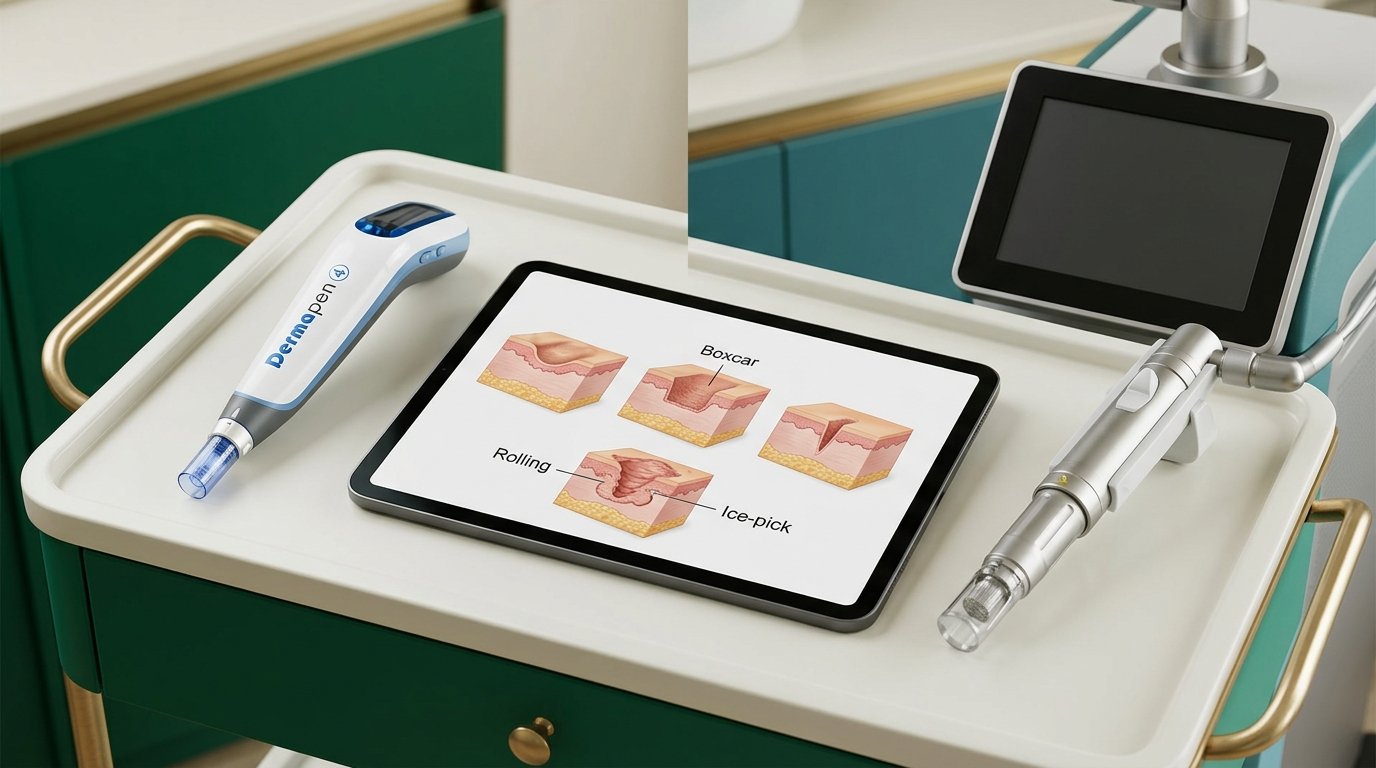
Microneedling uses fine needles; fractional CO2 laser uses heat and ablation to resurface selected areas. Both may improve some acne scars, but neither suits every scar type or guarantees scar removal. Microneedling often involves less visible recovery; laser treatment usually needs more recovery and careful pigment-risk planning.
Choose after assessment of scar shape and depth, active acne, healing history and the risk of post-treatment dark marks. Start with our acne scar assessment guide and microneedling service details. A clinician should confirm whether needling, resurfacing, another method or a staged plan fits your skin.
The
Short Comparison: Microneedling vs CO2 Laser for Acne Scars
| Question | Standard microneedling | Fractional CO2 laser |
|---|---|---|
| What creates the controlled injury? | Sterile needles moving vertically through the skin | Fractionated carbon dioxide laser energy that ablates and heats microscopic columns |
| Is there a thermal effect? | No intentional thermal energy in standard microneedling | Yes; ablation and surrounding coagulation are part of the effect |
| Typical role | Gradual collagen induction for selected atrophic scars and texture |
More intensive fractional resurfacing for selected textural and atrophic scars |
| Visible recovery | Often shorter, but redness, swelling, pinpoint bleeding or sensitivity may occur |
Usually more visible; redness, swelling, crusting/bronzing and peeling can occur |
| Pigment discussion | Post-inflammatory pigmentation is still possible | Thermal injury can make pigment-risk planning especially important, particularly in higher phototypes or recently tanned skin |
| Number of sessions | Commonly planned as a series | May use fewer or more sessions depending on settings, scar burden and recovery strategy |
| Best for every scar? | No | No |
| Treat active inflammatory acne first? | Usually active disease should be assessed and controlled before elective scar remodeling |
Usually active disease should be assessed and controlled before elective resurfacing |
| Can results be guaranteed? | No | No |
The table is deliberately general. Needle depth, number of passes,
treatment density, laser fluence, pulse characteristics, number of
stacks, cooling, anesthesia, scar-release procedures and aftercare all
affect the experience and outcome. A low-intensity treatment and a
high-intensity treatment carrying the same name are not equivalent.
Start With the
Scar Type, Not the Device Name
Acne scars are not one uniform problem. A face may contain several
scar types, enlarged pores, ongoing breakouts, post-inflammatory
redness, brown marks and normal skin texture at the same time. A device
cannot be matched responsibly until those features are separated.
Rolling scars
Rolling scars create broad, shallow undulations. Some are tethered by
fibrous bands beneath the surface. Collagen-remodeling procedures may
soften the texture, but a tether that pulls the skin downward may need
to be released with a scar-specific technique such as subcision before
or alongside resurfacing. Repeatedly resurfacing the surface without
addressing a strong tether can produce less change than expected.
Boxcar scars
Boxcar scars have more defined edges and can be shallow or deep.
Shallow boxcar scars may respond to fractional resurfacing or
needling-based collagen induction. Deep, sharply edged boxcar scars may
require a different or combined plan. The apparent depth can also change
with side lighting, which is why standardized photographs and
examination from several angles matter.
Ice-pick scars
Ice-pick scars are narrow and deep. Broad surface treatments often
have limited access to the deepest part of these tracts. A clinician may
discuss a focal method such as a chemical reconstruction technique or a
small surgical approach rather than expecting either microneedling or
fractional CO2 laser alone to solve the entire problem.
Hypertrophic or keloid scars
Raised scars are biologically different from atrophic scars. A person
with a history of keloids needs a specific assessment; creating
additional controlled injury without considering that history can be
inappropriate. The goal and treatment family may be different from the
methods used for depressed acne scars.
Red and brown post-acne
marks
Flat color change is not the same as a true indentation. Red marks
may reflect persistent vascular change, while brown or gray marks may
represent post-inflammatory hyperpigmentation. Texture procedures can
sometimes affect overall skin quality, but they are not automatically
the most precise first choice for color. Treating a flat mark as if it
were a deep scar can add recovery without matching the main concern.
For a fuller explanation of these distinctions, see acne
scars versus post-acne marks. If you are still developing inflamed
lesions, read why active
acne and scar treatment may need to be staged before comparing
resurfacing procedures.
How Standard Microneedling
Works
Standard microneedling uses a motorized or manual device with sterile
needles. The needles enter the skin at a selected depth and create many
controlled micro-injuries. The objective is not simply to make holes.
The controlled injury initiates a wound-healing response involving
inflammation, cell signaling, new extracellular matrix formation and
gradual collagen remodeling.
The American Academy of Dermatology describes microneedling as a
medical treatment used by dermatologists for concerns that include acne
scars, uneven texture, dark spots and wrinkles. The US Food and Drug
Administration notes that legally marketed microneedling devices have
specific authorized indications and that medical microneedling should
not be confused with superficial home rollers or cosmetic exfoliation
tools. Device authorization in one country does not replace local
professional rules or individualized assessment.
What varies during a
microneedling session
The name of the procedure does not tell you the entire protocol.
Relevant variables include:
- needle cartridge design and whether it is sterile and single
use; - actual needle depth rather than the maximum depth printed on a
device; - speed, number and direction of passes;
- pressure and treatment endpoint;
- whether the skin is thin, thick, scarred or located over a bony
area; - whether topical products are applied before, during or after
treatment; - infection-control technique;
- interval between sessions and the condition of the skin at the next
visit.
Depth should not be maximized simply because a scar looks deep. More
injury is not automatically more collagen or a better result. Excessive
passes or inappropriate depth can increase bleeding, inflammation,
pigment alteration and scarring risk. A professional plan adjusts the
technique to anatomy and scar pattern.
Standard
microneedling is not RF microneedling
This article uses “microneedling” to mean standard mechanical
microneedling unless stated otherwise. Radiofrequency microneedling
delivers electrical energy through needles and adds a thermal component
below the surface. It is a separate technology with different
parameters, evidence and risks. Studies comparing RF microneedling with
fractional CO2 laser cannot be treated as direct proof that ordinary
microneedling will behave identically. In 2025, the FDA issued a safety
communication about reports of serious complications with certain uses
of RF microneedling, including burns, scarring, fat loss, disfigurement
and nerve damage. That warning concerns RF microneedling, not a claim
that every needling procedure has the same risk profile.
What microneedling may do
well
For an appropriately selected person, standard microneedling may
gradually soften selected atrophic scars, reduce the contrast between
scar edges and surrounding skin, and improve the impression of texture.
Because it does not intentionally add heat, it may be considered when
thermal exposure is an important concern. Visible recovery is often
shorter than with more intensive ablative fractional laser settings.
The tradeoff is that improvement is gradual and commonly requires a
series. A gentle session chosen for safety cannot be expected to behave
like a deep resurfacing procedure. Very deep or tethered scars may need
focal or surgical techniques. The absence of laser heat also does not
mean “no risk”: infection, prolonged redness, pigment changes, herpes
reactivation, contact reactions and worsening scars can occur.
How Fractional CO2 Laser
Works
Carbon dioxide laser emits energy strongly absorbed by water in
tissue. Traditional fully ablative resurfacing removes a broad surface
area. Fractional CO2 systems divide treatment into microscopic columns,
leaving untreated skin between columns. These untreated bridges can
support re-epithelialization while the treated columns create ablation
and surrounding thermal coagulation.
Fractional delivery does not make the procedure non-ablative. It
remains an ablative fractional laser treatment. The depth and density of
columns, energy per microbeam, pulse duration, stacking and number of
passes can dramatically change the injury and recovery. Marketing
phrases such as “fractional,” “pixel” or “CO2 facial” do not disclose
the actual settings.
Why the thermal component
matters
The combination of ablation and controlled heat can contract tissue
immediately and stimulate longer-term remodeling. It can be useful for
selected atrophic scars and uneven texture. The same heat also makes
patient selection, conservative parameter choice, eye protection, plume
management, infection prevention and pigment-risk planning
important.
What fractional CO2 may do
well
Fractional CO2 laser can create a more intensive resurfacing effect
than standard microneedling. For some shallow-to-moderate boxcar scars,
rolling scars after appropriate tether assessment, and broader textural
irregularity, this may be useful. It can sometimes create noticeable
change per session, although this does not mean one session is
sufficient.
The tradeoff is a more visible healing period and a risk profile that
may include prolonged redness, swelling, crusting, acne or milia flares,
infection, herpes reactivation, post-inflammatory hyperpigmentation,
hypopigmentation and scarring. Risk varies with settings, operator
experience, skin characteristics, sun exposure, medical history and
aftercare.
What Does the Evidence
Actually Show?
Clinical studies support both needling-based treatments and
fractional CO2 laser as options for atrophic acne scars, but the
literature has limits. Trials often include small groups, short
follow-up, different scar scales, different laser systems, different
needle technologies and variable settings. Some studies compare
fractional CO2 with radiofrequency microneedling, not
standard microneedling. Others compare combination protocols. Results
from those designs should not be collapsed into a universal
percentage.
A 2023 randomized split-face trial compared a single treatment of
ablative fractional CO2 laser with microneedle radiofrequency. It is
relevant to the broader question of fractional thermal technologies, but
it does not directly answer how a course of standard mechanical
microneedling compares with a course of fractional CO2 laser. Newer
trials and reviews continue to report that both approaches can improve
atrophic scars, while recovery, adverse effects and the balance of
efficacy may differ.
The practical lesson is more modest than many advertisements
suggest:
- Both treatment families can improve selected atrophic acne
scars. - Fractional CO2 laser often produces a stronger resurfacing injury
and may produce greater change for some scar patterns or settings. - Needling-based procedures often offer a shorter visible recovery and
may have a different pigment-risk profile. - Scar subtype, skin phototype, protocol, clinician technique and
follow-up influence the result. - Direct comparisons do not establish that one device is best for
every person. - Combination or staged treatment may be more rational than repeatedly
increasing the intensity of one device.
When you read a study or clinic claim, ask whether the needling
method was standard microneedling, RF microneedling or another
energy-assisted device; whether the laser was ablative fractional CO2 or
a non-ablative fractional laser; how many sessions were performed; which
scar types were included; and how adverse events were recorded.
Which Option Fits
Different Scar Patterns?
Mostly shallow rolling
texture
Standard microneedling may be reasonable when scars are shallow and
the person prioritizes shorter visible recovery. Fractional CO2 may be
considered when a stronger resurfacing effect is appropriate. If the
rolling scars are tethered, neither surface-focused method may be the
complete answer without release of the bands.
Predominantly shallow boxcar
scars
Both approaches may be discussed. Fractional CO2 can reshape edges
and resurface a broader area, while microneedling can induce remodeling
with less thermal injury. Scar depth, edge definition, skin tone and
acceptable recovery help determine the plan.
Deep boxcar or ice-pick
scars
A focal method may be more useful for the deepest individual scars.
Broad microneedling or fractional CO2 can still play a supporting role
for surrounding texture, but promising to eliminate deep tracts with
either treatment alone is unrealistic.
Mixed scars
Mixed patterns are common. A staged plan might release tethered
scars, treat narrow deep scars focally, then use microneedling or
fractional resurfacing for overall blending. The sequence matters
because each step changes the skin and recovery requirements.
Texture plus
significant pigment concern
The clinician should first decide whether the dominant concern is
indentation, redness, brown pigmentation or a combination. A thermal
resurfacing procedure may not be the first step if pigment instability
is the main issue. Conservative settings, preparation, sun avoidance and
a staged strategy may be especially important.
Skin Tone and
Post-Inflammatory Hyperpigmentation
Post-inflammatory hyperpigmentation can occur after any procedure
that creates inflammation. People with medium-to-deep skin tones and
anyone with a personal history of persistent dark marks deserve explicit
risk counseling. This does not mean darker skin cannot be treated. It
means the device, settings, preparation and aftercare should be chosen
with pigment biology in mind.
Fractional CO2 laser adds thermal injury, so density and energy need
careful selection. Recent tanning, strong sun exposure and inadequate
photoprotection can complicate timing. Microneedling avoids laser heat,
which may be one reason it is considered in a pigment-conscious plan,
but aggressive needling can still cause prolonged inflammation and
pigmentation.
A consultation should document:
- natural skin tone and recent tanning;
- previous darkening after acne, cuts, peels, lasers or waxing;
- any history of light patches after treatment;
- current retinoids, acids, hydroquinone or other pigment
products; - pregnancy or breastfeeding when relevant to products or
anesthesia; - sun exposure expected during recovery;
- ability to use broad-spectrum sunscreen and follow aftercare;
- upcoming travel, beach holidays, weddings or camera-facing
work.
The objective is not to use the weakest treatment for everyone. It is
to choose an injury the skin can heal predictably and to avoid
preventable inflammation.
Active Acne Changes the
Decision
Scar remodeling is usually not the first priority when painful,
spreading or inflamed acne is active. Passing needles or laser energy
through inflamed areas may increase irritation and complicate healing.
More importantly, treating old scars while new scars are still forming
does not address the process creating additional damage.
An assessment should look for inflammatory papules, pustules,
nodules, cysts, excoriations, crusting and signs of infection. Current
prescriptions and recent isotretinoin use should be reviewed by an
appropriately qualified clinician. Modern decision-making about
procedures after isotretinoin is more nuanced than a single universal
waiting period, but this is not a reason to ignore medication
history.
Sometimes a person has controlled acne with only an occasional
superficial lesion. Sometimes the disease is still active enough that
scar procedures should wait. The distinction should be made clinically
rather than by applying a fixed rule from social media. If active acne
is the main issue, begin with a plan to reduce new lesions and protect
the barrier. Scar type and treatment can be reassessed when inflammation
is stable.
Downtime: What “Recovery”
Really Means
Downtime is not only the number of days before makeup can be worn. It
includes the period of visible redness, swelling, sensitivity, crusting
or peeling; the time before normal exercise and heat exposure are
comfortable; the period of strict sun protection; and the longer phase
during which redness or pigmentation may evolve.
Typical microneedling
recovery pattern
After standard microneedling, the skin may look red or feel warm and
tight. Mild swelling, pinpoint bleeding, sensitivity and dryness can
occur. Many people appear socially recovered in a few days, but this
varies with depth and number of passes. The barrier is temporarily
disrupted even when the surface looks calm. Strong actives, scrubs,
fragranced products, swimming, sauna and heavy exercise may need to be
paused according to professional instructions.
Typical fractional CO2
recovery pattern
Fractional CO2 laser generally has a more visible recovery. Redness,
swelling, heat, oozing or pinpoint crusting, bronzing and peeling may
occur. The treated area may require careful cleansing and ointment or
barrier care. Social downtime can extend beyond the initial
re-epithelialization, and redness may persist longer. Higher settings
and greater density usually increase the recovery burden.
Questions to ask about
downtime
- What will I look and feel like on days one, three, seven and
fourteen? - When can I wash normally, apply makeup and use sunscreen?
- When can I exercise, swim, use a sauna or visit a hammam?
- Which products should I stop before treatment, and when can I
restart them? - What symptoms are expected, and which require urgent contact?
- Who will review the skin if healing is slower than expected?
- How will travel or a long flight affect aftercare?
For detailed behavior after procedures, the planned D25 guide will
own the complete aftercare topic; this comparison keeps the focus on
choosing between methods.
Pain Control and the
Treatment Experience
Both procedures may use topical anesthetic. The application time,
formulation, treated area and local rules vary. Microneedling is often
described as vibration, pressure or scratching, with more sensitivity
over the forehead, upper lip and bony areas. Fractional CO2 may feel hot
or sharp during delivery, followed by a sunburn-like heat.
Pain should not be used as a marker of effectiveness. Excessive
discomfort can signal inadequate anesthesia, overly aggressive settings
or another problem. Conversely, a comfortable procedure is not
automatically ineffective. The endpoint is based on the planned tissue
response, not on how much pain a person tolerates.
Before treatment, discuss allergies, previous reactions to local
anesthetics, pregnancy, heart or neurologic conditions when relevant,
and medicines that affect bleeding or healing. Do not self-medicate with
aspirin, anti-inflammatory drugs or supplements solely to prepare for a
cosmetic procedure without medical advice.
How Many Sessions Are Needed?
There is no honest universal number. Standard microneedling is
commonly offered as a series because each session creates a limited
controlled injury and remodeling continues between visits. Fractional
CO2 laser may create more change per session in some circumstances, but
conservative treatments may also be repeated. Deep or mixed scars often
require several modalities rather than simply more sessions of one
device.
Session planning depends on:
- baseline scar severity and types;
- treatment intensity and area;
- previous response and adverse effects;
- skin tone and pigment history;
- whether subcision or focal methods are included;
- time available for recovery;
- budget and ability to complete follow-up;
- whether acne remains controlled;
- realistic endpoint agreed with the clinician.
Photographs should be standardized. Lighting, camera distance, facial
expression, makeup and skin hydration can make scars look substantially
different. Results should be reviewed after sufficient remodeling time,
not the morning after swelling subsides.
When Might Microneedling Be
Favored?
Microneedling may be favored when several of the following are
true:
- selected shallow-to-moderate atrophic scars are present;
- the person wants a gradual series with shorter visible
recovery; - avoiding intentional thermal injury is desirable;
- skin tone or pigment history makes a conservative non-thermal
approach attractive; - the person can attend repeated sessions and follow aftercare;
- examination shows that strong tethers or deep focal scars are not
the only problem; - the clinician has a regulated device, sterile single-use cartridges
and a clear depth plan.
These are discussion points, not automatic eligibility. A person with
infection, active inflammatory acne, a healing disorder, an unstable
skin condition or a strong keloid history may need another approach or
medical clearance.
When Might
Fractional CO2 Laser Be Favored?
Fractional CO2 laser may be favored when:
- selected boxcar or rolling scars and broader textural change may
benefit from ablative fractional resurfacing; - a stronger per-session intervention is appropriate;
- the person accepts a more visible healing period;
- pigment risk has been assessed and can be managed with an
individualized protocol; - there is no contraindication identified in the medical review;
- the clinician is trained with the specific platform and can explain
the planned density, depth and aftercare; - follow-up is available for infection, delayed healing or pigment
change.
Again, a device name does not replace assessment. An aggressive
fractional CO2 treatment is not automatically better than a carefully
planned microneedling series, and a very light fractional treatment
should not be sold as equivalent to a deeper protocol.
When Neither Is the Best
First Step
Neither microneedling nor fractional CO2 should be assumed to be the
first step when:
- active nodular or cystic acne is still producing new scars;
- there is a bacterial, fungal or viral infection in the treatment
area; - the main concern is flat redness or pigmentation rather than
indentation; - scars are predominantly ice-pick and need focal treatment;
- rolling scars are strongly tethered and need release;
- raised or keloid scars require a different plan;
- the skin barrier is acutely inflamed, sunburned or recently
tanned; - there is a history of poor wound healing that has not been
assessed; - expectations require complete scar removal;
- aftercare and follow-up cannot be completed safely.
Postponing a procedure can be an active treatment decision rather
than a refusal of care. It may allow inflammation to settle, medication
to be optimized, a holiday to pass or a diagnostic question to be
resolved.
Can
Microneedling and Fractional CO2 Be Combined?
They can be part of the same long-term strategy, but performing
everything at once is not automatically superior. Combination planning
should identify the job of each step. For example, a clinician may
release tethered scars first, use focal treatment for narrow deep scars,
then choose microneedling or fractional CO2 for global blending. Another
plan may alternate methods after observing healing.
Spacing allows the skin to remodel and makes it easier to attribute
benefits or adverse effects. Layering several injuries too closely can
increase inflammation without proportionate benefit. A combination plan
should state:
- which scar feature each procedure targets;
- why the chosen sequence is logical;
- how long healing will be observed before the next step;
- what would cause the plan to be modified;
- whether photographs and scar grading will be repeated;
- how pigment and active acne will be monitored.
The Role of
Professional Skin Assessment
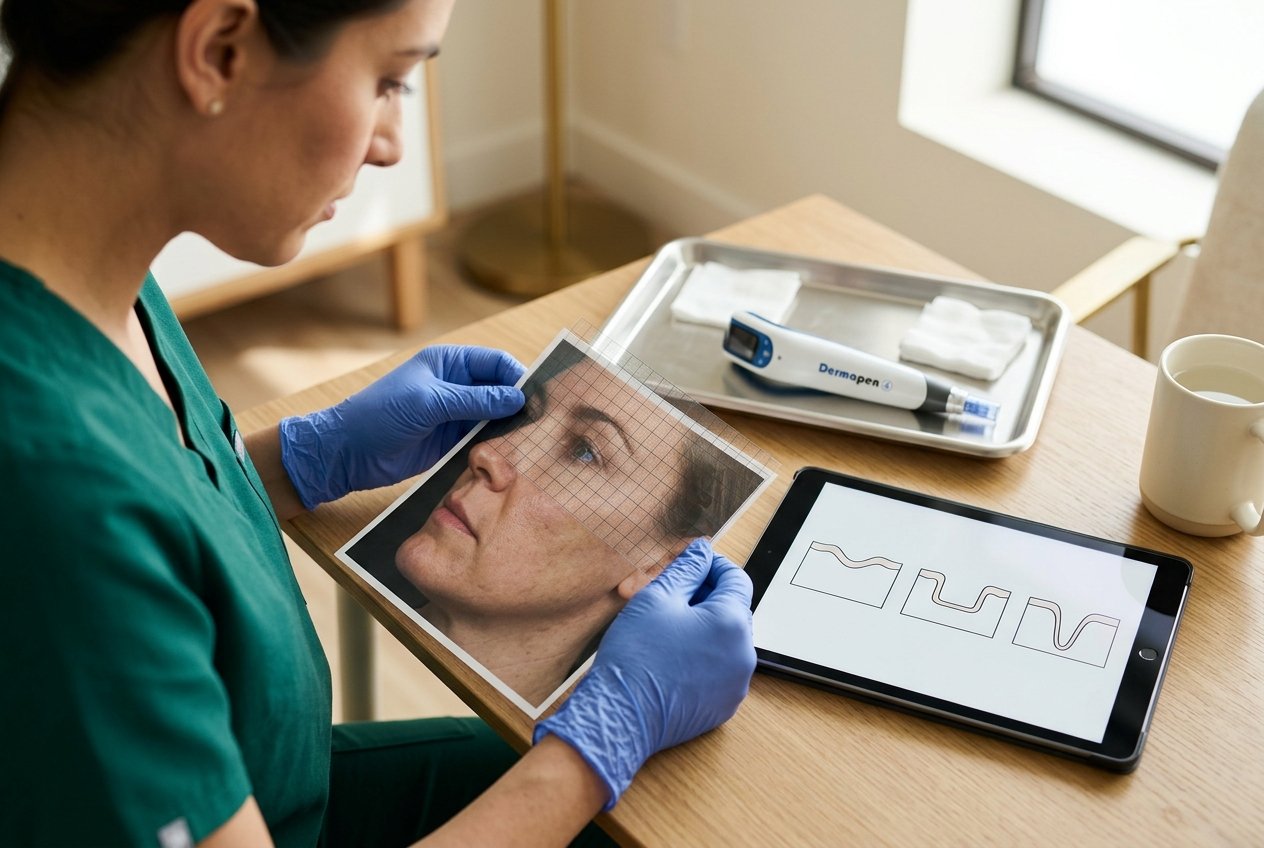
A useful assessment goes beyond naming the device. It maps scars by
type and location, distinguishes texture from color, looks for active
lesions and reviews the way your skin has healed after past procedures.
Side lighting, palpation and stretching the skin can reveal tethering.
Standardized photographs create a baseline.
At Nexja Skin Clinic, the purpose of assessment is to decide what
should be prioritized and whether a cosmetic procedure is appropriate
within the clinic’s scope. Read more about what a
professional skin analysis can and cannot tell you and review the
clinic’s microneedling
treatment details before a consultation. A professional skin
analysis does not diagnose every medical skin condition, replace
dermatology, or guarantee suitability for a procedure.
Bring a concise history:
- when acne began and whether new inflamed lesions still appear;
- all prescription and non-prescription acne products;
- previous isotretinoin dates and dose history if known;
- past peels, lasers, needling, subcision or injections;
- history of cold sores, eczema, dermatitis or pigment changes;
- tendency to keloid or heal slowly;
- medicines, supplements, allergies and pregnancy status where
relevant; - recent sun exposure and upcoming travel or events;
- what outcome would count as worthwhile improvement.
How to Compare
Providers, Not Just Prices
Prices can differ because the device, cartridge, treatment area,
anesthesia, clinician level, included follow-up and intensity differ. A
cheaper “CO2 laser” session may use a different platform or very low
settings; a higher price does not prove quality. Ask for clarity rather
than choosing by a single number.
Questions for a
microneedling provider
- What exact device and cartridge will be used?
- Is the cartridge sterile, sealed and single use?
- Who performs the procedure and what training do they have?
- How is depth selected for each area?
- Is this standard microneedling or RF microneedling?
- What products, if any, are applied through or immediately after
needling? - How are infection control and sharps disposal managed?
- What follow-up is available?
Questions for a
fractional CO2 provider
- What exact laser platform is used?
- Is it ablative fractional CO2, and what does that mean for my
recovery? - Who operates it and under what professional authorization?
- How are energy, density, passes and pulse settings selected?
- What eye protection and plume precautions are used?
- How is herpes history managed?
- What is the plan for my skin tone and pigment history?
- Who evaluates delayed redness, infection or darkening?
Questions for either
provider
- Which of my scars are expected to respond, and which may not?
- Do I need acne control, subcision or focal scar treatment
first? - What are realistic best-case, typical and limited-response
outcomes? - May I see standardized before-and-after images for a similar scar
pattern and skin tone? - What is included in the fee and what happens if healing is
delayed?
Myths vs Facts
Myth:
Fractional CO2 laser always removes acne scars in one session
Fact: Fractional CO2 can improve selected scars, but
complete removal is not realistic. The number of sessions and degree of
change depend on scar type, settings, healing and combined methods.
Myth:
Microneedling has no downtime because it is not a laser
Fact: Microneedling disrupts the barrier and can
cause redness, swelling, sensitivity and peeling. Deeper or repeated
passes can create more recovery and risk.
Myth: The
deepest setting gives the best result
Fact: Excessive injury can increase adverse effects
without improving the match between treatment and scar. Settings should
be selected for anatomy, scar type and healing capacity.
Myth: Darker
skin cannot receive fractional laser
Fact: Higher phototypes can be treated in selected
circumstances, but parameter choice, preparation, sun exposure, operator
experience and pigment counseling are especially important. Suitability
must be individualized.
Myth:
Microneedling and RF microneedling are the same
Fact: Standard microneedling creates mechanical
channels. RF microneedling also delivers electrical energy and heat
through needles. Evidence and risk information should not be
interchanged.
Myth:
If a scar looks brown, resurfacing is the obvious answer
Fact: A flat dark mark may be pigmentation rather
than an indentation. Color and texture require different assessment and
may need different treatments.
Myth: Bleeding
proves microneedling is working
Fact: Bleeding is not a quality score. The intended
endpoint varies by site and protocol. More bleeding can simply mean more
injury.
Myth: Fractional
means the laser is gentle
Fact: Fractional describes the pattern of treatment,
not a universal intensity. Ablative fractional CO2 can still create
substantial injury and downtime.
Myth:
Scar treatment can begin while severe acne continues unchecked
Fact: Active inflammatory acne often needs priority
because it can create new scars and complicate healing. Timing should be
decided clinically.
Myth: A branded
device guarantees the result
Fact: Device quality matters, but diagnosis,
settings, technique, sterility, aftercare and follow-up are equally
important. No device compensates for poor patient selection.
A Practical Decision
Framework
Use these five questions to organize a consultation.
1. What exactly is being
treated?
List scar types, color changes and active lesions separately. If you
cannot describe the target, you cannot judge whether the proposed
treatment matches it.
2. How much
controlled injury is justified?
Compare the desired change with your healing history, pigment risk
and available recovery time. The most aggressive acceptable treatment is
not necessarily the most appropriate.
3. Does the
plan address causes of limited response?
Ask about tethering, deep focal scars, active acne and unrealistic
expectations. A good plan explains what the chosen device will not
fix.
4. Can you complete
aftercare and follow-up?
Recovery may conflict with sun exposure, work, travel, sport, makeup,
swimming or caregiving. A theoretically effective procedure is not
suitable if safe aftercare is impossible.
5. How will progress be
measured?
Agree on standardized photographs, timing and review criteria.
Improvement should be assessed after remodeling, not only from immediate
swelling or lighting changes.
Preparing for a
Consultation in Istanbul
If you are visiting Istanbul, do not schedule an intensive procedure
solely because it fits between tourist activities. Heat, strong sun,
long flights, hammam visits, swimming and a packed itinerary can
conflict with recovery. Leave time for assessment before treatment and a
way to contact the clinic afterward.
Bring photographs of previous reactions and the names of products or
procedures you have used. Avoid arriving with fresh tanning or a
sunburn. Tell the practitioner if you will fly soon, change hotels, or
travel somewhere without access to follow-up. A conservative plan or
postponement can be the safest outcome when the itinerary is
incompatible with healing.
For broader planning, the acne-scar pillar explains professional
acne scar treatment options in Istanbul. The current comparison
remains focused on choosing between microneedling and fractional CO2
rather than claiming that either is automatically the best
treatment.
Frequently Asked Questions
1.
Is microneedling better than fractional CO2 laser for acne scars?
Not universally. Microneedling may suit selected scars when a
non-thermal, gradual approach and shorter visible recovery are
priorities. Fractional CO2 may create a stronger resurfacing effect for
some textural scars but usually involves more downtime and a different
risk discussion. Scar type, skin tone, healing history and settings
determine the fit.
2. Which treatment works
faster?
Fractional CO2 may produce more visible change per session in some
protocols, but a stronger session also creates more recovery.
Microneedling commonly uses a series. “Faster” should include the time
needed for healing, the risk of delays and the number of stages required
for mixed scars.
3. Which is safer for darker
skin?
There is no blanket answer. Microneedling avoids intentional laser
heat and may be considered in pigment-conscious plans, but it can still
cause post-inflammatory hyperpigmentation. Fractional CO2 can be used
selectively in higher phototypes by experienced clinicians using
appropriate settings and preparation. Personal pigment history matters
more than a slogan.
4. Can
fractional CO2 laser permanently remove acne scars?
No procedure can promise permanent removal of every scar. The
objective is improvement in depth, edge contrast and overall texture.
Residual scars generally remain, and aging, new acne or sun damage can
change the skin later.
5. Can
microneedling remove deep ice-pick scars?
Microneedling alone is often not the most precise method for narrow
deep ice-pick tracts. A clinician may discuss a focal chemical or
surgical technique, with microneedling later used for surrounding
texture.
6. Does fractional CO2
help rolling scars?
It can improve texture and some rolling scars, but strong fibrous
tethering may need release first. Resurfacing the surface without
assessing the tether can limit the result.
7. How
long after active acne can I start scar treatment?
There is no single interval for everyone. The clinician should
confirm that inflammatory disease is adequately controlled, the barrier
is stable and medicines have been reviewed. Occasional minor lesions and
ongoing nodulocystic acne are not equivalent situations.
8. How long
does redness last after microneedling?
Visible redness often settles within a few days after standard
treatment, but deeper sessions can cause longer redness, swelling or
dryness. Skin may remain biologically sensitive after it looks
normal.
9. How long
does fractional CO2 laser downtime last?
The most visible phase may last about a week or longer depending on
density, energy and individual healing, while redness can continue
beyond surface peeling. Your provider should give a day-by-day plan
based on the exact settings.
10. Can I wear
makeup after either procedure?
Makeup should wait until the surface has healed enough and the
provider permits it. Applying products too early can irritate the skin
or introduce contamination. The appropriate timing is usually longer
after ablative fractional CO2 than after a light microneedling
session.
11. Can I exercise after
treatment?
Heat, sweat and friction may aggravate freshly treated skin. Many
protocols advise a temporary pause. The duration depends on procedure
intensity, healing and the exercise environment.
12. Can I have
treatment before a flight?
It may be inconvenient or unsafe to travel immediately after an
intensive procedure because swelling, dryness, sun exposure and access
to follow-up need consideration. Discuss the exact itinerary before
booking treatment.
13.
Is at-home microneedling equivalent to professional treatment?
No. Home rollers and professional medical devices differ in needle
design, depth, sterility, control and intended use. Reusing or sharing a
device can cause infection, and aggressive home treatment can worsen
pigmentation or scarring. The FDA distinguishes medical microneedling
devices from superficial cosmetic tools.
14. Can microneedling
spread acne bacteria?
Treating through active inflamed or infected lesions can create
additional irritation and contamination concerns. This is one reason
active acne is assessed before needling. Sterility and single-use
cartridges are essential.
15. Does fractional CO2
thin the skin?
The intended response is controlled ablation followed by repair and
remodeling, not chronic thinning. Inappropriate settings, repeated
excessive injury or poor healing can cause scarring or other damage.
Treatment intervals and endpoints should be clinically planned.
16. Which hurts more?
Experience varies. Both may use topical anesthetic. Fractional CO2
often produces more heat during and after treatment, while microneedling
may feel like vibration or scratching. Pain is not a reliable measure of
treatment quality.
17. Can either
treatment make scars worse?
Yes, although serious worsening is not expected in properly selected
and performed cases. Infection, prolonged inflammation, pigment
alteration and new scarring are possible. Keloid history, active
disease, poor technique and inadequate aftercare can increase risk.
18. Is one session
enough for mild scars?
Some improvement may be visible after one treatment, especially with
an intensive fractional protocol, but one session should not be
guaranteed to meet the goal. Remodeling continues for months and the
plan should be reviewed after healing.
19. Can the
treatments be used on the same day?
Combining injuries on the same day is not automatically beneficial.
The rationale, total injury and evidence should be clear. A staged
approach often makes response and adverse effects easier to
evaluate.
20. What age
is appropriate for acne-scar treatment?
Suitability depends on acne control, scar maturity, consent rules,
device indications and the person’s medical situation. Device
authorizations may specify age ranges. Younger patients with active acne
often need acne management first.
21. What
products should I stop before treatment?
Retinoids, exfoliating acids, benzoyl peroxide, depilatories and
other irritating products may need adjustment, but the timing depends on
the procedure and prescription status. Do not stop prescribed medicine
without the prescriber’s advice.
22.
Do I need antiviral medicine before fractional CO2 laser?
A history of herpes simplex or cold sores should be disclosed. Some
clinicians prescribe antiviral prophylaxis for resurfacing around the
mouth or larger facial areas. This requires individualized medical
advice.
23. Will either treatment
shrink pores?
Texture remodeling may make pores look less prominent, but pores are
normal structures and cannot be permanently closed. Acne-scar planning
should not be based on a promise of pore elimination.
24. Can treatment help
red acne marks too?
The primary target of microneedling and fractional CO2 in this
comparison is atrophic texture. Persistent red marks may respond better
to vascular assessment or time, while brown marks need pigment-conscious
care. A mixed concern may need staged treatment.
25. How do
I know whether a clinic uses a real device?
Ask for the manufacturer and exact model, who is authorized to
operate it, how cartridges or handpieces are managed, and what settings
are planned. A photograph of a machine or a brand name in an
advertisement does not prove training or maintenance.
26.
Why do before-and-after photos sometimes look dramatic?
Lighting direction, camera distance, facial expression, makeup, skin
hydration and image sharpening can change the visibility of scars.
Reliable comparisons use the same camera, angle, lighting and timing
after swelling has resolved.
27. Can scar
treatment be performed during summer?
It may be possible for selected people, but sun exposure and the
ability to protect healing skin are central. A person with outdoor work
or a beach holiday may need different timing or a more conservative
plan.
28. What is
the most important consultation question?
Ask: “Which of my specific scar types will this procedure target, and
what will it not fix?” A clear answer reveals whether the recommendation
is based on your skin or on the device the provider wants to sell.
29. When
should I seek medical help after treatment?
Contact the treating professional promptly for worsening pain,
spreading redness, pus, fever, grouped blisters, unexpected pale or dark
patches, marked swelling, visual symptoms or delayed healing. Emergency
symptoms require urgent local medical care.
30. How should I
choose between the two today?
Do not choose from a generic winner list. Confirm the scar pattern,
active acne status, pigment risk, recovery window and clinician’s
protocol. If several scar types coexist, ask whether a staged
combination will match them better than repeating one device.
Reading a Treatment
Proposal Line by Line
A written proposal should be more than a device name and a package
price. It should connect the diagnosis, intended endpoint and recovery
plan. If the proposal says “three sessions of microneedling” or “one CO2
session” without explaining the scar features being targeted, ask for
the missing reasoning.
Diagnosis and baseline
The baseline should state whether scars are predominantly rolling,
boxcar, ice-pick or mixed; whether tethering is suspected; and whether
flat pigment or redness contributes to the appearance. It should record
active acne, skin phototype, recent sun exposure, relevant medicines and
previous procedure response. A broad label such as “acne scar” is not
enough for a complex pattern.
Treatment goal
A realistic goal is usually improvement in texture, edge contrast or
the way scars catch directional light. “Glass skin,” “poreless skin” and
“scar-free” are not measurable clinical endpoints. The plan may focus
first on the deepest or most visible scars, or it may prioritize global
texture. Those are different goals and may use different methods.
Technique
For microneedling, the proposal should identify standard versus RF
microneedling and explain how depth varies by area. For fractional CO2,
it should confirm that the laser is ablative fractional CO2 and that
settings will be individualized. It is reasonable for a clinician not to
promise exact settings before seeing the skin on treatment day, but the
rationale for conservative or intensive treatment should be
understandable.
Recovery resources
Ask what cleanser, ointment, moisturizer and sunscreen are
recommended; whether these are included; and who is available after
hours. The plan should tell you what normal healing looks like and how
to send a photograph if something changes. A clinic that provides a
treatment but no route for follow-up leaves an important part of care
undefined.
Review point
The date of review should account for collagen remodeling. A very
early photograph may document healing but cannot show the final effect.
The review should compare standardized images and decide whether to
repeat, change intensity, add a scar-specific method or stop.
Why
Procedure Settings Matter More Than Marketing Categories
People often compare procedures as if every microneedling session has
one intensity and every fractional CO2 session has another. In reality,
each technology has a range. Two sessions carrying the same label may
create very different tissue effects.
Microneedling variables
Needle depth is only one variable. Cartridge geometry, actual needle
protrusion under load, device speed, pass count, overlap and pressure
influence injury. Thin temple or forehead skin should not automatically
receive the same approach as thicker cheek skin. Scarred tissue may
resist needles differently from normal skin. The endpoint may range from
uniform redness to pinpoint bleeding, depending on protocol and
location.
Applying unapproved products through freshly created channels can
introduce ingredients beyond the barrier and may increase inflammation,
allergy or granulomatous reaction. “Cocktail” is not a safety
description. Ask exactly what is applied, why it is used, whether it is
sterile and whether it is intended for intradermal exposure.
Fractional CO2 variables
Laser energy, microscopic treatment zone depth, density, spot
spacing, pulse duration, stacking and passes interact. Higher density
treats more surface area in one session and can substantially increase
heat and recovery. Greater energy may deepen columns, but
device-specific behavior varies. Settings cannot be compared simply by
reading one number from two different platforms.
The clinician may lower density while using adequate energy to limit
bulk heat, or stage treatment over sessions. Another plan may use focal
higher intensity on selected scars and lower intensity elsewhere. This
is one reason a whole-face package described only as “high power” is not
a meaningful sign of quality.
Treatment area and anatomy
Cheeks, temples, forehead, jawline and upper lip do not have
identical thickness or healing behavior. Hairline, eyebrows, lips and
eyes require protection and technique adjustments. Scar treatment should
respect facial contours rather than use identical passes everywhere.
A Day-by-Day Recovery
Planning Guide
The following timeline is illustrative, not a promise. Follow the
instructions for your exact procedure.
Microneedling: treatment
day to day two
Immediately after treatment, redness and heat may resemble sunburn.
Pinpoint bleeding should stop. Mild swelling and tightness can become
more noticeable later the same day. Use only the products approved by
the treating professional. Touch the skin with clean hands and avoid
sharing towels.
During the first forty-eight hours, heat, sweating, friction and
strong actives can increase discomfort. Some people see fine dryness or
roughness. Sunscreen timing depends on surface condition and the product
recommended by the clinician; physical sun avoidance remains important
even before a product is comfortable.
Microneedling: days three to
seven
Redness often decreases, but dryness, mild peeling or sensitivity may
continue. Makeup and exercise should resume only when permitted. Do not
pull peeling skin or attempt to accelerate shedding with scrubs. Contact
the clinic if pain, warmth or redness worsens rather than improves.
Fractional CO2:
treatment day to day two
Heat and swelling can be significant. The skin may ooze or develop
pinpoint crusting. Instructions may include gentle cleansing, frequent
ointment or a specific barrier product. Sleep position and cool
compresses may be discussed. Apply nothing unapproved, and do not assume
a “natural” oil is safe for ablated skin.
Fractional CO2: days three
to seven
Bronzing, crusting or peeling may become more visible before it
improves. Picking can cause infection, delayed healing and pigmentation.
Redness may remain after the surface closes. Social recovery varies:
being able to work from home is not the same as being ready for makeup,
studio lighting or outdoor activity.
After the first week
Newly healed skin can remain reactive. Sun protection and gentle
skincare continue. Persistent redness does not always mean a
complication, but it should be monitored. New darkening, pale patches,
blisters, spreading redness or increasing pain deserve prompt
review.
Building a
Staged Plan Instead of Chasing Intensity
A staged plan treats acne scars as a set of structural problems
rather than a single surface defect. The sequence begins with the
condition that can undermine every later step. If inflammatory acne is
still creating lesions, controlling that process protects future skin.
If strong tethering is present, releasing selected bands may allow the
surface to lift before a resurfacing procedure is chosen. If a few deep
ice-pick scars dominate, focal treatment may be more efficient than
increasing whole-face intensity.
After those priorities, a global remodeling method can blend the
remaining texture. Standard microneedling may be selected for a gradual
non-thermal series, while fractional CO2 laser may be selected when an
ablative thermal response is justified. The first session can function
as both treatment and information: healing time, redness, pigmentation
and early texture response help refine the next step.
The plan should have stopping rules. A procedure should not be
repeated automatically when the skin develops persistent pigmentation,
delayed healing or no meaningful response after an adequate interval.
Reassessment may show that the remaining scars are a type that needs
another technique. Continuing to increase depth or energy because a
prepaid package remains can turn limited benefit into avoidable
risk.
Staging also protects scheduling. A person preparing for a wedding,
long flight or sunny holiday may begin with assessment and conservative
barrier care, then reserve intensive treatment for a safer season.
Someone with flexible recovery time may choose a stronger intervention,
but the decision should still be based on scar match rather than
impatience.
An example sequence for mixed atrophic scars might be:
- stabilize active acne and daily skincare;
- photograph and map rolling, boxcar and ice-pick scars;
- release clinically significant tethering if appropriate;
- treat selected deep narrow scars focally;
- allow healing and reassess;
- use microneedling or fractional CO2 for broader blending;
- review pigment, redness and texture after remodeling;
- repeat, modify or stop based on documented response.
This example is not a prescription. Some people do not need every
step, and the order can change. Its purpose is to show why a single
“best machine” answer is often less useful than a sequence tied to
specific scar features.
Lifestyle
and Timing Factors That Change the Choice
Daily life can make an otherwise reasonable treatment impractical.
Outdoor work, frequent exercise, swimming, caregiving, mask friction and
public-facing responsibilities influence recovery. A person who cannot
avoid sun or heat during the early healing period may need different
timing, lower intensity or another method.
Smoking and nicotine exposure can affect circulation and wound
healing. Nutrition, sleep and chronic disease management also matter,
although supplements should not be marketed as a shortcut to scar
remodeling. Diabetes, immune suppression and medicines that alter
healing require appropriate medical review.
Menstrual cycles do not create a universal prohibition, but perceived
pain, acne activity and scheduling preferences may vary. Pregnancy and
breastfeeding change which medicines, anesthetics and elective
procedures are appropriate; disclose them before treatment. People prone
to herpes outbreaks should discuss prevention rather than waiting for
symptoms after resurfacing.
Mental readiness matters as well. Acne scars can affect confidence,
but a procedure should not be used to promise a transformed identity. If
minor texture causes extreme distress or repeated procedures never feel
sufficient, pausing for a broader conversation may be more helpful than
escalating treatment.
Risk Reduction
Before, During and After Treatment
No checklist eliminates risk, but several preventable problems can be
reduced.
Before treatment
- Confirm that the treatment area has no active infection or
significant inflammation. - Disclose cold sores, keloids, eczema, psoriasis, vitiligo and
pigment changes. - Provide a complete medicine and supplement list.
- Avoid deliberate tanning and report accidental sunburn.
- Arrange recovery away from major events and intense outdoor
exposure. - Understand which products to stop and when.
- Confirm who performs the treatment and who provides medical review
if needed.
During treatment
- Sterile, single-use needle cartridges should be opened and discarded
appropriately. - Laser eye protection must match the wavelength and be used by
everyone in the room. - Skin preparation and disinfection should be appropriate for the
procedure. - Treatment endpoints should be observed rather than blindly repeating
passes. - Pain, unexpected blanching, excessive bleeding or another unusual
response should be assessed.
After treatment
- Follow the written cleansing and barrier-care instructions.
- Avoid picking, scrubbing and unapproved actives.
- Limit sun, heat, friction and contamination during early
healing. - Use the recommended broad-spectrum photoprotection when
appropriate. - Keep follow-up appointments and send clear photographs when
advised. - Seek prompt help for warning signs rather than waiting for the next
routine visit.
Understanding Pigment
Risk in More Detail
Pigment change is not a simple light-skin versus dark-skin switch.
Natural phototype matters, but so do recent tanning, inflammation,
hormones, medicines, past post-inflammatory marks, treatment density and
sun behavior. A person who develops dark marks after every pimple may
need a more conservative plan even if their baseline skin is relatively
light.
Post-inflammatory hyperpigmentation can appear after the first
redness fades. It may resolve gradually, but it can be distressing and
persistent. Hypopigmentation is less common but can be difficult to
treat. Fractional treatment leaves bridges of untreated skin that can
support healing, yet excessively aggressive settings or repeated
inflammation can still create uneven color.
Preparation regimens are not universal. A clinician may recommend
pigment-regulating products for selected patients, but those products
can also irritate the barrier if used incorrectly. The plan should
explain what to use, when to stop before the procedure and when to
restart. Prescription agents require appropriate medical oversight.
Sun avoidance is not limited to sunscreen. Hats, shade, timing
outdoor activity and avoiding a beach holiday can be equally important.
Sunscreen cannot compensate for hours of direct exposure on recently
treated skin.
Interpreting
Before-and-After Results Responsibly
Acne scars change dramatically with light. Direct frontal light can
flatten shadows and make indentations nearly disappear; side light can
exaggerate them. A fair comparison uses the same camera, lens, distance,
angle, expression and directional lighting.
Timing matters too. Early swelling can temporarily lift depressed
scars. Immediate “after” images are evidence that a procedure occurred,
not evidence of final collagen remodeling. Conversely, transient dryness
can make texture look worse before it improves.
Ask whether photographs show one session or a full course, whether
other procedures were added, and how long after the final session the
image was taken. Images from another patient cannot predict your result.
They are most useful when the scar pattern, skin tone and treatment
protocol are similar and when consent and authenticity are clear.
Objective grading scales can improve consistency but are not perfect.
Patient-reported outcomes matter as well: scars that appear modest in a
photograph may strongly affect confidence, while a measurable change may
not meet a person’s expectations. The consultation should align the
visible target with the change that would feel meaningful.
Cost, Value and the
Risk of False Economy
The lowest session price may not be the lowest total cost. Consider
the number of sessions, time away from work, travel, aftercare products,
follow-up and the possibility that a mismatched treatment will need
correction. A higher price also does not guarantee better care.
Value comes from accurate assessment, an appropriate device, trained
operation, safe consumables, individualized settings, clear aftercare
and accessible follow-up. Ask whether the quoted price includes
anesthesia, face or sub-area treatment, review appointments and taxes.
If a combination is proposed, request separate reasons and costs for
each step.
Be cautious with prepaid packages sold before scar typing or a test
of healing. A series can be sensible, but the plan should allow
intensity or modality to change when response, pigmentation or acne
activity changes. Treatment should not continue simply because sessions
were purchased.
Five Example Scenarios
These examples illustrate reasoning, not prescriptions.
Scenario
A: shallow rolling scars with limited downtime
A person has stable acne, mostly shallow rolling texture, no obvious
tethering and work that allows only a weekend of visible redness.
Standard microneedling may be a reasonable starting discussion because
it can be staged conservatively. The plan still needs realistic
expectations and repeated sessions.
Scenario
B: mixed boxcar scars with a recovery window
A person has shallow-to-moderate boxcar scars, stable skin, no recent
tanning and can accept a more visible recovery. Fractional CO2 may be
discussed for stronger resurfacing. Deep individual scars might still
need focal treatment.
Scenario
C: higher phototype and persistent dark marks
A person develops long-lasting brown marks after minor inflammation.
The clinician separates pigment from texture, stabilizes the barrier,
plans strict photoprotection and may favor a cautious non-thermal or
lower-injury approach. This does not mean laser is forever prohibited;
it means pigment risk is central to sequencing.
Scenario D: deep
ice-pick scars and active acne
The main priorities are controlling active disease and considering
focal treatment for deep tracts later. Selling either whole-face
microneedling or fractional CO2 as the single answer would ignore the
dominant problems.
Scenario
E: rolling scars with tethering after several failed resurfacing
sessions
If scars remain anchored, repeating a surface treatment at higher
intensity may not solve the mechanical cause. The consultation should
assess release techniques and then decide whether microneedling or
fractional CO2 has a later blending role.
What a
High-Quality Consent Discussion Includes
Consent is not a signature collected after numbing cream has been
applied. It is a discussion while the person can consider alternatives.
The explanation should include the proposed treatment, expected course,
common temporary effects, material risks, alternative procedures, the
option of no treatment and the limits of predicted improvement.
For microneedling, discuss infection, herpes reactivation, pigment
changes, prolonged redness, allergic or granulomatous reactions to
applied substances and scarring. For fractional CO2, discuss the
ablative wound, infection, herpes reactivation, prolonged redness, acne
or milia flares, hyperpigmentation, hypopigmentation, lines of
demarcation and scarring. The exact risk list depends on the person and
treatment area.
Photography consent should be separate and clear. Clinical
documentation does not automatically authorize advertising. Patients
should know who can see images and whether they are de-identified.
What
to Do if Healing Does Not Follow the Expected Course
Do not self-diagnose a complication from social media, but do not
ignore worsening symptoms. Contact the treating provider with the
treatment date, procedure, products used and clear photographs in
natural light. State whether pain, redness or swelling is improving or
worsening and whether there is fever, discharge, blistering or visual
change.
The response may involve examination, swabs, antiviral or
antibacterial treatment, anti-inflammatory care, pigment management or
referral, depending on findings. Starting leftover antibiotics, strong
steroids, acids or bleaching products without assessment can obscure the
problem or worsen it.
If the original provider is unavailable and symptoms are concerning,
seek local medical care. Severe eye pain, visual symptoms, rapidly
spreading redness, systemic illness, airway symptoms or severe swelling
require urgent evaluation.
A More Complete Comparison
Matrix
| Decision factor | Standard microneedling | Fractional CO2 laser | Why it matters |
|---|---|---|---|
| Primary injury | Mechanical channels | Ablative and thermal microcolumns | Changes recovery and risk profile |
| Scar match | Selected rolling and boxcar scars; global texture | Selected rolling and boxcar scars; stronger resurfacing potential |
Deep focal scars may need another method |
| Tethered scars | Does not release strong bands by itself | Does not reliably release strong bands by itself | Subcision assessment may be needed |
| Ice-pick scars | Limited as a sole treatment | Limited as a sole broad treatment | Focal techniques may be more precise |
| Pigment risk | Present; often considered lower thermal burden | Present; heat and density require careful planning | Prior pigmentation history is important |
| Visible recovery | Often shorter | Usually longer and more intensive | Work, travel and event timing matter |
| Treatment course | Often a series | Variable; may be staged or repeated | Compare total plan, not one session |
| Operator variables | Depth, speed, passes, cartridge, products | Energy, density, pulse, passes, stacking | Procedure label alone is insufficient |
| Infection control | Sterile single-use cartridge and clean technique | Asepsis, wound care and plume precautions | Both breach the barrier |
| Follow-up | Review response and pigment | Review healing, redness, infection and pigment | Early support can reduce harm |
| Evidence caveat | Standard and RF studies must be separated | Devices and settings differ | Study results may not match your protocol |
| Guarantee | None | None | Improvement, not erasure, is the realistic goal |
Ten Red Flags in
Acne-Scar Advertising
- “Permanent scar removal” or “100% pore closure.”
- A single device recommended before anyone examines the scars.
- RF microneedling evidence used to sell standard microneedling
without explanation. - Immediate post-treatment swelling shown as a final result.
- No discussion of active acne, skin tone or pigment history.
- Reused or unsealed microneedling cartridges.
- A laser operator who cannot name the platform or explain eye
protection. - Unlabelled cocktails applied through fresh channels.
- No written aftercare or follow-up contact.
- Pressure to purchase a fixed package before response is
reviewed.
Twelve Questions
to Record Before You Decide
Write down the answers rather than relying on memory:
- What scar types do I have in each facial area?
- Are any scars tethered?
- Is acne controlled enough to begin remodeling?
- Is the proposal standard microneedling, RF microneedling or
fractional CO2? - Which exact feature will each procedure target?
- What result is unlikely even if healing is ideal?
- What recovery should I expect day by day?
- What is my personal pigment risk and how is it reduced?
- Which medicines or products need review?
- Who performs treatment and manages complications?
- When will standardized photographs be repeated?
- What is the next option if response is limited?
Final Takeaway
The comparison between microneedling and fractional CO2 laser is a
comparison between two kinds of controlled injury, not two
interchangeable beauty treatments. Standard microneedling creates
mechanical channels without intentional heat and often supports a
gradual, lower-downtime approach. Fractional CO2 laser creates ablative
and thermal microcolumns and may offer stronger resurfacing for selected
scars, with a more demanding recovery and pigment-risk discussion.
The deciding factor should be the fit between the treatment and the
scar biology. Identify rolling, boxcar, ice-pick and raised scars;
separate texture from red or brown marks; control active acne; discuss
skin tone and healing history; and choose a provider who can explain
settings, limitations and follow-up. A staged plan that uses different
tools for different scar features is often more credible than a promise
that one machine will erase everything.
To prepare for a professional assessment, review acne
scar treatment in Istanbul, the clinic’s microneedling
service information, and the guide to treating
acne scars while acne is still active. The goal is not to select the
strongest procedure. It is to select the safest reasonable sequence for
the scars, skin and life around them.
Medical and Technical
Sources
- American Academy of Dermatology. “Acne scars: Consultation and
treatment.” https://www.aad.org/public/diseases/acne/derm-treat/scars/treatment - American Academy of Dermatology. “Microneedling can fade scars,
uneven skin tone, and more.” https://www.aad.org/public/cosmetic/scars-stretch-marks/microneedling-fade-scars - US Food and Drug Administration. “Microneedling Devices.” https://www.fda.gov/medical-devices/aesthetic-cosmetic-devices/microneedling-devices
- US Food and Drug Administration. “Microneedling Devices: Getting to
the Point on Benefits, Risks and Safety.” https://www.fda.gov/consumers/consumer-updates/microneedling-devices-getting-point-benefits-risks-and-safety - US Food and Drug Administration. “Potential Risks with Certain Uses
of Radiofrequency (RF) Microneedling.” https://www.fda.gov/medical-devices/safety-communications/potential-risks-certain-uses-radiofrequency-rf-microneedling-fda-safety-communication - Hendel K, Karmisholt K, Hedelund L, Haedersdal M. “Fractional CO2
laser versus microneedle radiofrequency for acne scars: a randomized,
single-treatment, split-face trial.” Lasers in Surgery and
Medicine. 2023;55(4):335–343. https://pubmed.ncbi.nlm.nih.gov/36934435/
Educational information only. This page does not diagnose
disease, guarantee results or replace consultation with a dermatologist
or other appropriately qualified healthcare professional.