Quick answer: are acne scars and acne marks the same?
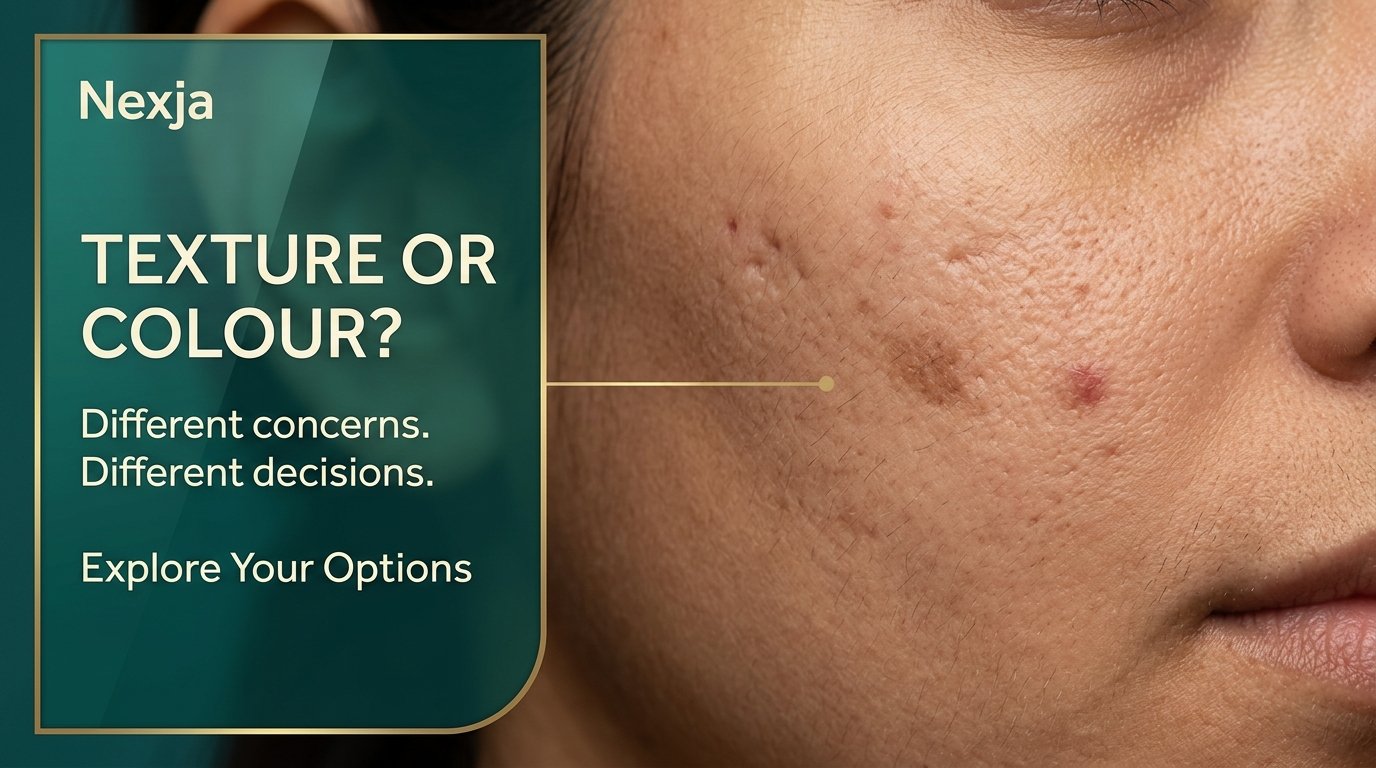
Acne scars change the skin’s structure; post-acne marks mainly change its colour. Scars may be depressed or raised, while marks are often flat and red or brown. The same area can have both, so a treatment aimed at colour may not improve an indentation.
For next steps, read our acne scar assessment guide or pigmentation assessment guide. If scar remodelling is appropriate, the microneedling service page explains one option to discuss. Active or painful acne should be assessed before selecting a cosmetic procedure.
A useful first question is: does the concern involve colour, contour, an active lesion or a combination? The American Academy of Dermatology explains that a flat spot left after acne clears is usually different from a true acne scar, while a scar can also carry discolouration. Read the AAD overview of acne scars.
That question helps organise a consultation; it is not a reliable home diagnostic test. Shadows can exaggerate shallow irregularities, makeup can conceal colour, and a photograph cannot show every feature a clinician may need to examine. Avoid selecting a procedure solely from a social-media comparison or an image-analysis label.
For Istanbul residents, expats and international visitors, the practical starting point is the same: identify what remains after the breakout before purchasing a service intended to change it. A concern about brown patches needs a different conversation from a concern about indentations. A painful new bump needs assessment of what is happening now, rather than being automatically classified as an old mark.
The most useful takeaways are these:
- Describe colour and surface shape separately.
- Mention continuing breakouts, symptoms and recent treatments.
- Ask which part of the concern a proposed service targets.
- Discuss improvement in specific terms, rather than expecting complete erasure.
- Keep clinical assessment ahead of cosmetic treatment when the diagnosis is uncertain.
What does each term mean?
The language can be confusing because people use “scar,” “mark,” “spot” and “blemish” loosely. Everyday language is a reasonable starting point, but a treatment decision requires more precision. You do not need to arrive knowing medical terminology. You do need an explanation that connects the terminology to what is actually being assessed.
What is an acne scar?
An acne scar is a structural consequence of healing after acne. Depressed scars sit below the surrounding surface; raised scars project above it. The AAD describes differences in collagen production during healing as part of why these patterns develop. See the AAD explanation of acne-scar causes.
For a consultation, the important detail is not simply that the skin looks uneven. Explain where the unevenness appears, when you first noticed it and whether it remains visible under different ordinary lighting conditions. A clinician can then assess the shape and the surrounding skin rather than relying on the broad word “scar.”
Do not assume a small indentation is minor just because it occupies little space. Equally, do not assume every visible pore is a scar. The distinction needs context, including the history of the area and an appropriate examination.
What is a post-acne mark?
A post-acne mark is an everyday description for lingering discolouration where acne has occurred. Brown or darker marks often relate to post-inflammatory hyperpigmentation, abbreviated PIH. Red or pink residual marks may involve post-inflammatory erythema, often abbreviated PIE. These labels describe different processes, and they can overlap with structural scars.
A mark may be visually prominent even when the surface looks level. That prominence does not make it less important to the person experiencing it. It does mean that a plan aimed at changing skin contour may fail to address the main reason the area is noticeable.
Ask the assessor to identify the suspected type of colour change and explain how confident they are. If the answer is uncertain, the next step should clarify the uncertainty rather than move directly to a treatment package.
What is an active acne lesion?
An active lesion is part of the current breakout rather than simply its aftermath. A raised area may be an inflamed spot, a clogged follicle, a healing lesion or something else. It should not be labelled a raised scar only because it has been present longer than you expected.
The NHS describes acne as including different types of spots and recommends medical advice when acne is significant, persistent or causing complications. Read the NHS acne guidance.
Tell the practitioner about pain, discharge, changes in size and new lesions elsewhere. Those details can change the appointment's priority. A discussion about old cosmetic marks should not distract from a current condition that needs medical care.
Can one area fit more than one category?
Yes. A depression can also be darker than nearby skin, and a raised scar can have a different colour from its surroundings. DermNet describes mixed or hybrid scar features and notes that post-inflammatory colour changes can occur alongside scarring. Read DermNet's acne-scarring explanation.
This is why a single label for the whole face is often unhelpful. Your forehead may have a different concern from your cheeks, and different areas of the same cheek may need different explanations.
An assessment should make these distinctions understandable without turning every small feature into a separate problem to sell a treatment for. The aim is an accurate picture of your priorities, not an ever-expanding list of imperfections.
How do the main categories compare?
Use the following comparison to prepare questions, not to diagnose a photograph. Descriptions are general and do not account for every skin condition or healing stage.
| Feature | Structural acne scar | Brown or darker post-acne mark | Red or pink post-acne mark | Active or uncertain lesion |
|---|---|---|---|---|
| Main concern | Surface contour or tissue structure | Uneven colour associated with pigment | Residual colour associated with inflammation-related vascular changes | A current or unexplained skin process |
| Typical description | Indented, pitted, wavy or raised | Flat area darker than surrounding skin | Flat pink, red or sometimes purplish area | New, changing, tender, swollen or otherwise symptomatic area |
| Useful question | What type of contour change is present? | Is this post-inflammatory pigmentation? | Is this residual erythema or ongoing inflammation? | What is the diagnosis and does it need treatment? |
| Outcome to discuss | A change in the appearance of the contour | A change in colour contrast | A change in residual visible colour | Control or assessment of the underlying condition |
| Common mistake | Expecting a brightening product to fill a depression | Calling all pigmentation a permanent scar | Assuming every red area is the same kind of mark | Treating a current lesion as old cosmetic damage |
The table deliberately separates what you can describe from what a professional needs to establish. Someone can report that an area looks darker without knowing whether the pigment is related to acne, another inflammatory condition or a different cause entirely.
It also separates a treatment target from a treatment name. “Reduce the contrast of these flat marks” is a clearer target than “renew my skin.” “Assess these persistent depressions” is clearer than “give me the strongest facial.”
Why do some marks look brown, red, purple or grey?
Colour gives useful information, but it is not a diagnosis by itself. Natural skin tone, lighting, inflammation, pigment and the depth of a colour change can all affect what you see. An assessor should consider the history and the overall pattern rather than classify everything from one shade in a selfie.
What does brown discolouration suggest?
Brown post-acne discolouration commonly raises the possibility of PIH. DermNet explains that inflammation or injury can lead to increased pigment in affected skin, with marks occurring where the original problem has healed. It can occur in anyone and is often more pronounced or persistent in darker skin tones. Read about post-inflammatory hyperpigmentation.
The practical question is whether the timing and distribution fit that explanation. Did the mark appear where a particular breakout occurred? Was there irritation or picking? Are similar patches present where there was no acne? Those observations help determine what should be assessed.
Do not conclude that all dark areas need the same product. A label such as “pigmentation treatment” is incomplete until the provider explains which kind of pigmentation they believe is present and what supports that conclusion. For a broader decision framework covering melasma, post-inflammatory hyperpigmentation, sun-related spots and procedure selection, read our guide to pigmentation treatment in Istanbul.
What does red or pink discolouration suggest?
Residual red or pink colour after a breakout may be described as post-inflammatory erythema. The term concerns a colour change associated with the aftermath of inflammation, rather than a hole in the skin. However, ongoing inflammation and other causes of facial redness can look similar.
Explain whether the area is comfortable and stable or still feels hot, tender, itchy or otherwise different. Describe whether the redness is limited to former spots or occurs more widely. These details matter more than forcing every red area into the abbreviation PIE.
A provider should be able to say when an examination is needed to distinguish residual colour from an active condition. A cosmetic consultation should not overrule persistent symptoms simply because the visible pattern resembles an online example.
Can purple or grey automatically identify a particular problem?
No. Colour names are imprecise, especially across different cameras and screens. A purple-looking area may not appear the same in daylight, and grey-brown discolouration cannot be reliably classified by comparing it with a chart online.
Record what you see without turning the description into certainty. You might say, “This looks grey-brown in daylight and darker in photographs.” That gives the assessor information while leaving room for clinical interpretation.
Avoid buying a product because a filter makes your skin resemble a marketing photograph. The relevant match is between your assessed concern and the intervention's purpose, not between two images with similar colours.
What about a pale or lighter mark?
A lighter area also deserves appropriate assessment. Not every post-inflammatory colour change is darker, and a pale patch should not automatically be treated with a product designed to reduce pigment.
Mention whether the area followed acne, another rash, a procedure or an injury. If the pattern is expanding or its cause is unclear, medical evaluation is more useful than trialling a brightening routine.
The broader lesson is that “uneven tone” includes different situations. A provider should explain the direction of the colour change and the intended goal before recommending anything meant to alter pigmentation.
What kinds of structural scars might be discussed?
A clinician may describe different depressed or raised patterns because shape can affect treatment planning. These descriptions are useful vocabulary, not instructions to select a procedure yourself.
Depressed patterns: ice-pick, boxcar and rolling scars
The AAD describes ice-pick scars as narrow and deep, boxcar scars as broader depressions with more defined edges, and rolling scars as depressions that can create an uneven, wave-like appearance. People can have more than one pattern. See the AAD guide to acne-scar signs and symptoms.
Ask the clinician to point out which description is relevant to your main concern. A good explanation should help you understand the recommendation, not require you to memorise a catalogue of scar types.
The word “deep” also needs context. A photograph with strong side lighting can make a contour look dramatic without providing a dependable measurement. Exact depth, tissue behaviour and suitability for procedures cannot be established from an adjective in a booking message.
Raised scars: why is the conversation different?
Raised scars are not simply the opposite cosmetic appearance of a depressed scar. Their assessment and management require a different clinical discussion. Keloids, for example, can grow beyond the original injury area, and a history of this type of scarring matters when considering further procedures. Read the British Association of Dermatologists information on keloids.
Do not apply a general “collagen boosting” recommendation to a raised area without understanding what it is. A slogan that sounds relevant to an indentation may not describe an appropriate aim for raised tissue.
If a lump is growing, uncomfortable or not clearly linked to a healed acne lesion, arrange medical assessment. Its identity should be established before it is included in a cosmetic scar-treatment plan.
Why does the surrounding skin matter?
A scar is not viewed in isolation. Nearby pigment, active acne, surface dryness and ordinary texture can influence what draws your attention. Your priority may be colour contrast even when an indentation is also present.
Ask the assessor to separate those observations. This can prevent a broad recommendation from being justified by one feature while you are hoping it will improve another.
For example, you may mainly notice how makeup sits across a particular area. Explain that practical concern rather than assuming the answer must be the treatment most often associated with the scar's name. The right consultation connects the observed feature with the outcome that matters to you.
How can you describe the concern without diagnosing it yourself?
Describe the appearance, history and symptoms in ordinary language. A useful description can be accurate without naming the condition. This makes an initial enquiry more informative and reduces the chance that a service is recommended simply because you used a particular keyword.
Try separating your description into four parts: where it is, what you notice, how it has changed and what you hope to improve. “There are flat brown areas on both cheeks where spots used to be, and my main concern is their colour” is different from “There are indentations that show when light comes from the side.”
Start with the history of the area
Explain whether you remember a breakout at the same location. Give an approximate timeline and mention anything that happened afterwards, such as picking, irritation or a procedure. You do not need a perfect chronology; a few clear reference points can be useful.
If there was no obvious preceding acne lesion, say so. Do not make the history fit a label because you want a particular treatment. An unexplained mark may need a different assessment from a familiar change following a known breakout.
It can help to bring an older photograph that shows the area before the current concern. The photograph provides context, not proof of a diagnosis. Explain whether the image was filtered, taken in unusual lighting or captured while you were wearing makeup.
Separate what you see from what you feel
A mark can be visible without symptoms. A bump may also be sore, itchy or changing. Describe both appearance and sensation rather than assuming one explains the other.
Avoid repeatedly rubbing, stretching or pressing the area to test your own theory. You do not need to provoke a reaction to make your concern valid. If a clinician wants to examine how the skin behaves, that can be done as part of the assessment.
Your observations should help the professional decide what to examine. They should not become a home procedure, especially when the area is tender or its nature is uncertain.
State the practical problem
People seek help for different reasons. You may notice colour contrast in everyday light, unevenness when applying makeup, a raised area that catches your attention or uncertainty about whether the acne has actually resolved.
Explaining that priority helps prevent a mismatch. A recommendation aimed at improving contour may be scientifically plausible yet fail to address your main concern about colour. A brightening routine may be relevant to pigment while leaving your expectations about indentations unanswered.
Ask the provider to repeat the agreed target in plain language. If their summary does not match your concern, clarify it before discussing a package or a series of appointments.
Why can the same skin look different in different photographs?
Photographs record lighting, angle, camera processing and surface appearance together. They can support assessment, but they are not a neutral measurement of every skin feature. This is particularly important when comparing acne scars vs acne marks because shadows and colour contrast may change independently.
A useful photograph should make the concern easier to understand. A dramatic photograph is not necessarily a more informative one.
Lighting can change the apparent contour
Light coming from one side can create shadows around small surface irregularities. A more frontal light may reduce those shadows. This does not mean the skin's structure has changed between the two photographs.
If your concern is visible mainly in one lighting situation, explain that. A clinician may examine the area under more than one condition, while interpreting the findings in context. You should not need to search for the harshest possible lighting to demonstrate that you deserve a consultation.
For home records, choose a reasonable, repeatable setup. The goal is a useful comparison over time, not a photograph that makes the problem look as severe or as minimal as possible.
Camera processing can change apparent colour
Automatic exposure, white balance, portrait modes and beauty filters can alter the appearance of redness, pigmentation and texture. A phone may process two images differently even when you did not intentionally edit them.
Before using a photograph to judge improvement, ask whether the conditions were comparable. Differences in makeup, distance and facial position also deserve attention. A more flattering image can be welcome without establishing what caused the change.
Avoid numerical claims derived from ordinary photographs unless the method and its limitations are explained. A coloured overlay or percentage displayed by an app is not automatically a clinically meaningful measurement.
What makes a useful photograph for a dermatologist?
The AAD recommends clear, well-lit photographs that show the relevant area without distracting shadows, glare or blur. It also advises checking how to send images securely to the clinician. Read the AAD guidance on photographing skin concerns.
In practical terms, keep a contextual image and a closer view when requested. Label the date and explain whether a new product or procedure occurred between photographs. Let the clinician decide what additional views would be useful.
Do not publish your images publicly just to obtain a treatment recommendation. A secure clinical communication route is more appropriate when medical assessment is needed. Images of your skin should support your care without creating an obligation to use them in marketing.
What can an assessment establish that a selfie cannot?
For a closer look at the role and limits of imaging, read what professional skin analysis can and cannot tell you.
An assessment can combine your history, symptoms, direct examination and priorities. That combination helps distinguish a suspected post-acne change from another condition and connects any proposed intervention to a defined target.
A selfie may show an area of concern, but it cannot replace every part of this process. It may omit a relevant symptom, hide a contour or fail to show whether the area is still changing.
What should the assessor explain?
Ask for a description of the main findings and any uncertainty. You should understand whether the concern appears primarily structural, pigment-related, redness-related, active or mixed.
The explanation does not need to be a technical lecture. It should be specific enough that you can understand why the next step is relevant. “This service improves skin quality” is not a complete explanation when your question is whether a persistent indentation or a flat mark is being addressed.
If different areas need different consideration, ask how that affects the plan. You may decide to focus on one priority first rather than combine several interventions simply because several features can be identified.
What information should you bring?
Bring the names of current skincare products and medicines, dates of recent procedures and a short account of previous reactions. Mention a history of raised scarring, persistent pigmentation after injury or difficulties tolerating products.
Explain any practical constraints, including an upcoming event, travel dates or limited ability to attend follow-up. These do not determine the diagnosis, but they help establish whether a proposed plan is manageable.
If you have an existing dermatologist, bring relevant written advice where available. A cosmetic provider should understand the boundaries of that medical plan rather than ask you to reconstruct it from memory during treatment.
Where does AI-supported skin analysis fit?
AI-supported imaging can assist documentation or help organise visible observations, depending on the system. It should not be assumed to diagnose the cause of every mark, distinguish all scar types or determine that a procedure is safe.
Ask what the system is designed to show, what its labels mean and who interprets the result. A report should add clarity rather than replace the discussion of symptoms and history.
If the report and your experience seem inconsistent, raise that difference. A favourable score does not resolve unexplained pain, and a dramatic graphic should not create pressure to purchase treatment. The useful outcome is an understandable assessment, not simply a large number of measurements.
How does the distinction change your options?
The distinction changes the intended target of care. A plan for colour contrast, a plan for a depressed contour and a plan for an active lesion should have different explanations, even if some interventions have overlapping uses.
This guide does not select a procedure for you. Its purpose is to help you recognise whether a recommendation addresses the concern you actually have.
If colour is the main concern
Ask what kind of colour change is suspected and whether the underlying trigger is still active. A pigmentation-focused recommendation should explain why it is relevant to the assessed pattern, your skin and your current routine.
Do not assume every flat mark requires a procedure. Depending on the diagnosis, the discussion may include observation, management of ongoing inflammation, suitable home care, protection from light or medical treatment.
The important link is between the target and the proposed action. If the provider cannot explain that link without relying on a brand name, request a clearer answer before proceeding.
If contour is the main concern
Ask how the scar pattern affects the recommendation and what level of improvement is realistic. Different depressed and raised patterns are not automatically suited to the same approach.
The AAD describes scar treatment as individualised and notes that a dermatologist may use different methods according to the scar type and circumstances. This supports asking for a tailored explanation rather than expecting one treatment to erase every kind of scar. Read about acne-scar consultation and treatment.
A useful outcome statement might concern making a particular area less noticeable under ordinary conditions. It should not promise skin with no visible pores, perfectly even texture or a guaranteed percentage of improvement.
If both colour and contour matter
Agree how each will be assessed. You may need separate outcome measures because a change in colour can make the overall area less noticeable while a structural feature remains.
Ask whether the plan has one target or several, and whether those targets should be addressed together or in stages. More interventions are not automatically a better match. A staged approach can make the purpose of each decision easier to understand.
Also ask what happens if one aspect improves while the other remains important to you. That is a reason for review, not proof that the entire plan failed or that an increasingly intensive package is always necessary.
If the area is still active or uncertain
Resolve the current condition before treating the area as a stable cosmetic after-effect. Ongoing acne, persistent inflammation or an unexplained lesion changes the assessment.
NICE includes diagnostic uncertainty, scarring, persistent pigmentary changes and significant psychological distress among reasons to consider specialist referral in acne care. These are UK clinical recommendations, not Turkish referral or authorisation rules. Read the NICE acne-management recommendations.
For your own appointment, ask who is responsible for establishing the diagnosis and when another clinician should be involved. A cosmetic consultation can be useful even when its most appropriate result is to recommend medical evaluation.
What should you understand about common treatment language?
Treatment terminology can obscure the distinction between marks and scars. Before comparing prices or devices, translate the advertised claim into a concrete target.
Words such as resurfacing, brightening, renewal and collagen support may describe very different interventions. None is a complete statement of suitability on its own.
“Brightening” is not the same as filling an indentation
If a product is proposed for uneven tone, ask what colour change it is intended to address. Do not assume that a more even-looking surface proves a depressed scar has been structurally corrected.
Conversely, an intervention aimed at contour should not be expected to resolve every type of pigmentation. Ask which outcome is supported and which may require a separate discussion.
This distinction is especially useful when evaluating photographs. An image showing less colour contrast may look smoother, but the provider should be clear about what was measured or observed.
“Resurfacing” does not identify one procedure
A resurfacing label can encompass different methods with different purposes, risks and recovery requirements. Ask for the actual procedure and why it is relevant to the assessed concern.
Do not compare appointments only by the amount of peeling, discomfort or visible redness they produce. Those experiences are not a universal scale of effectiveness. The meaningful question is whether the intervention is appropriate and how its intended result will be reviewed.
A clear explanation should include limits. You should know what the proposed service is unlikely to change, as well as what it may reasonably improve.
“Microneedling” needs a specific explanation
Standard microneedling and radiofrequency microneedling are different procedures; evidence or experiences relating to one should not automatically be applied to the other. Ask which is being discussed, who performs it and what assessment supports its use.
Nexja's existing microneedling in Istanbul information discusses acne-scar appearance and assessment before care. Reading a service page can help you prepare questions, but it does not establish individual suitability or identify every device detail.
The relevant question for this comparison is whether a proposed intervention addresses an assessed structural concern. Do not use the presence of a microneedling service as a reason to classify every post-acne colour change as a scar.
Do acne marks and acne scars fade on the same timetable?
No single timetable applies to every post-acne change. The type of change, continuing inflammation, individual healing and any treatment all affect the discussion. A calendar estimate should follow assessment, not substitute for it.
Ask whether the estimate concerns colour, contour, recovery from a procedure or the time needed to judge treatment. These are different clocks. Confusing them can make an otherwise reasonable plan seem unsuccessful or create unrealistic expectations before an important event.
Why does the age of a mark matter?
A recent mark and one that has persisted for years provide different histories. Tell the assessor when you first noticed it and whether its appearance has been stable, fading or changing.
If you cannot remember the exact date, use a practical reference point such as the end of a course of acne treatment or an older photograph. Avoid assigning a precise age based only on how dark the area looks.
Also distinguish the age of the original breakout from the age of the current change. New irritation or another lesion in the same area can make the history more complicated than “this mark has been here for months.”
What can be said about dark-mark fading?
The AAD explains that some relatively superficial dark spots may fade over six to twelve months once the cause is addressed, while deeper discolouration can last much longer. That is general guidance, not a promised deadline for an individual post-acne mark. Read the AAD guidance on fading dark spots.
Use an estimate to plan a review, not to decide that every mark remaining on a particular date requires a stronger procedure. Ask what would count as reasonable progress and what findings would prompt reassessment.
If new spots keep appearing, separate changes in old marks from the arrival of new ones. A face can look similarly uneven overall while individual areas follow different courses. A clear record helps explain that distinction.
Why is a scar's colour different from its contour?
The colour associated with a scar may become less noticeable without the contour disappearing. The NHS distinguishes different scar patterns and notes that scars can change over time while treatment decisions depend on their characteristics. Read the NHS overview of scars.
When judging progress, ask whether the same feature is being compared. A less red indentation and a shallower indentation are different observations. Both may matter, but they should not be described as the same result.
This also explains why “my scar faded” can mean different things to different people. Ask what changed before assuming that someone else's experience predicts how your own concern will respond.
What is a sensible review point?
A review point is a planned opportunity to decide what comes next. It should allow enough time for the agreed target to be assessed while leaving a clear route for earlier advice if symptoms change.
Ask what you should record, whether photographs are useful and who will interpret the comparison. You do not need to inspect your face repeatedly throughout the day to monitor a long-term concern.
A review should lead to an understandable decision: continue, adjust, simplify, pause or seek another assessment. The passage of time alone is not a reason to buy another series of appointments.
What should daily care support while you clarify the diagnosis?
Daily care should support a manageable routine and avoid creating unnecessary confusion through constant experimentation. It should fit with any existing medical treatment rather than replace it.
The AAD recommends gentle skin-care habits for people with acne, including avoiding aggressive scrubbing and other practices that irritate the skin. Read the AAD's acne skin-care guidance.
For a comparison between scars and marks, the practical benefit of a clear routine is that it helps you explain what changed. If several new products are introduced at once, a new reaction becomes harder to interpret.
How should you discuss products already in use?
Bring the product names and explain how often you actually use them. Include prescription products, occasional exfoliants and anything you recently stopped because it felt uncomfortable.
Do not independently stop a prescribed treatment to make room for a cosmetic service. If a proposed procedure requires changes, the question should be discussed with the relevant clinician and provider.
Ask which parts of a suggested routine address active acne, which address colour and which are intended for general comfort. A large product list is easier to evaluate when each item has a clear purpose.
Where does sun protection fit?
Sun protection belongs in a broader plan for skin health and pigment concerns. Ask for guidance that fits your skin, any proposed procedure and the amount of time you spend outdoors.
The AAD recommends broad-spectrum, water-resistant sunscreen with SPF 30 or higher. Its guidance also explains that tinted products can help protect against visible light that can worsen dark spots. Read the AAD guidance on choosing sunscreen.
Do not treat sunscreen as a way to fill a depressed scar. Its role should be explained accurately. A product can be useful without being presented as the solution to every structural or colour concern.
If a product stings or seems unsuitable, ask about alternatives instead of assuming that protection is impossible for your skin. Practical advice should help you follow the plan consistently.
Should you use makeup or camouflage?
Nexja · PRODUCT PERSPECTIVE
Camouflage is a cosmetic choice
Discuss your priorities at your consultation.
You can discuss cosmetic camouflage as an optional way to manage appearance while considering longer-term decisions. The British Association of Dermatologists describes camouflage products as a means of concealing differences in colour, including marks and scars. They do not change the underlying structure. Read the BAD information on skin camouflage.
Your choice to use makeup or leave the skin uncovered does not determine whether you should seek treatment. It is a preference that can be discussed alongside comfort and the condition of the skin.
After a procedure, ask separately when makeup or particular products may be used. Ordinary daily skincare advice should not be assumed to cover every form of post-procedure care.
How should treatment preparation and aftercare be discussed?
Preparation and aftercare must match the actual intervention. A person with flat pigment marks and a person undergoing a structural scar procedure should not automatically receive identical instructions.
The AAD emphasises following procedure-specific directions after acne-scar treatment, including advice about skin care and protection from the sun. Read the AAD's acne-scar aftercare guidance.
Before proceeding, ask what is expected, what should be reported and how to obtain help. Recovery information is part of choosing an appropriate service, not an optional detail to discover afterwards.
What does downtime actually mean for your schedule?
Ask whether downtime refers to visible redness, changes in routine, restrictions on particular activities or the need for follow-up. The same word can conceal very different practical commitments.
Explain your work, travel and event plans. A person who can work privately for several days may have different practical options from someone attending public meetings or travelling immediately.
Avoid accepting “no downtime” as a guarantee that no visible or uncomfortable response can occur. Request a description of the expected range and what would be outside that range for the specific intervention.
What should written instructions contain?
Written instructions should identify what was done, the products or procedures involved, relevant care directions and the contact route for questions. They should also explain when medical attention is needed.
If the plan includes temporarily changing a product, ask how its reintroduction will be decided. If an instruction conflicts with existing medical advice, request clarification before combining the two.
For international visitors, a written record is useful after returning home. A clinician assessing a later concern needs more detail than a description such as “a skin-renewal treatment.”
What if a reaction is dismissed as normal healing?
Ask for an explanation tied to the actual procedure and symptoms. A label such as healing, purging or renewal should not prevent reassessment when something is worsening or concerning.
Record when the change began and what you used afterwards. Contact the appropriate provider or clinician rather than trying to correct an uncertain reaction with additional active products.
A new problem should be evaluated on its own merits. It should not automatically be interpreted as a reason to purchase more sessions or intensify the original plan.
How can you assess a provider's explanation?
A useful explanation connects the finding, the proposed target, the intervention and the review plan. Each part should be clear enough that you can describe it afterwards in your own words.
For example, a provider might identify a mixed concern and explain that the first discussion concerns colour while a contour question remains for separate assessment. That is more informative than promising a comprehensive transformation without defining the components.
Ask what the recommendation is based on
The answer should refer to your history and examination, not only to the provider's most popular treatment. Ask why the recommendation fits the specific pattern that concerns you.
If a technology is proposed, ask for its identity and intended role. You should not have to infer those details from a photograph of an unfamiliar machine or a generic scientific illustration.
Also ask who performs the assessment and the intervention. Medical diagnosis and procedures require an appropriate clinical setting and qualified personnel; marketing terms alone do not establish those arrangements.
Ask how evidence applies to you
Evidence for one outcome does not automatically establish another. A study reporting improvement in scar appearance may not answer a question about a different type of pigmentation, a different procedure or your individual likelihood of benefit.
You can ask what kind of improvement is being discussed without demanding a technical literature review. The provider should explain the relevance and the limits in language you understand.
Be cautious about an exact percentage offered without context. Ask what was measured, in whom, using which method and over what period. A numerical claim should clarify the decision rather than decorate it.
Ask about alternatives and the option to wait
A complete discussion should allow room for another assessment, a simpler approach or postponement. Optional cosmetic treatment is not compulsory because an image reveals a feature.
Ask what would be gained by proceeding now and what would be lost by waiting. The answer should relate to the concern and the proposed intervention rather than the expiry date of a discount.
If active disease needs treatment, postponing an optional cosmetic procedure does not mean postponing necessary medical care. Those decisions should be separated clearly.
What should Istanbul residents and visitors plan?
The scar-versus-mark distinction remains the same wherever you live. Istanbul adds practical questions about scheduling, communication and continuity of care, especially for visitors with a limited stay.
Start with the appropriate assessment and then consider logistics. A short journey or available appointment does not establish that a particular service fits the concern.
For residents and expats
Choose a plan you can follow over time. Clarify who handles medical questions, who provides optional cosmetic support and how information will be shared when more than one professional is involved.
Bring your current treatment information to each relevant appointment. If you receive conflicting advice, ask the professionals concerned to clarify the difference rather than combining instructions on your own.
Language also matters. Request written explanations in a language you understand, particularly when discussing risks, expected outcomes and aftercare. Do not assume the availability of a particular language without confirming it.
For international visitors
Explain your arrival and departure dates before agreeing to treatment. Ask whether a consultation can be useful even if a procedure is not appropriate during the trip.
Do not compress a long-term plan into a holiday itinerary simply to use the available days. A visit may reasonably end with an assessment and a recommendation to continue care near home.
Discuss outdoor plans, hammam visits and other appointments if they could affect aftercare. The relevant restrictions depend on the actual intervention; there is no universal itinerary that fits every scar or mark treatment.
How should location and follow-up be verified?
Use current first-party contact details when arranging a visit. Nexja publishes its Istanbul location and contact information on the Skincare Center website. Confirm the address and arrangements directly rather than relying on an old listing.
Ask how questions will be handled after the appointment and when an in-person medical assessment would be necessary. Remote communication can be useful without replacing every form of examination.
Do not mistake access to a report for a complete follow-up service. The practical question is who will interpret new information and help you decide what to do if the situation changes.
What does personalised planning mean in this context?
Personalised planning means that the explanation follows your assessed concern and priorities. It should not simply mean that several services are combined under one label.
For this comparison, a useful plan identifies whether colour, contour, ongoing acne or uncertainty is driving the decision. It then states what the next step can reasonably establish or improve.
Nexja's described approach includes professional assessment before microneedling. That process is relevant only when it helps clarify suitability and expectations; it should not be interpreted as evidence that every post-acne mark needs needling.
You should leave a consultation knowing what was observed, what remains uncertain and what the proposed service is intended to do. The clearest plan may include referral, staged decisions or no immediate procedure.
How can these distinctions play out in everyday situations?
These examples are hypothetical decision scenarios, not diagnoses or Nexja client outcomes.
A flat mark that remains after a breakout
Someone reports a flat brown area where a spot healed. Their main concern is colour contrast, and they have not noticed a persistent indentation.
The consultation should establish whether the history and appearance fit post-inflammatory pigmentation and whether there is another cause to consider. A structural scar package should not be assumed to answer the question.
The person can ask how the colour will be monitored and what would justify changing the plan. This keeps the goal clear without promising a particular fading date.
An indentation that looks different under side lighting
Another person mainly notices small depressions when light comes from a window beside them. In frontal photographs, the same area looks less obvious.
The assessment should consider contour directly and explain the effect of viewing conditions. The difference between photographs does not itself prove improvement or deterioration.
The useful outcome is a realistic description of the structural concern and the options for assessment, rather than an attempt to find the most dramatic image.
A mixed area with new breakouts
A third person has darker marks, some uneven contour and continuing painful spots. They want one appointment to remove everything.
The first conversation should separate the concerns and establish whether active acne needs medical attention. A cosmetic result affecting old marks should not be mistaken for control of new disease.
A staged explanation can make the next step easier to understand. It also creates room to revisit optional appearance goals after the current condition has been appropriately addressed.
Myths vs Facts: what is actually true?
Myth: every mark left by acne is a permanent scar
Fact: Post-acne changes can involve colour, structure or both.
Why: Using one word for every remaining feature can lead to choosing the wrong kind of assessment. Describe what you notice and ask the practitioner to separate the components. The fact that a change is still visible does not, on its own, establish its category or future course.
Myth: if the colour improves, the scar has been removed
Fact: Colour and contour can change independently.
Why: A less contrasting area may look less noticeable while an indentation remains. That can still be useful progress if colour was part of the goal. The important point is to describe the outcome accurately rather than convert a change in appearance into a claim of complete structural correction.
Myth: red and brown marks need exactly the same approach
Fact: Similar-looking residual marks can involve different processes.
Why: A treatment chosen for one type of colour change may not answer another concern. Ask how the assessor reached the working explanation and what remains uncertain. Selecting products by matching your skin to a coloured internet chart is not a substitute for that conversation.
Myth: a more aggressive treatment must work better
Fact: Intensity does not establish that an intervention matches the target.
Why: A stronger procedure can add recovery demands without resolving a mistaken diagnosis or an unclear goal. Ask what specific benefit is expected and why the proposed approach is proportionate. The relevant comparison includes suitability, alternatives and follow-up, not just how dramatic the appointment sounds.
Myth: a scan can settle every scar-versus-mark question
Fact: Imaging is supporting information with system-specific limits.
Why: A report cannot be assumed to incorporate every symptom, healing feature or possible diagnosis. Ask what the images actually show and who interprets them. An impressive interface should make the assessment easier to understand, rather than become a reason to skip the clinical questions.
Myth: all raised areas should receive collagen-stimulating treatment
Fact: A raised area needs an appropriate diagnosis before treatment selection.
Why: The language used for a depressed scar should not automatically be applied to a lump or raised scar. Ask what the area is believed to be and why the intervention fits. An uncertain or changing lesion belongs in a medical assessment before a cosmetic plan.
Myth: darker skin cannot be considered for professional treatment
Fact: Skin tone is a factor in individual assessment, not a complete eligibility rule.
Why: The discussion should include your history, the proposed procedure and relevant risks, rather than a blanket promise or refusal. Ask how the plan accounts for your experience of pigmentation and healing. Appropriate selection requires more information than a broad category on a booking form.
Myth: a mark that persists means the routine has failed
Fact: Persistence must be interpreted in the context of the diagnosis and plan.
Why: A review should consider what changed, what did not and whether new lesions or irritation occurred. Do not add a stronger product merely because an online deadline has passed. Ask whether the original explanation remains convincing and what evidence would support adjusting the approach.
Myth: a before-and-after photograph predicts your result
Fact: A photograph documents one presentation under particular conditions.
Why: Differences in the concern, lighting, procedure and follow-up can limit its relevance. Ask what was actually changed and whether the image relates to the same problem you are discussing. An attractive result is not an individual guarantee or a substitute for a realistic explanation.
Myth: every visible skin feature needs correction
Fact: Treatment of an optional appearance concern is a personal decision.
Why: You can seek information without committing to a procedure. A respectful assessment should respond to your priorities and avoid turning normal texture into a source of pressure. Choosing observation, camouflage or no cosmetic intervention can be a considered decision when appropriate medical concerns have been addressed.
Myth: one session should fix mixed marks and scars
Fact: Mixed concerns can require separate decisions and different review points.
Why: A single appointment label does not make all its proposed outcomes equivalent. Ask which component is being targeted first and what would be assessed later. A clear sequence is more useful than a promise that every visible feature will change on the same timetable.
Myth: a short visit is enough to compress any treatment plan
Fact: Travel dates do not change the need for suitability assessment and follow-up.
Why: A useful visit may involve discussion rather than a procedure. Ask what can reasonably be achieved during your stay and what requires continuing care. A limited itinerary should be treated as a planning constraint, not a reason to skip assessment or create unrealistic expectations.
Your next step: define the feature before choosing the intervention
Once the concern has been assessed, our guide to acne scar treatment in Istanbul explains how to compare professional options, recovery needs and consultation questions.
Start with a short description: where the concern is, whether it mainly involves colour or contour, how it developed and whether there are current symptoms. Bring your existing products, treatment history and practical priorities to the consultation.
Ask the professional to explain the likely category, any uncertainty and the purpose of the proposed next step. You should also understand the alternatives and how progress would be reviewed.
For acne scars vs acne marks, the most valuable early decision is often identifying the right question. Once that question is clear, it becomes easier to assess whether a service is relevant, whether medical evaluation should come first and whether the expected outcome matches what you want.
Frequently Asked Questions
1. How can I tell whether I have an acne scar or a mark?
Begin by describing colour and contour separately, then seek an assessment when the distinction is uncertain. A flat area of discolouration and a persistent indentation raise different questions, but appearance alone is not enough for a reliable diagnosis. Mention the history, symptoms and continuing breakouts. Avoid selecting a procedure solely from a selfie or an online comparison.
2. Can a flat mark still be very noticeable?
Yes. Colour contrast can make a flat area visually prominent without a structural depression. That does not make the concern trivial or mean you need a scar procedure. Explain what bothers you under ordinary conditions and ask whether the proposed plan addresses colour, contour or both. The treatment target should match the reason you sought help.
3. Can a scar also have a brown or red colour?
Yes, structural and colour changes can occur together. Ask the assessor to explain each component and how it affects the recommendation. A plan may have more than one goal, but those goals should remain understandable. If colour improves while contour remains, the review should describe that accurately rather than calling the whole concern either completely resolved or unchanged.
4. Does a red mark always mean active acne?
No. Residual colour can remain after a lesion settles, but continuing inflammation or another skin condition can also produce redness. Describe pain, warmth, itching, new bumps and changes over time. Persistent or unexplained symptoms deserve appropriate medical assessment. Do not assume an internet label such as PIE establishes what is happening in your own skin.
5. Does every brown mark after a breakout mean PIH?
Not necessarily. The history may suggest post-inflammatory pigmentation, but other causes of discolouration can coexist or resemble it. Tell the assessor whether each area clearly followed acne and whether patches appear elsewhere. A confident explanation should come from an appropriate assessment, not simply from the colour. Uncertainty is a reason to clarify the diagnosis before selecting treatment.
6. Can I have more than one type of depressed scar?
Yes. A person may have a mixture of patterns rather than one uniform scar type. Ask which features are most relevant to your concern and whether they change the proposed approach. You do not need to classify every indentation yourself. The purpose of naming a pattern is to make the reasoning behind the plan clearer.
7. Is a large pore the same as an acne scar?
No, and a photograph may not make the distinction obvious. A visible follicular opening should not automatically be labelled an ice-pick scar. Explain the history and what you notice, then ask for assessment if the difference matters to a treatment decision. Normal skin structure should not be presented as scarring simply to justify a corrective service.
8. Can makeup show which category I have?
Makeup may change how colour and contour appear, but it is not a diagnostic test. Coverage can reduce contrast while leaving surface irregularities visible under certain lighting. Tell the practitioner if makeup application is part of your practical concern. They can discuss that goal without treating the behaviour of a cosmetic product as proof of a specific scar type.
9. Why do my scars look worse on one phone camera?
Different cameras and processing can change shadows, sharpness and colour. That difference does not establish that your skin has worsened. Use a consistent, reasonable setup if photographs are part of follow-up, and ask the clinician which images would be useful. Avoid switching between heavily processed pictures and unfiltered close-ups when trying to judge a subtle change.
10. Should I stretch or press the skin to identify a scar?
You do not need to manipulate the area to prove what it is. Repeated home testing can distract from an appropriate assessment, especially when the skin is uncomfortable. Describe what you see and let the clinician decide how to examine it. A home manoeuvre should not become the basis for purchasing a procedure or ruling out medical evaluation.
11. Will all post-acne marks eventually disappear?
No individual outcome can be guaranteed. Some changes improve over time, while others persist or need further assessment. The expected course depends on what the change actually is and whether its trigger is still present. Ask for a realistic review plan rather than a universal deadline. A mark that changes unexpectedly should be reassessed rather than simply watched indefinitely.
12. Can an old acne scar disappear with a brightening serum?
A product intended for colour should not be expected to erase a structural depression. It may have a role in an appropriate routine, but the provider should identify the outcome it is meant to support. If your priority is contour, request an explanation specific to that concern. Do not judge an old scar solely by changes in its surrounding colour.
13. Does exfoliation remove every kind of post-acne mark?
No. Exfoliation is not a universal answer to structural scars, pigment changes and persistent redness. Suitability depends on the actual method and your skin. Ask why it is being proposed and how it fits your current routine. Adding stronger exfoliation because the category is unclear does not resolve that uncertainty and may make the situation harder to interpret.
14. Is visible peeling necessary for improvement?
No. Peeling is not a universal measure of whether a treatment is appropriate or effective. Different interventions have different expected responses. Ask what outcome will be assessed and when, rather than using the amount of visible shedding as a score. Do not intensify a service simply because someone else's experience looked more dramatic online.
15. Should I treat old marks while I still get breakouts?
Discuss both concerns and establish whether current acne needs medical attention. An appearance-focused plan should not distract from continuing disease or new scarring. The sequence depends on the assessment, not on a universal rule for every person. Ask what should be addressed now, what can be supported alongside it and what should wait for a later review.
16. Can I stop acne medication before a scar appointment?
Do not independently change prescribed medication to make a cosmetic appointment possible. Give the provider the names of current and recent treatments, and involve the prescribing clinician when timing or compatibility needs clarification. The exact proposed procedure matters. A generic booking instruction should not replace advice that accounts for your medical plan and individual response.
17. Does pregnancy change the conversation?
Yes. Tell the provider if you are pregnant, breastfeeding or trying to conceive before discussing products or procedures. Suitability may require review with your obstetrician or dermatologist. Do not assume that something is appropriate because it is topical, natural or previously tolerated. The consultation should identify the exact proposed intervention and who can advise on its use.
18. Do darker skin tones always develop pigmentation?
No. Individual responses vary, and skin tone alone does not predict every outcome. Your history of marks, reactions and healing is important. Ask how the proposed plan accounts for those factors and what risks need discussion. Avoid both blanket assurances that nothing can go wrong and blanket claims that professional assessment or treatment is never possible.
19. What if my main concern is a raised scar?
Seek an assessment that specifically addresses raised tissue. Do not assume that a recommendation designed for depressed scars applies. Mention growth, discomfort and any history of keloids or raised scarring elsewhere. The clinician should explain what the area is believed to be and how that finding changes the options before a cosmetic procedure is considered.
20. What if I have similar marks on my back or chest?
Mention them during the assessment even if your initial enquiry focuses on the face. The distribution, history and current symptoms can affect the discussion. Advice for one body area or procedure should not automatically be transferred to another. Ask which areas are being assessed and whether the same explanation applies to all of them.
21. Can a new pale patch be treated like a dark mark?
Do not assume so. A lighter area raises a different question from excess colour and should be assessed before using a product intended to reduce pigmentation. Explain whether it followed acne, irritation or a procedure. If the patch is changing or its origin is unclear, medical evaluation is more useful than experimenting with brightening products.
22. Does an AI report replace a dermatologist's diagnosis?
No cosmetic report should be assumed to provide that replacement. Imaging may help document visible features, but its intended use and limitations matter. Ask who interprets the findings and how they relate to your symptoms and history. The report should support an explanation, not independently determine every diagnosis or approve a procedure.
23. Is microneedling automatically appropriate for acne scars?
No. A service's general association with scar care does not establish individual suitability. The type of concern, current skin condition, treatment history and proposed procedure all need consideration. Ask what is being offered and why. Standard microneedling and radiofrequency microneedling should also be identified separately rather than treated as interchangeable labels.
24. How many appointments will I need?
A number should follow assessment and a defined target. It should not be promised simply because you used the words acne scar or acne mark. Ask when the recommendation will be reviewed and what would lead to continuing, adjusting or stopping. The plan should also account for follow-up, tolerance and your practical ability to attend.
25. How should I compare the price of different options?
Compare what is being assessed and treated, who performs the intervention, and what follow-up is included. Appointment length and the number of advertised steps do not explain value by themselves. Ask which purchases are optional and how changes to the plan are handled. Current Nexja pricing and scope should be confirmed directly after the relevant suitability discussion.
26. Can I complete a treatment plan during a short Istanbul visit?
That depends on the assessed concern and proposed intervention. Do not assume a long-term plan can be compressed to fit travel dates. Confirm follow-up arrangements before booking and request written details of any care received. A consultation without an immediate procedure can be a useful outcome when treatment or continuing assessment is better arranged near home.
27. Should I book before an important event?
Explain the event date before choosing a service. Ask about the specific intervention's expected response and the possibility of visible changes or follow-up needs. Avoid an unfamiliar intensive procedure solely because the event is approaching. The decision should account for your history and priorities rather than rely on a guarantee that everyone looks settled by a fixed date.
28. What if my concern affects my confidence a lot?
Tell the clinician or provider how it affects daily life, even if another person considers the visible change small. Your experience is relevant to the consultation. You should receive respectful information and time to decide, without pressure based on insecurity. Significant distress can also justify seeking appropriate professional support alongside any discussion about the skin.
29. What should I keep after an assessment or procedure?
Keep the explanation of the concern, the names of any products or procedures used, the date, written aftercare and the agreed review plan. Record important changes in your routine and any new symptoms. This makes follow-up more useful, particularly if another clinician becomes involved or you return home after visiting Istanbul.
30. What is the most useful question to ask before agreeing?
Ask, “Which part of my concern is this intended to improve, and how will we know?” A clear answer should identify colour, contour, active disease or another assessed target, then explain the expected outcome and review process. If the connection remains unclear, request clarification or another assessment before committing to treatment.