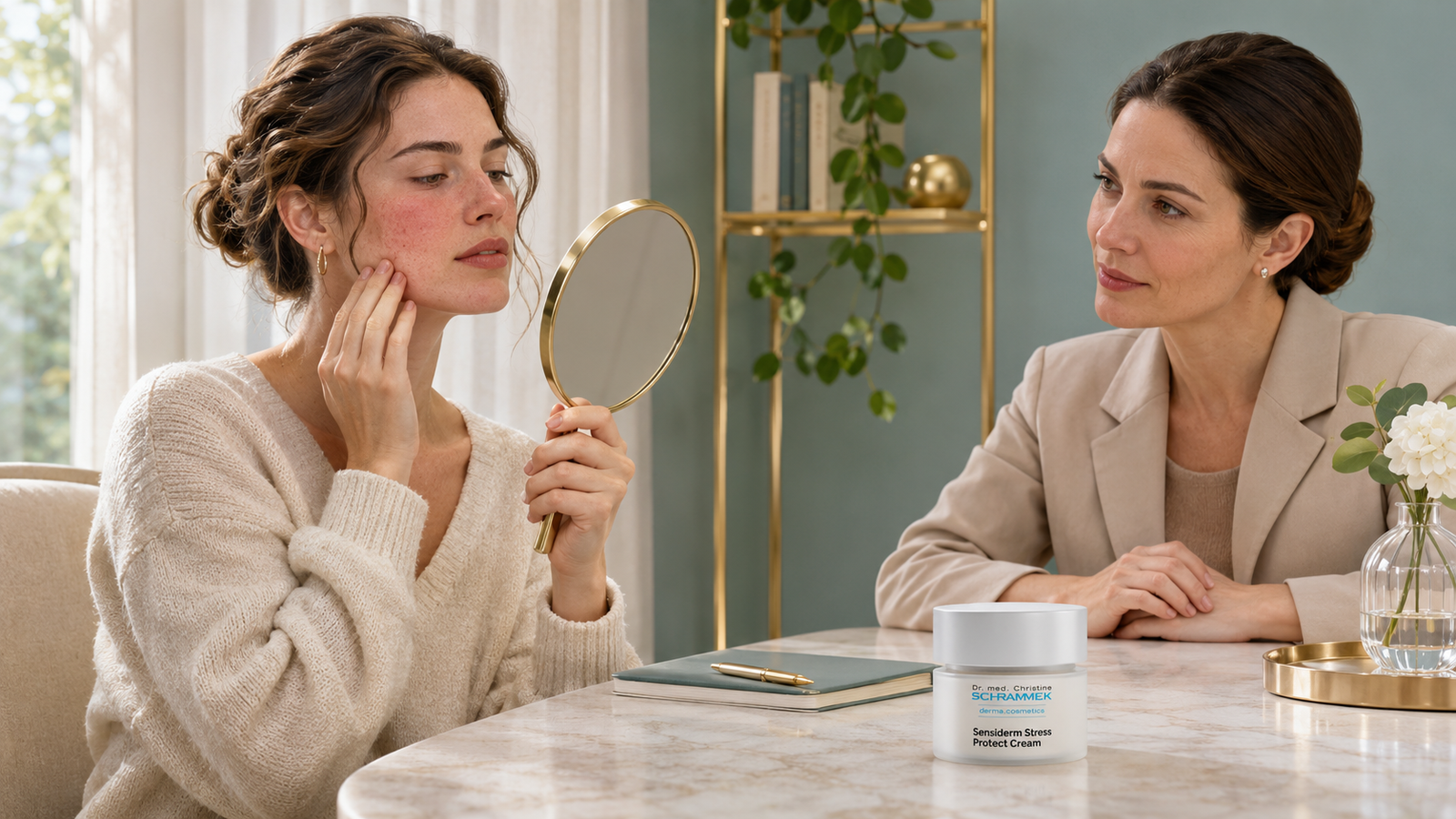
Direct answer: If your face is burning, newly red, swollen, tender, blistered, weeping, crusted, unusually hot, painful, or reacting to water and familiar products, pause the facial. A cosmetic appointment should not be used to test whether inflamed skin can tolerate more cleansing, steam, massage, extraction, exfoliation, acids, enzymes, suction, needles, heat, fragrance, or unfamiliar products. The right next step may be simple avoidance and gentle care, a clinician’s advice, or urgent medical help depending on the symptoms. If redness is mild, familiar, stable, and fully explained, a provider may still decide that a very limited service is reasonable—but that decision should follow an assessment, not a promise that every “sensitive-skin facial” is safe.
This guide answers the practical question “Can I get a facial with irritated skin?” It is written for people considering a professional facial in Istanbul, including visitors who may be dealing with travel, sun, heat, a new product, a recent procedure, or a sudden flare. It does not diagnose contact dermatitis, rosacea, eczema, acne, infection, allergy, or a burn. It also does not replace medical care. Its purpose is narrower: to help you decide whether today is a reasonable day for cosmetic treatment, what information to give the provider, what should make the appointment stop, and when a salon or clinic should refer rather than proceed.
The Short Pause Rule: Symptoms First, Facial Second
A facial is optional. Protecting irritated skin and identifying a potentially important reaction are not optional. When symptoms are new, worsening, unexplained, or uncomfortable enough to change how you wash, sleep, work, or apply ordinary products, the safest default is to pause. That does not mean every red face is an emergency, and it does not mean you can never have professional skin care. It means that adding exposures before understanding the current problem can make the picture harder to interpret and may make the skin feel worse.
Burning is particularly important because it is a symptom, not a skin type. People sometimes use “sensitive” to describe many experiences: easy flushing, dryness, tightness, stinging with products, a history of eczema, allergy, rosacea, over-exfoliation, sunburn, or discomfort after a procedure. Those situations do not have one protocol. The word “sensitive” on a menu cannot tell a provider whether the skin is stable, whether a new rash is present, or whether a treatment should proceed.
Redness also needs context. Long-standing visible vessels, a predictable blush after heat, a sharply defined sunburn, a patch where a product was applied, and rapidly spreading redness with pain are not interchangeable. Skin tone can also affect how inflammation appears: redness may be obvious on some complexions and appear purple, brown, grey, darker, or simply different in texture or warmth on others. A provider should ask about change from your normal rather than relying only on a quick visual judgment.
The American Academy of Dermatology lists burning or stinging, tenderness, swelling, heat, dryness, cracks, hives, blisters, oozing, crusting, and scaling among possible signs of contact dermatitis. The NHS notes that irritant contact dermatitis can range from mild dryness and redness to burning, stinging, and painful fluid-filled blisters. These sources do not establish the cause of your symptoms, but they show why “a little redness” should not automatically be treated as a cosmetic issue. See the AAD description of contact dermatitis signs and the NHS contact dermatitis symptom guide.
What Burning, Stinging and Redness Can Signal
Symptoms can follow many different events. A cleanser may remove too much oil; repeated acids or retinoids may irritate the surface; fragrance or a preservative may trigger contact dermatitis; heat may worsen flushing; a recent peel, laser, microneedling session, waxing, threading, shaving, or sun exposure may leave the skin temporarily vulnerable. A medical condition may also be active. A cosmetic provider does not need to diagnose the cause to recognize that proceeding is inappropriate.
Irritation after repeated or strong products
Overlapping actives are a common story: a retinoid at night, an exfoliating acid in the morning, a scrub, a cleansing brush, a new vitamin C formula, an acne treatment, and then a peel booked because the skin looks rough. Each item may have a legitimate use, but the combined schedule may exceed what the person tolerates. Clues include diffuse tightness, stinging when water touches the face, shiny-looking dry patches, flaking, and discomfort with products that were previously comfortable. The answer is not to “remove the dead layer” more aggressively. The current exposure history needs to be reviewed and the optional procedure postponed.
Possible contact reaction
A reaction may occur where a product touched the skin, but the pattern is not always obvious. Shampoo, nail products, hair dye, fragrance, adhesives, essential oils, masks, cosmetics, sunscreens, or aftershave can be relevant. Allergic contact reactions may be delayed, so the product used immediately before the rash is not necessarily the cause. A familiar product is not automatically innocent; formulations change, and people can develop a new sensitivity after previous use. If the rash is persistent or recurrent, a dermatologist may recommend formal patch testing. A salon “patch test” is not the same as medical patch testing.
Rosacea-like symptoms
Central facial redness, flushing, visible vessels, acne-like bumps, burning, stinging, and sensitivity to products can occur with rosacea, but self-diagnosis is unreliable. The AAD explains that rosacea-prone skin may burn or sting with washing, sunscreen, and makeup, and that sun and heat are common triggers. A facial cannot confirm or rule out rosacea. When symptoms are recurrent, worsening, or accompanied by eye discomfort, medical assessment is more useful than repeatedly trying “calming” salon products.
Sun, heat or wind exposure
A day of sightseeing, a boat trip, a beach visit, hot weather, cold wind, or a long flight can change how skin feels. Sunburn may not become fully apparent while you are outdoors. Heat can intensify flushing, and low-humidity travel environments may increase dryness. A provider should ask what happened during the previous days, not just what products were applied that morning. Treatment should be delayed on sunburned, windburned, or heat-irritated skin.
Reaction after another procedure
Recently treated skin should follow the aftercare and timing instructions for that exact procedure. A facial booked after waxing, threading, shaving irritation, a peel, microneedling, laser, injectable treatment, surgery, or another energy-based procedure may interfere with recovery or make it harder to identify the cause of symptoms. Do not use a generic waiting period copied from social media. Tell both providers exactly what was done, where, when, and what products or devices were used.
Possible infection or urgent reaction
Rapidly increasing pain, spreading warmth or redness, discharge, crusting with worsening symptoms, fever, chills, feeling unwell, significant swelling, eye pain, light sensitivity, vision change, breathing difficulty, wheezing, faintness, or trouble swallowing are not facial-selection questions. They require appropriate medical evaluation; severe allergic symptoms require emergency care. The FDA lists facial swelling, wheezing, trouble swallowing, shortness of breath, and lightheadedness among serious allergic-reaction signs. Do not let a cosmetic appointment delay help.
A Practical Traffic-Light Decision Before a Facial
This framework is not a diagnostic tool. It is a conservative way to organize the decision and communicate with a provider.
Red light: do not start the facial
- Breathing difficulty, wheezing, throat tightness, trouble swallowing, faintness, or rapidly increasing facial or lip swelling.
- Eye pain, marked eyelid swelling, light sensitivity, blurred vision, or other new visual symptoms.
- Blisters, open or weeping skin, active bleeding, extensive crusting, or a chemical- or heat-burn concern.
- Rapidly spreading redness or warmth, worsening pain, pus or discharge, fever, chills, or feeling generally unwell.
- A new severe rash, widespread hives, or a reaction that is progressing.
- Skin that is intensely painful or burns with water and basic contact.
These findings need medical guidance, and some need urgent or emergency care. A cosmetic provider should not attempt to cover symptoms with cooling masks, strong antiseptics, essential oils, extraction, or an “anti-inflammatory” add-on. Document the products and events, stop suspected exposures, and seek the appropriate level of care.
Amber light: postpone and clarify
- New burning, stinging, itching, tenderness, or persistent redness without an established explanation.
- Flaking, tightness, rough shiny patches, or discomfort after a new product or an increase in actives.
- A recent sunburn, windburn, waxing, threading, peel, laser, microneedling, or other procedure.
- A recurring flare that has not been medically assessed or is not following the usual pattern.
- New acne-like bumps mixed with burning or rash-like symptoms.
- Uncertainty about medicines, topical prescriptions, allergies, or the exact products planned for the appointment.
Amber does not mean “proceed gently.” It means gather the missing information and allow the skin to settle or obtain appropriate advice. Rescheduling is a successful safety decision, not a failed appointment.
Green light does not mean zero risk
A stable face with no active burning, rash, swelling, wound, recent procedure conflict, or unexplained change may be considered for a facial after consultation. Even then, the protocol should match the goal and history. A person who flushes easily may need less heat and friction. A person with a known fragrance allergy needs full ingredient review. Someone using a prescription topical may need guidance from the prescriber. Consent should cover what will be used, what sensations are expected, what can be omitted, and when the provider will stop.
The History That Changes the Decision
A useful consultation is more than “What is your skin type?” The provider should build a timeline. When did symptoms begin? What touched the face during the previous week? What changed? What has happened before? Which products were used in the last 48 hours? Did the reaction start before or after sun, heat, exercise, a flight, a hair appointment, a dental procedure, medication, or another cosmetic service?
Products and ingredients
Bring photographs or names of cleansers, moisturizers, sunscreens, makeup, masks, acne products, retinoids, acids, scrubs, essential oils, hair products, beard products, and topical medicines. Include products used only occasionally. “Natural,” “clean,” “organic,” “hypoallergenic,” and “dermatologist tested” are marketing descriptions, not guarantees of tolerance. The FDA notes that terms such as “hypoallergenic” and “for sensitive skin” do not have a single federal definition that proves a product will not cause a reaction.
Medicines and health conditions
List prescription and non-prescription medicines, topical treatments, supplements relevant to the procedure, known allergies, pregnancy or breastfeeding where relevant, immune conditions, a history of cold sores, eczema, rosacea, psoriasis, acne, pigment change, keloids, and previous reactions. Do not stop a prescribed medicine simply to qualify for a facial. If the planned service conflicts with treatment, the provider should seek prescriber guidance or postpone.
Recent procedures
Give exact dates and treated areas for peels, laser, intense pulsed light, microneedling, radiofrequency, injections, waxing, threading, dermaplaning, extractions, surgery, dental work that affected the face, or any procedure that changed the skin. Describe expected aftercare and whether recovery has followed the expected course. A second provider should not override written instructions without a sound reason.
Previous reactions
Explain what happened, how quickly it started, how long it lasted, whether medical care was needed, and which ingredients or products were involved. Photographs can help. “I am allergic to everything” is understandable shorthand but not precise enough to design a protocol. A responsible provider should not experiment with a long product list when the history is unclear.
Common Exposures Before an Appointment
Retinoids and acne treatments
Prescription retinoids, over-the-counter retinol, benzoyl peroxide, salicylic acid, azelaic acid, antibiotics, and combination acne treatments have different effects and instructions. Some may cause dryness or irritation, particularly after a change in frequency or concentration. The provider needs the exact name and schedule. Do not accept an automatic instruction to stop a prescription for an arbitrary number of days; confirm changes with the clinician who prescribed it.
Exfoliating acids, scrubs and brushes
Glycolic, lactic, mandelic, salicylic, and other acids can be useful in selected routines, but stacking them with scrubs, cleansing devices, peel pads, or professional exfoliation increases exposure. The absence of visible peeling does not prove the barrier is comfortable. Burning, tightness, and unusual sensitivity should move the decision toward postponement.
Hair and nail services
Hair dye, bleach, shampoo, styling products, fragrance, nail polish, gel systems, and adhesives can be relevant when symptoms appear on the forehead, hairline, eyelids, neck, or sides of the face. The reaction may not occur on the fingers or scalp where exposure seemed most obvious. Tell the provider about recent hair and nail appointments.
Shaving, waxing and threading
Hair removal can create short-lived redness and tenderness; it can also cause cuts, follicular irritation, or a reaction to wax, aftercare, or fragrance. Do not apply strong exfoliation or extraction over irritated areas. If the skin remains painful, swollen, broken, or rash-like, postpone and obtain advice.
Sun and travel
International visitors may arrive with sun exposure, dehydration, unfamiliar hotel products, mask friction, climate change, and disrupted routines. These factors do not require treatment; they require context. A facial should not be positioned as a way to “repair” sunburn overnight or prepare damaged skin for more sightseeing.
Why Common Facial Steps Can Be Wrong Today
Steam and heat
Steam is not required to “open pores”; pores do not open and close like doors. Heat can worsen flushing and discomfort for some people. If warmth already triggers redness, the provider should not use steam as a default step. A warm towel can also be too much when the skin is burning.
Double cleansing
More cleansing is not automatically better. Multiple surfactants, long massage, hot water, or friction from cloths can increase tightness and stinging. If cleansing is necessary, the product, temperature, contact time, and method should be chosen conservatively. Actively irritated skin may be better left alone pending advice.
Scrubs, enzymes and acids
Rough texture during irritation is not proof that exfoliation is needed. Flaking can reflect inflammation or dryness. Scrubs add friction; enzymes and acids add chemical exposure. A “gentle” label does not establish suitability, and a low percentage does not describe the complete formula, pH, vehicle, contact time, or combined protocol.
Extraction
Red bumps are not always clogged pores. Forcing extraction on inflamed, rash-like, tender, or fragile skin can cause injury and obscure the original problem. The provider should distinguish visible comedones from lesions that need medical evaluation and should leave uncertain areas alone.
Massage and tools
Massage, gua sha, rollers, brushes, sponges, microcurrent accessories, suction tips, and other tools create friction, pressure, or electrical exposure. Pleasant sensation on stable skin does not make them suitable during an unexplained flare. Avoiding massage is particularly important when rubbing itself worsens redness.
Occlusive masks
A mask may feel cooling, but it also holds ingredients against the skin. Botanical extracts, fragrance, preservatives, and active ingredients can irritate or cause allergy. Occlusion can increase exposure. The correct response to burning is not to layer another unfamiliar product and wait.
Needling, peels and energy devices
Microneedling, chemical peels, intense light, laser, radiofrequency, and other higher-intensity procedures require procedure-specific assessment. They should not be performed over active irritation, infection concern, open skin, or an unexplained rash. A provider should not downgrade a strong procedure into a “mini version” simply to keep the booking.
What a Responsible Consultation Should Include
A responsible provider is comfortable saying no, delaying, or recommending medical assessment. The consultation should document current symptoms, onset, likely exposures, diagnoses, medicines, allergies, recent procedures, sun exposure, and the client’s goal. The provider should examine the intended treatment area in good light and ask how the skin feels, not only how it looks.
The protocol should be named step by step. “Sensitive facial” is not enough. Ask which cleanser, exfoliant, device, mask, serum, moisturizer, and sunscreen will be used; whether fragrance, heat, acids, suction, extraction, or massage are included; and what can be removed without substituting another unapproved step. Ingredient lists should be available when allergy is relevant.
Consent should include realistic outcomes. A facial may improve temporary comfort or hydration on stable skin, but it cannot diagnose or cure every cause of redness. The provider should not promise barrier repair in one session, detoxification, removal of inflammation, or a guaranteed lack of reaction. “Hypoallergenic” does not transfer responsibility away from assessment.
Agree on stop criteria before starting. Increasing burning, sharp pain, intense itching, swelling, hives, eye irritation, or unexpected redness should prompt immediate communication and removal of the suspected product according to safe instructions. The client should never be told that severe burning proves an active ingredient is working.
Aftercare should be written and specific. It should list what was used, expected temporary effects, products to avoid, when to resume ordinary routines, who to contact, and which warning signs need medical attention. International visitors need a plan for help after leaving Istanbul.
What to Do Instead of Forcing the Appointment
Postponement does not mean doing nothing. The useful work may be documenting the timeline, stopping suspected new exposures, following existing medical advice, arranging a dermatology appointment, or simplifying the routine to products already known to be tolerated. Do not introduce a collection of “barrier” products at once; if symptoms change, multiple new items make the cause harder to identify.
The AAD advises people with contact dermatitis to avoid the cause, stop scratching, and use appropriate gentle care; it also recommends dermatologist guidance for raw, irritated, or hypersensitive skin. Its product-testing guidance describes repeated small-area use over seven to ten days for ordinary new skin-care products. That approach can reduce uncertainty for routine products, but it is not an emergency test and it cannot guarantee that a full professional protocol will be tolerated.
If a product appears to have caused the reaction, stop using it and keep the packaging or ingredient list. Record the time of application and symptom onset. The FDA advises stopping a cosmetic associated with an unexpected rash, redness, burn, or other reaction and contacting a healthcare provider for advice. Reporting systems differ by country; the practical principle is to preserve the product details and obtain appropriate care.
Once the skin is stable and the cause is understood, the next appointment can be reconsidered with fewer variables. The plan may use familiar products, omit heat and exfoliation, shorten contact time, avoid fragrance, treat a smaller area, or choose no procedure at all. A previous reaction should improve planning, not be erased from the record.
Planning a Facial in Istanbul When Your Skin Is Irritated
Do not schedule an aggressive first-time procedure immediately after arrival or just before a flight, wedding, photography session, or important meeting. Travel adds time pressure, but a deadline does not make inflamed skin suitable. If symptoms arise, change the plan rather than asking the provider to hide redness for the event.
Send clear photographs before travelling to the clinic, while understanding that photographs cannot replace examination. Include a list of products and procedures, the date symptoms began, and any medical diagnoses. Ask whether the clinic will recommend postponement based on the information provided. A professional answer may be “we need more information” or “seek medical advice first.”
For longer-term planning, review our guide to professional facials for sensitive and reactive skin in Istanbul. If tightness and flaking are the main concern after irritation has settled, the comparison of dry versus dehydrated skin explains why oil deficiency, water loss, and active inflammation should not be treated as the same problem. A professional skin analysis can organize observations and history, but it cannot diagnose a rash or replace medical assessment.
Myths vs Facts
Myth: Burning means the product is working
Fact: Increasing burning is a warning symptom, not a performance measure. Tell the provider immediately. The product should be removed appropriately, and the skin should be assessed.
Myth: A sensitive-skin facial is safe during every flare
Fact: A menu name does not diagnose the cause or severity of symptoms. Active burning, swelling, rash, broken skin, or unexplained redness may require postponement or medical advice.
Myth: Natural ingredients cannot cause reactions
Fact: Essential oils and botanical extracts can irritate skin or cause allergy. Natural origin is not proof of tolerance.
Myth: Steam opens pores and releases irritation
Fact: Pores do not open like doors. Heat can worsen flushing or discomfort and should not be routine on irritated skin.
Myth: Exfoliation removes the damaged layer
Fact: Flaking and roughness during irritation may reflect inflammation or dryness. More exfoliation can add injury and delay recovery.
Myth: If a product was fine last year, it cannot be the cause
Fact: Formulas can change, and allergy can develop after previous exposure. A delayed reaction can also make the timeline confusing.
Myth: A quick salon patch test guarantees safety
Fact: A small informal test has limits and is not the same as medical patch testing. It cannot guarantee tolerance to a multi-step facial.
Myth: Redness is always visible in the same way
Fact: Inflammation can appear differently across skin tones. Warmth, swelling, texture, tenderness, and change from baseline also matter.
Myth: Cooling masks treat every reaction
Fact: A mask adds ingredients and exposure. It may be inappropriate when the cause is unknown or the skin is open, blistered, or severely inflamed.
Myth: Rescheduling wastes the appointment
Fact: A well-documented postponement protects the client and allows a better-informed plan later.
Frequently Asked Questions
1. Can I get a facial if my face is slightly red?
It depends on whether the redness is normal for you, stable, comfortable, and explained. New, persistent, worsening, hot, tender, itchy, burning, swollen, or rash-like redness should be postponed and assessed. A provider should ask about products, sun, heat, procedures, medicines, and previous episodes before deciding.
2. What if my skin only burns when I apply products?
That is still relevant. Burning with several ordinary products can indicate active irritation or a condition that needs assessment. Stop introducing new products and do not use a facial to discover what the skin tolerates. Seek medical advice if symptoms persist, worsen, or are accompanied by rash, swelling, eye symptoms, or broken skin.
3. Is stinging with water a reason to cancel?
Marked stinging with water suggests the skin is uncomfortable enough that optional treatment should wait. Keep the routine simple and avoid scrubs, acids, heat, fragrance, and multiple new products. If it does not improve promptly or is severe, obtain healthcare advice.
4. Can a hydrating facial calm irritation?
A familiar gentle moisturizer can support comfort in some situations, but a hydrating facial is a multi-step exposure and is not a diagnosis or treatment for an unexplained reaction. Cleansers, massage, masks, serums, fragrance, preservatives, and heat can still irritate. Postpone until suitability is clear.
5. Should I have a facial after using too much retinol?
If there is burning, tenderness, peeling, or unusual redness, postpone. Tell the provider the exact product, strength, frequency, and last use. Do not stop prescription treatment based only on salon advice; contact the prescriber if you need instructions.
6. How long should I wait after irritation?
There is no universal number of days. Wait until the skin has returned to its usual comfortable baseline and any medical or procedure-specific advice has been followed. A calendar interval does not override persistent burning, redness, swelling, wounds, or a recurring rash.
7. Can I have extractions if only one area is irritated?
The provider should assess the whole context and avoid the irritated area. However, a localized reaction may still affect product choice and may need diagnosis. Painful, rash-like, cystic, pustular, or uncertain lesions should not be forced. Rescheduling may be simpler and safer.
8. Is a fragrance-free facial automatically safe?
No. Fragrance is only one possible issue. Preservatives, surfactants, acids, botanicals, adhesives, and other ingredients can irritate or cause allergy. “Fragrance-free” also does not prove that a procedure is appropriate for active inflammation.
9. Can sensitive skin tolerate steam?
Some people tolerate mild warmth, but heat can worsen flushing and discomfort. Steam is not required to open pores. If heat is a known trigger or the face is already burning or red, omit it and reconsider whether the facial should happen at all.
10. What if I have rosacea?
Tell the provider about the diagnosis, current treatment, triggers, and whether symptoms are stable. Avoid rubbing, scrubbing, and unnecessary heat. During a flare or when symptoms are changing, follow your clinician’s advice and postpone optional procedures. Eye symptoms need prompt medical attention.
11. Can makeup hide redness for the consultation?
You may arrive as you are, but the provider needs to see the skin and understand the baseline. Do not aggressively remove makeup immediately before the appointment. Bring the makeup and remover names if they may be relevant. New swelling, hives, or severe symptoms should not be concealed to proceed.
12. Should I take an antihistamine so I can have the facial?
Do not use medication to qualify for an optional procedure without appropriate medical guidance. Antihistamines may be used for specific conditions, but they can also mask symptoms and do not make an unknown product or procedure safe.
13. Can a patch test be done immediately before treatment?
A quick test may reveal immediate irritation but cannot rule out delayed allergy or predict the effect of a full multi-step protocol. The AAD describes repeated small-area testing over seven to ten days for ordinary products. Medical patch testing is a different diagnostic process.
14. What if the provider says tingling is normal?
Ask what sensation is expected, how intense it should be, and how long it should last. Mild transient tingling from some products is not the same as increasing burning, sharp pain, itching, swelling, or hives. You can stop at any time. Severe or escalating symptoms should not be normalized.
15. Can I get a facial after sunburn?
No. Sunburned skin should be protected and allowed to recover. Do not add exfoliation, steam, massage, fragrance, or devices. Significant blistering, swelling, severe pain, extensive burn, or systemic symptoms require medical advice.
16. Can I have a facial after waxing or threading?
Wait until the skin is intact, calm, and no longer tender or unusually red, following the hair-removal provider’s instructions. Do not apply strong acids, scrubs, or heat over freshly treated or irritated areas. Persistent symptoms need assessment.
17. What if redness is caused by a long flight?
Do not assume travel is the cause. Review sun, climate, hotel products, masks, food, medicines, and prior symptoms. If redness is mild and resolves, a later conservative consultation may be reasonable. Burning, swelling, rash, eye symptoms, or worsening discomfort should prompt postponement.
18. Can men with shaving irritation have a facial?
Shaving irritation, cuts, follicular bumps, aftershave fragrance, and ingrown hairs need separate assessment. Avoid exfoliation and extraction over tender or broken areas. If the pattern is persistent, painful, pustular, or spreading, seek appropriate medical advice rather than treating it as ordinary sensitivity.
19. Does oily skin still need to pause?
Yes. Oiliness does not protect against irritation or allergy. Strong degreasing, scrubs, acids, and extractions can worsen discomfort while oil production continues. Treat the current symptoms, not a skin-type label.
20. What if only my eyelids are red?
Eyelid skin is thin and can react to products transferred from hair, hands, nails, or cosmetics. Avoid applying facial products close to irritated eyes. Swelling, pain, light sensitivity, discharge, or visual change needs prompt medical evaluation.
21. Is cold therapy safe for irritated skin?
Extreme cold can injure skin, and direct ice should not be applied. A cool—not freezing—compress may be suggested for some mild reactions, but this does not make a facial appropriate. Follow medical advice for severe, persistent, or uncertain symptoms.
22. Can I use essential oils to calm redness?
Essential oils can irritate skin or cause allergy. Do not apply them to an unexplained facial reaction, especially undiluted. “Natural” does not mean non-irritating. Keep a list of anything already applied and stop adding new exposures.
23. Should I exfoliate flakes before the appointment?
No. Flakes can reflect dryness, irritation, dermatitis, or recovery from another procedure. Scrubbing them off can create more injury. Allow the provider or clinician to assess the skin without extra manipulation.
24. What if I already paid a deposit?
Safety should not depend on payment. Contact the provider promptly, document the symptoms, and ask how the clinic handles medically unsuitable appointments under its written policy. Do not conceal symptoms or accept a substitute procedure merely to avoid losing the booking.
25. Can the provider treat only the non-red areas?
Sometimes a limited service may be possible, but an unexplained facial reaction can influence the whole protocol and product exposure. A provider should not improvise around significant symptoms. Postponement is often the clearer decision.
26. When is redness an emergency?
Seek emergency help for breathing difficulty, wheezing, throat tightness, trouble swallowing, faintness, severe rapidly increasing swelling, or other signs of a serious allergic reaction. Eye pain or vision change also needs urgent assessment. Rapidly worsening pain, spreading warmth, discharge, fever, or feeling unwell needs prompt medical advice.
27. What photographs should I take?
Use similar neutral lighting, include close and wider views, and record the time. Do not use beauty filters. Photograph relevant product labels and ingredient lists. Images help show change but cannot diagnose the cause.
28. What should be recorded if a reaction starts during the facial?
Record the exact products, order, contact times, devices, settings where applicable, symptoms, timing, removal steps, photographs, and aftercare. The provider should give written product names and a contact route. Significant symptoms require healthcare advice.
29. Can I rebook once the redness disappears?
Disappearance is encouraging but does not always identify the cause. Review the timeline and avoid repeating the identical protocol blindly. If the reaction was severe, recurrent, or unexplained, medical advice may be appropriate before rebooking.
30. What should I ask Nexja before coming?
Describe when symptoms began, what they feel like, recent products and procedures, medicines, allergies, and any diagnosis. Ask whether the appointment should be postponed, which exact products and steps would be used, what can be omitted, and what findings would trigger referral. A cautious answer is a sign of responsible care.
Decision Checklist for the Day of the Appointment
- Is the skin at its normal comfortable baseline?
- Is there any new burning, stinging, itching, pain, swelling, rash, blister, wound, oozing, crusting, or unusual warmth?
- Was there sunburn, waxing, threading, shaving injury, a peel, laser, microneedling, injection, or another recent procedure?
- Were new products, stronger actives, hair dye, nail products, fragrance, or hotel products introduced?
- Are medicines, topical prescriptions, allergies, and previous reactions documented?
- Can the provider name every planned product and step?
- Are heat, friction, exfoliation, suction, extraction, and devices optional rather than automatic?
- Are stop criteria and aftercare clear?
- Is medical advice needed before cosmetic treatment?
- Would postponement make the decision safer and easier to interpret?
If any answer creates uncertainty, pause. A good provider will prefer a documented delay over an avoidable reaction. The aim is not to complete a menu item at any cost. It is to choose care that fits the condition of the skin on that day.
Why “Irritated” Is a Decision Description, Not a Diagnosis
People use the word irritated when they notice almost any unwanted facial change. It may mean dryness after a flight, stinging after a new serum, flushing after heat, an itchy rash after fragrance, tenderness after a procedure, a shaving reaction, or a worsening skin condition. That broad language is useful for starting a conversation, but it is too imprecise to choose a procedure. The provider’s first responsibility is not to assign a salon diagnosis. It is to recognize uncertainty, identify warning signs, and avoid adding exposure when the skin is not at baseline.
A diagnosis matters because different problems can look similar while requiring different responses. Irritant contact dermatitis results from direct injury or disruption by an exposure. Allergic contact dermatitis involves an immune reaction and may appear after a delay. Rosacea can include flushing, persistent central redness, visible vessels, bumps, burning, or eye symptoms. Acne can coexist with irritation, but inflamed lesions are not evidence that the face needs stronger cleansing. Infection, sunburn, medication reactions, and post-procedure complications also belong outside a routine facial decision. A cosmetic professional should know the limits of scope and refer appropriately.
The time course can be more useful than a single photograph. Minutes after applying a product may suggest immediate irritation or an acute reaction; symptoms appearing a day or two later can still be linked to exposure. A recurrent pattern after heat, sun, alcohol, spicy food, or stress may point the conversation in a different direction. A sharply limited patch can suggest contact, while widespread symptoms or systemic signs change urgency. None of these patterns allows a salon to diagnose, but they help explain why a fixed facial protocol is unsafe.
Sensation should be documented separately from appearance. Ask whether the skin burns at rest, only with water, only with products, or only during flushing. Ask about itch, pain, tightness, heat, numbness, or tenderness. Record whether symptoms interrupt sleep and whether they are getting better, worse, or staying the same. A face that looks only mildly different may still be intensely uncomfortable, especially across skin tones where colour change is less obvious.
Understanding Barrier Language Without Overpromising
The outermost skin layer helps limit water loss and exposure to the environment. Cleansing, friction, low humidity, UV exposure, some active ingredients, and inflammatory skin conditions can affect how comfortable and resilient the surface feels. This is often described as “barrier disruption.” The phrase can be useful, but it is frequently stretched into a diagnosis for every red or stinging face. A camera score, a device reading, or a consultant’s impression cannot rule out dermatitis, allergy, rosacea, infection, or another medical problem.
Barrier-supportive care usually means reducing unnecessary exposure and using a tolerable cleanser, moisturizer, and sun protection when appropriate. It does not mean that every product marketed with ceramides, hyaluronic acid, panthenol, botanical extracts, or “repair” language will be comfortable. A long mask, occlusive layer, fragranced balm, or complex serum can still sting. The safest product during an unexplained reaction is not automatically the one with the most barrier claims; it is the one supported by the person’s history and appropriate professional advice.
A single facial cannot guarantee complete barrier repair. Temporary softness or reduced tightness after hydration does not prove that the cause has resolved. Conversely, a product that stings does not necessarily mean permanent damage has occurred. The useful outcome is a calm plan: remove avoidable triggers, protect the skin, monitor symptoms, and seek medical assessment when the pattern is severe, persistent, recurrent, or unclear.
Providers should be cautious with before-and-after moisture readings. Environmental conditions, recent cleansing, product residue, device method, and measurement location can influence numbers. Measurements may help document a visit, but they should not be used to pressure a client into treatment while the skin is visibly or symptomatically inflamed. Subjective comfort, clinical history, visible integrity, and scope limits remain central.
A Detailed Same-Day Assessment Workflow
Step 1: Pause the service before product contact
If the client reports burning or new redness at reception, do not begin with cleansing “so we can see the skin.” Ask questions first. Removing makeup with an unfamiliar cleanser is already an exposure. Photograph the skin with consent, record the complaint in the client’s own words, and establish whether urgent symptoms are present.
Step 2: Screen for urgent and medical warning signs
Ask about breathing, swallowing, faintness, rapid swelling, eye pain, visual change, fever, chills, discharge, severe pain, blisters, open skin, and rapidly spreading symptoms. A positive answer can move the issue beyond cosmetic scope. The provider should have a written escalation process, know local emergency contacts, and avoid driving or transporting a severely unwell client without appropriate guidance.
Step 3: Build the exposure timeline
Start at least several days before the first symptom. Include skin care, makeup, hair and nail services, shaving, sun, heat, exercise, swimming, hotel products, laundry products touching pillowcases, masks, medicines, topical prescriptions, and procedures. Record product names rather than categories. “A vitamin C” is less useful than the full product and concentration; “a peel” is less useful than the exact procedure and date.
Step 4: Compare with the person’s baseline
Ask what the skin normally looks and feels like. Some people have stable visible vessels or predictable flushing. Others have never experienced facial burning. Determine whether the current episode is familiar, whether it follows a clinician-confirmed pattern, and whether it is responding to the existing management plan. A familiar diagnosis does not automatically make today suitable, but it gives better context.
Step 5: Review the requested facial goal
The client may want glow, extraction, hydration, event preparation, or relief from discomfort. Clarify that relief from a possible medical flare is not a cosmetic claim. If the goal is to hide redness for an event, discuss postponement and familiar makeup only when appropriate, rather than introducing a peel or extraction. If the goal is comfort, a no-treatment consultation may be the best service.
Step 6: Decide and document
Record whether the service is cancelled, postponed, modified, or referred, and why. If proceeding with any limited service, list every included and excluded step, products, stop criteria, and aftercare. If postponing, give a concrete next action: contact the prescriber, seek dermatology assessment, allow recovery after a recent procedure, or rebook only after the skin returns to baseline.
Step 7: Follow up proportionately
A client referred for urgent symptoms should not receive casual messages that imply the salon has diagnosed the problem. A postponed client can receive a brief check-in and a request for updated information before rebooking. Keep records of communications and do not recommend multiple new products remotely without adequate context.
Scenario Walkthroughs: How the Decision Changes
Scenario A: Burning after a new acid toner
A visitor started a daily acid toner three days ago and now feels burning with water, tightness, and diffuse flaking. There are no breathing problems, swelling, blisters, discharge, fever, or eye symptoms. This is not a green light for a “hydrating peel.” The facial should be postponed, the new product stopped, and the person advised to use only previously tolerated gentle care and seek medical advice if symptoms are severe, persistent, or worsening. Recording the exact toner and other actives is more useful than choosing a soothing mask.
Scenario B: Stable mild flushing with known triggers
A client has a diagnosed condition, stable symptoms, an established medical plan, and predictable mild flushing after entering a warm room. There is no burning, swelling, rash, wound, or recent procedure. A provider may consider a conservative service after reviewing products and triggers, omitting heat, scrub, aggressive massage, and unnecessary actives. Proceeding is not mandatory; the client’s comfort and clinician’s advice remain important.
Scenario C: Eyelid swelling after a nail appointment
A client develops itchy red eyelids the day after a nail service. The face was not directly treated. Contact allergy can involve substances transferred by the hands, and eyelid skin is particularly delicate. A facial should not proceed around the eyes, and adding eye masks or botanical products may confuse the reaction. The client should obtain appropriate medical advice, especially if swelling is significant or eye symptoms occur.
Scenario D: Tender redness after a day in the sun
A tourist spent hours outdoors and now has hot, tender, uniformly red skin. They want exfoliation before an event. The correct decision is to postpone. Exfoliation, steam, massage, acids, and devices add stress to sunburned skin. Blistering, severe pain, extensive burn, dehydration, dizziness, or systemic symptoms need medical evaluation.
Scenario E: Local shaving bumps without burning
A client has a few familiar shaving bumps on the neck but no diffuse redness, burning, open cuts, or worsening pain. The provider may avoid the affected area and modify products, but should still examine for pustules, spreading inflammation, or infection concern. If the bumps are recurrent, painful, scarring, or uncertain, medical assessment may be more useful than repeated extraction.
Scenario F: Redness two days after a peel
A client books a facial because recovery from another provider’s peel feels slower than expected. The current provider should not layer a neutralizing product or scrub without knowing the exact peel, concentration, contact time, aftercare, and expected course. Contact the original provider and seek medical advice for worsening pain, blisters, discharge, eye involvement, or other warning signs. The priority is recovery and documentation, not a new facial.
Scenario G: Hives and lip swelling
Raised itchy welts with lip or facial swelling can be part of an allergic reaction. If there is breathing difficulty, wheezing, throat tightness, trouble swallowing, faintness, or rapid progression, emergency help is needed. A salon must not delay by offering cold rollers, antihistamine advice beyond scope, or a calming treatment.
Scenario H: Roughness after a long flight
A traveller reports dryness and roughness but no burning, rash, swelling, pain, recent procedure, or new reaction. The provider can review hotel products, sun exposure, and ordinary routine. A conservative hydration-focused service may be reasonable if products are familiar and the skin is intact. The key difference is absence of active inflammatory symptoms, not the traveller’s desire to refresh quickly.
How to Evaluate Product Claims During a Flare
Marketing language can sound reassuring precisely when people are most worried. “Calming,” “soothing,” “barrier repair,” “post-procedure,” “dermatologist tested,” “hypoallergenic,” and “sensitive” do not guarantee that a product is suitable for a specific reaction. Ask for the full ingredient list and the reason each product is proposed. A provider should be able to omit a product without replacing it with another complex formula.
Fragrance deserves attention because it is a common source of cosmetic reactions, but avoiding fragrance does not eliminate every risk. “Unscented” can mean that masking fragrance is used, and botanical extracts can contain aromatic components. Preservatives are necessary in many water-based products and may also be relevant for some individuals. Surfactants, acids, retinoids, solvents, and high concentrations of certain ingredients can cause irritation without allergy.
Do not focus only on the highlighted active ingredient. The vehicle, pH, concentration, contact time, application amount, occlusion, and combination with other products matter. A low-percentage acid left on for longer or combined with friction may be more irritating than the percentage implies. An enzyme mask under occlusion is not automatically milder than a brief product used as directed.
Professional-only branding is not proof that the formula cannot cause a reaction. Training and correct use can reduce avoidable error, but no product is universally tolerated. Likewise, a luxury price or natural origin does not change the need for assessment. The provider’s willingness to disclose products, follow instructions, and stop when symptoms occur is more important than prestige language.
Communication Templates You Can Use
Message before the appointment
“My face developed burning and redness on [date]. It feels [describe sensation] and is [better/worse/unchanged]. In the previous week I used [products] and had [procedures/sun/travel]. I have [diagnoses/allergies/medicines]. There is/is not swelling, blistering, broken skin, eye discomfort, fever, discharge, or breathing difficulty. Should the facial be postponed, and what information do you need before I rebook?”
Questions at consultation
- What findings would make you stop or postpone today?
- Which exact products and ingredients would touch my skin?
- Will you use steam, heat, exfoliation, extraction, suction, massage, needles, or energy devices?
- Can every nonessential step be omitted without substitution?
- What symptoms are expected, and which are not?
- Who should I contact after the appointment?
- When should I seek medical care rather than contact the clinic?
Message after an unexpected reaction
“Symptoms began at [time] after [step/product]. I now have [burning/itching/swelling/pain/rash]. The symptoms are [progressing/stable/improving]. Please send the exact product names, ingredient lists, devices, settings, contact times, and aftercare used. I am seeking appropriate medical advice because [warning signs, if present].”
These templates improve documentation but do not replace urgent action. If severe allergic symptoms, eye pain, vision change, rapidly increasing swelling, fever, spreading pain, or other urgent signs occur, seek medical help immediately rather than waiting for a message response.
What Appropriate Aftercare Documentation Looks Like
Aftercare should be linked to the actual service, not copied from a generic card. It should state the date, products, devices, treatment areas, expected effects, and what the client should avoid. It should explain when ordinary cleansing, makeup, actives, exercise, heat, and sun exposure may resume, but only for the procedure performed. If no treatment occurred because the skin was irritated, the note should document postponement and referral rather than pretending a facial was completed.
Clients should receive product names in a form they can share with a healthcare professional. “Professional calming serum” is not enough. Include the brand, exact product, and ingredient list or manufacturer reference when possible. If a device was used, include its name and relevant settings according to record policy. Good documentation protects both the client and provider and makes later troubleshooting more precise.
Warning signs should be written in plain language. Severe or increasing pain, significant swelling, blisters, open or weeping skin, rapidly spreading redness or warmth, discharge, fever, chills, breathing difficulty, trouble swallowing, faintness, eye pain, light sensitivity, or visual change should not be buried in small print. State who to contact and when emergency services are appropriate.
Follow-up should not involve diagnosing by chat. Photographs and symptom descriptions can help decide whether the person needs medical evaluation, but a salon should avoid telling a client that a major reaction is normal “purging.” The terms detox and purge should not be used to dismiss swelling, hives, blisters, severe burning, or infection signs.
Additional Frequently Asked Questions
31. Can a facial make contact dermatitis worse?
Yes. Cleansers, fragrance, preservatives, botanicals, adhesives, massage, heat, and active ingredients can add exposure or friction. If contact dermatitis is possible, postpone and avoid the suspected trigger. A dermatologist may recommend medical patch testing when the cause is unclear.
32. Is redness after exercise different from a rash?
Exercise-related flushing may be brief and familiar, but persistent redness, burning, itching, bumps, swelling, or a changed pattern deserves assessment. Arrive after the skin has returned to baseline so the provider can evaluate the normal condition. Do not assume every post-exercise change is harmless.
33. Can dehydration cause facial burning?
Dryness and environmental water loss can increase tightness and sensitivity, but burning should not automatically be labelled dehydration. Products, dermatitis, rosacea, sun exposure, procedures, and other causes may be relevant. Treating the label with a complex facial can delay proper evaluation.
34. Should a facial therapist diagnose my rash?
No. The therapist can observe, document, recognize warning signs, and refer. Diagnosis and treatment of a skin disease belong to qualified healthcare professionals. A cautious scope boundary is a strength, not a lack of expertise.
35. Can I use a sheet mask before visiting the clinic?
Avoid adding a new product to an unexplained reaction. Sheet masks hold ingredients against the skin and can contain fragrance, preservatives, or botanicals. Bring the package if you already used one and symptoms followed.
36. What if my skin feels hot but does not look red?
Sensation matters. Heat, burning, tenderness, and swelling may be important even when colour change is subtle. Compare with your baseline, stop new exposures, and postpone optional treatment until the cause and severity are clearer.
37. Can LED light calm an active reaction?
Do not use a device as a substitute for diagnosis. LED parameters, evidence, contraindications, and product combinations vary. Active unexplained irritation, medication sensitivity, eye concerns, or a recent procedure require assessment before device use.
38. Can oxygen facials treat redness?
“Oxygen facial” can describe different devices and products. The name does not establish medical benefit or safety during a flare. Ask what will touch the skin and postpone if symptoms are active or unexplained.
39. Is micellar water always gentle?
No product is universally gentle. Micellar waters contain surfactants and other ingredients, and rubbing with cotton pads adds friction. If a familiar remover suddenly stings, stop and reassess rather than cleansing repeatedly.
40. Can I use petroleum jelly?
The AAD mentions petroleum jelly as an option for some minor product reactions, but individual needs differ and occlusion is not appropriate for every condition. Use healthcare guidance for significant, persistent, infected-looking, or uncertain symptoms. Do not layer it over multiple unknown actives.
41. Should I wash my face immediately after a reaction?
If a product is causing immediate irritation, gently removing it as directed can be sensible, but avoid hot water, scrubbing, or repeated cleansing. Chemical exposures, eye contact, severe reactions, or burns need specific urgent guidance. Preserve the product label.
42. Can redness be caused by sunscreen?
Yes, any cosmetic can potentially irritate or cause allergy, although sun protection remains important. Record the exact formula and stop the suspected product during a reaction. A clinician can help choose alternatives; do not remain unprotected in strong sun while testing products.
43. What does “non-comedogenic” tell me about irritation?
It refers to a product’s intended tendency not to clog pores; it does not guarantee that the product will not sting, irritate, or cause allergy. Acne suitability and irritation tolerance are separate questions.
44. Is redness from niacinamide possible?
Any formula can be uncomfortable for some people, and concentration plus other ingredients matter. Do not diagnose the cause from one highlighted ingredient. Stop the suspect product, document the full formula, and seek advice if symptoms persist or are severe.
45. Can vitamin C cause burning?
Some vitamin C formulas are acidic or contain other potentially irritating ingredients. Burning is not required for effectiveness. Stop use during an active reaction, review the exact formula and other actives, and do not add a peel or scrub.
46. Does facial redness mean my skin is thin?
Not necessarily. Redness can relate to many factors, including flushing, inflammation, sun, heat, contact reactions, or visible vessels. “Thin skin” is often used loosely and should not replace an assessment.
47. Can I have a facial while taking antibiotics?
It depends on the medicine, reason for treatment, skin condition, and planned procedure. Provide the exact name and prescriber instructions. Do not stop medication for a facial. Active infection or illness may make postponement necessary.
48. Can I have a facial during an eczema flare?
Active eczema requires appropriate medical management. A multi-product facial can introduce irritants or allergens and should generally be postponed during a flare unless the treating clinician has given specific guidance. Avoid scratching and new products.
49. Can a facial spread infection?
Working over infected skin can worsen injury, contaminate tools or products, and expose other areas. Pus, spreading warmth, increasing pain, fever, or feeling unwell needs medical advice. Hygiene does not make treatment over a suspected infection appropriate.
50. What is the single best rule?
Do not use an optional facial to test active, unexplained, or worsening symptoms. Pause, document, remove avoidable exposures, and obtain the right level of medical advice. Resume only when the skin is stable and the protocol can be justified.
A Conservative Rebooking Plan
Rebooking should be based on recovery and understanding, not simply the next available date. First confirm that the skin has returned to its usual baseline: no active burning, unusual stinging, tenderness, swelling, open areas, weeping, crusting, or unexplained rash. If a clinician diagnosed the problem or gave treatment instructions, follow that plan and ask whether the proposed cosmetic service is appropriate. If another procedure caused the reaction, obtain the original product or device details and the expected recovery guidance.
Next, reduce variables. Do not introduce several new products in the week before the rescheduled visit. Use products that are already tolerated and keep a short record of any symptoms. Send the provider the updated timeline, photographs, diagnoses, medicines, and known triggers. Ask the provider to confirm the exact protocol in writing, including the cleanser, mask, moisturizer, sunscreen, devices, heat, exfoliation, extraction, and massage. A vague promise to “make everything gentle” is less useful than a step-by-step plan.
The first appointment after a reaction may appropriately be shorter and simpler. Familiar products, minimal friction, no steam, no exfoliation, and no unnecessary device exposure may reduce uncertainty, but only if treatment is otherwise suitable. A provider can choose to perform consultation only. There is no obligation to replace a postponed strong procedure with a low-intensity one on the same day.
Plan follow-up before starting. The client should know which temporary effects are expected, how long they usually last, who will respond to questions, and which signs require medical care. International visitors should consider whether they will remain in Istanbul long enough for review. If meaningful follow-up is impossible, delaying treatment until home may be safer.
Finally, treat the previous episode as permanent information. Record suspected products, dates, sensations, photographs, and medical conclusions. Do not repeat the identical protocol merely because the skin later looked normal. A careful rebooking plan changes at least one relevant variable or explains why the original exposure is not believed to be responsible.
Provider Quality Markers
- The provider asks how the skin feels and how it has changed, not only what treatment the client wants.
- They document products, medicines, allergies, diagnoses, recent procedures, travel, sun, and previous reactions.
- They can name every product and step and provide ingredient information when needed.
- They explain scope limits and refer medical concerns without presenting referral as a sales failure.
- They do not use burning, redness, or peeling as automatic proof that a product is effective.
- They can postpone without pressuring the client into a substitute service.
- They use clean tools and sound hygiene while also recognizing that hygiene alone does not make inflamed skin treatable.
- They provide written stop criteria, aftercare, and warning signs.
- They preserve records and respond to a reaction with specific product details rather than vague reassurance.
- They avoid guaranteed outcomes and do not claim that natural, professional, or hypoallergenic products are reaction-proof.
Red flags include refusing to disclose products, insisting that steam or exfoliation is mandatory, diagnosing a rash from a photograph, encouraging a client to stop prescribed medicine without the prescriber, describing significant swelling or blistering as detox, or promising that one calming facial will repair every barrier problem. A provider who pauses when information is incomplete demonstrates professional judgment.
A Practical Pre-Appointment Conversation
A useful facial consultation starts before anyone touches the skin. You do not need to identify a medical condition or arrive with a perfect explanation. Describe what changed, when it changed, how it feels, and what has touched the area recently. That short history helps the provider decide whether the planned service still fits the condition of the skin on that day. It also prevents a common problem: treating the original booking as fixed even though the skin has changed since the appointment was made.
Begin with timing. Say whether the burning, stinging, heat, tightness, itching, swelling, or redness began today, yesterday, several days ago, or after a specific event. Mention whether it is improving, stable, or becoming more noticeable. A brief symptom timeline is more useful than a label such as sensitive skin, because the label does not show whether the present reaction is active. Photographs from earlier in the day may help show a trend, but they do not replace an in-person assessment or medical advice when symptoms are concerning.
Next, list recent exposures in plain language. Include a new cleanser, sunscreen, fragrance, hair product, laundry product, makeup, mask, adhesive, home peel, exfoliating tool, retinoid, acne treatment, depilatory product, or professional procedure. Also mention unusually long sun exposure, heat, friction, shaving, waxing, or vigorous exercise if symptoms appeared soon afterward. The goal is not to prove a cause. It is to avoid adding more variables while the skin is reacting and to give the provider enough context to make a conservative decision.
Ask a direct operational question: “Given what you can see and what I have described, should today’s service be postponed, simplified, or referred for medical assessment?” This wording keeps the decision focused on suitability rather than sales or schedule pressure. A responsible answer may be to pause. Avoiding the irritated region is not automatically adequate. Widespread redness, burning, broken skin, swelling, weeping, blistering, eye-area involvement, or rapidly worsening symptoms make postponement more important.
If the provider recommends proceeding, ask exactly what will be used and what sensations are expected. Request the product names and ask whether heat, friction, extraction, acids, enzymes, fragrance, or devices are part of the plan. Expected mild sensations should not be used to dismiss escalating pain, intense burning, or new swelling. Agree on a stop signal before the service begins. During treatment, report a change immediately rather than waiting for the next step or assuming discomfort is required for results.
If the appointment is postponed, ask what objective signs should guide rebooking. A calendar interval alone is not enough because recovery differs. A practical answer may include intact skin, no active burning or stinging, redness returned to baseline, no new swelling or weeping, and normal tolerance of a simple routine. If symptoms persist, recur, spread, or interfere with sleep or daily activity, medical evaluation is more appropriate than repeatedly testing the skin with facials.
Ask the clinic to document the postponement and the reason in neutral terms. A short note—active burning after a new product, visible diffuse redness, barrier not intact, medical review advised—creates continuity for the next visit. It helps the future provider understand that the decision was based on the condition of the skin, not on a generic preference. Good documentation supports safer rebooking and reduces the temptation to repeat the same triggering combination without reflection.
A Concise Script You Can Use
“My skin began burning and looking red after [exposure] on [date]. It is currently [improving, stable, or worsening], and I also notice [itching, swelling, broken skin, or no additional symptoms]. I have used [recent products or treatments]. Please assess whether the planned facial is appropriate today. I am comfortable postponing if the skin is not ready, and I want to know what signs should be present before I rebook.”
Final Decision Summary
When asking “Can I get a facial with irritated skin?”, begin with symptoms rather than the menu. Burning, new or worsening redness, swelling, tenderness, blisters, open or weeping skin, crusting, eye symptoms, severe pain, or systemic signs move the decision away from cosmetic treatment. Severe allergic symptoms, eye or vision problems, rapidly spreading pain or warmth, discharge, fever, or feeling unwell require prompt medical care.
If symptoms are mild but new or unexplained, postpone, document the exposure timeline, stop suspected new products, and obtain appropriate advice. If the skin is stable, comfortable, and at baseline, a conservative facial may be considered after a transparent consultation. The plan should identify products, omit unnecessary heat and friction, establish stop criteria, and provide written follow-up.
At Nexja in Istanbul, the safest outcome may be adaptation, postponement, or referral. The goal is not to complete a facial because a booking exists. It is to make a defensible decision for the condition of the skin on that day.
Sources and Further Reading
- American Academy of Dermatology: Contact dermatitis signs and symptoms
- American Academy of Dermatology: Contact dermatitis management tips
- American Academy of Dermatology: How to test skin-care products
- American Academy of Dermatology: Signs of rosacea and facial irritation
- American Academy of Dermatology: Rosacea-friendly skin-care tips
- U.S. Food and Drug Administration: Using cosmetics safely
- U.S. Food and Drug Administration: Allergens in cosmetics
- NHS: Contact dermatitis symptoms
- NHS: Contact dermatitis treatment