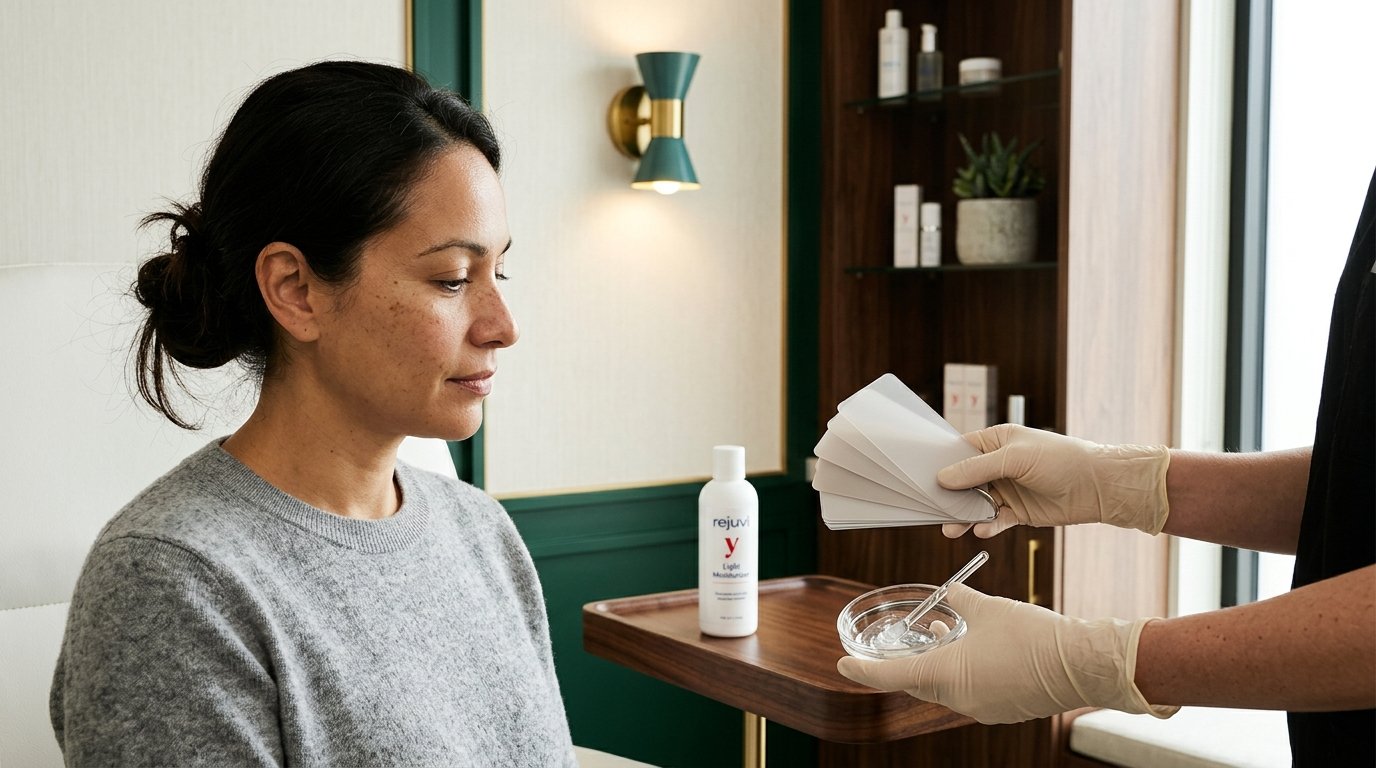
BBL uses filtered light; a chemical peel uses a chemical agent to exfoliate or resurface the skin. Neither is the best choice for every dark mark. The cause of the pigmentation, skin tone, recent sun exposure, skin sensitivity and planned treatment intensity determine suitability and recovery.
At Nexja, the listed light platform is AMI SOLRAY IPL, which is different from Sciton BBL. This comparison does not mean that Nexja offers Sciton BBL. Read our pigmentation assessment guide and current treatment menu before discussing a specific light or peel option with the clinic.
A changing, bleeding or otherwise suspicious mark needs medical assessment before cosmetic treatment. Melasma and post-inflammatory marks also require an individual plan; this guide cannot establish a diagnosis.
The
short answer: assessment comes before the device or peel
BBL is a branded form of filtered intense pulsed light rather than a
single-wavelength laser. It delivers bands of light that may be selected
to target chromophores such as melanin and haemoglobin. A chemical peel
applies a controlled chemical agent to create a predictable degree of
epidermal, and sometimes deeper, injury followed by renewal. In simple
terms, light tries to selectively heat a target; a peel creates
controlled exfoliation and wound repair across the treated surface.
That difference matters. A sharply defined superficial sun spot on
lighter, stable, untanned skin may be a very different light-treatment
candidate from diffuse melasma in skin that darkens readily. A person
with post-acne marks, an impaired barrier and active picking has
different needs again. The correct comparison is therefore not BBL
versus “a peel” in the abstract. It is a comparison between a specific
light protocol and a specific peel depth and agent for a correctly
identified pigment problem in a particular person at a particular
time.
Before choosing, a qualified clinician should assess at least the
likely diagnosis, pigment depth, skin tone and tanning response, recent
sun exposure, triggers, medication and medical history, active
inflammation, barrier condition, history of cold sores or scarring,
previous treatment reactions, and the person’s ability to follow sun
protection and aftercare. When the diagnosis is uncertain, referral to a
dermatologist is more valuable than escalating cosmetic treatment.
BBL
and IPL are light treatments, not the same thing as a laser
People often use “BBL laser” as a convenient search phrase, but
broadband light belongs to the intense pulsed light family. A laser
emits a comparatively narrow, coherent wavelength; an IPL or BBL
platform uses a broad spectrum filtered into selected ranges. The
operator can also vary fluence, pulse duration, pulse sequence, cooling
and spot size. Those settings change the interaction with epidermal
pigment and the intended target.
Melanin absorbs light. If enough optical energy is absorbed, heat can
injure pigment-containing structures. That can be useful for a selected
superficial brown lesion, but epidermal melanin is also a competing
target. A person with a recent tan, a darker constitutive skin tone, or
a tendency to develop post-inflammatory hyperpigmentation may therefore
have a narrower safety margin. Excessive heating can cause burns,
blistering, prolonged redness, darker marks or lighter spots.
This is why a platform name does not establish suitability. Safe use
depends on the indication, the filter and settings, cooling, test-spot
strategy where appropriate, operator training, and recognition of what
should not be treated. It is also why a clinic should not present BBL as
a generic eraser for every form of pigmentation.
Chemical
peels are a family of procedures, not one treatment
“Chemical peel” covers many agents, concentrations, combinations,
application techniques and depths. Superficial peels may use
alpha-hydroxy acids such as glycolic or lactic acid, beta-hydroxy acids
such as salicylic acid, or other carefully formulated agents.
Medium-depth procedures may use trichloroacetic acid alone or in
combinations. The clinical effect depends not only on the ingredient
printed on a label but also on concentration, pH, vehicle, number of
coats, contact time, preparation, skin condition and endpoint.
A superficial peel may loosen cohesion between corneocytes,
accelerate epidermal turnover and help some uneven tone alongside an
appropriate home plan. A deeper peel creates more injury and recovery,
and it is not automatically more appropriate for pigment. More
inflammation can mean more risk of post-inflammatory darkening,
especially in pigment-prone skin. “Stronger” is therefore not a synonym
for “better.”
Peels also do not remove the cause of recurrent melasma, ongoing
acne, friction, eczema or sun exposure. They may improve a visible
component while the biological trigger remains active. When a peel is
chosen, the agent and depth should match the indication and the skin’s
risk profile—not a fashionable treatment name or a desire for dramatic
peeling.
First identify the pigment
pattern
Solar
lentigines and other discrete sun-related spots
Solar lentigines are usually well-defined, flat brown spots
associated with cumulative ultraviolet exposure. They commonly appear on
the face, hands and other exposed sites. A clinician still needs to
distinguish them from freckles, seborrhoeic keratoses, pigmented actinic
keratoses and melanocytic lesions. Once a benign diagnosis is reasonably
established, selected superficial lesions may respond to
pigment-targeting light or an appropriately chosen peel.
Discrete lesions can be easier to target optically than diffuse
pigment because the contrast between the spot and surrounding skin may
be clearer. Yet the surrounding epidermis still absorbs light. Skin
tone, tan status and device parameters remain important. A peel treats a
field rather than only one spot, which can be useful when the problem
includes broader photodamage, but the trade-off is more generalized
inflammation and recovery.
Melasma
Melasma is an acquired, often symmetrical hyperpigmentation pattern
commonly affecting the cheeks, forehead, upper lip or jawline.
Ultraviolet and visible light, hormones, heat and genetic predisposition
can contribute. Vascular and inflammatory factors may also be involved.
It is often chronic and relapsing.
Melasma is where simplistic treatment comparisons are most
misleading. Aggressive heat or inflammation can provoke worsening. A
light-based procedure may temporarily reduce visible pigment in a
selected patient, yet recurrence can occur because the condition’s
drivers remain. A peel can also improve epidermal pigment for some
people, but it can irritate and trigger rebound darkening. Neither
option replaces daily photoprotection, trigger management and medically
appropriate topical treatment when indicated.
The assessment should ask whether the pattern is truly melasma,
whether there is mixed epidermal and dermal pigment, what has triggered
previous flares, and whether the person can maintain a long-term plan. A
cautious clinician may prioritize stabilization and barrier support
before adding a procedure. In some cases, the correct answer is that
neither BBL nor a peel should be the first step.
Post-inflammatory
hyperpigmentation
Post-inflammatory hyperpigmentation, or PIH, is excess pigment that
follows inflammation or injury. Acne, eczema, picking, burns and
procedures can all trigger it. It is more common and often more
persistent in darker skin tones, although anyone can develop it.
PIH creates a circular risk: a procedure intended to treat pigment
can cause inflammation that makes more pigment. The first priority is
usually to control the initiating problem. Active acne, dermatitis,
rubbing or picking can keep producing new marks faster than a procedure
clears old ones. The practitioner must consider whether pigment is
epidermal or deeper, how the skin has reacted to previous injury, and
whether the barrier is stable.
Light may be inappropriate when epidermal melanin competes strongly
for energy or when the diagnosis and depth are unclear. A mild,
carefully selected peel can sometimes support an acne and PIH plan, but
it can also worsen irritation. The right starting point may be gentle
topical care, acne control and sun protection rather than either
procedure.
Mixed redness and brown
pigment
Some marks contain both vascular redness and melanin. A recent acne
mark may look red-purple, brown or both depending on skin tone and
stage. BBL filters can be chosen for different chromophores, but
treating a mixed picture still requires careful identification of the
dominant target and appropriate parameters. A peel may help epidermal
turnover without directly addressing dilated vessels.
If the person calls every residual mark “pigmentation,” the
consultation should slow down. Redness and brown pigment respond to
different strategies. A plan that treats the wrong chromophore can
disappoint or irritate the skin.
Pigmented
lesions that should not be cosmetically treated first
A lesion that is new, changing, asymmetric, irregularly bordered,
variegated in colour, symptomatic, bleeding, crusting or unlike the
person’s other spots needs medical review. Cosmetic light or peeling can
alter its appearance and potentially delay diagnosis. The same caution
applies when the practitioner is not confident that a lesion is
benign.
No aesthetic comparison should override that rule. Photography,
dermoscopic assessment by an appropriately trained medical professional,
biopsy or specialist referral may be needed. The goal is not to “clear”
every brown mark; it is to treat only what has been adequately
assessed.
The assessment
checklist that changes the choice
1. What is the working
diagnosis?
The label determines the logic of treatment. A solar lentigo,
melasma, PIH and a suspicious melanocytic lesion are not
interchangeable. The consultation should document the history,
distribution, onset, change, triggers and previous responses. If the
diagnosis cannot be made confidently in the setting, the next action
should be referral rather than treatment escalation.
2. Is the
pigment mainly epidermal, dermal or mixed?
Superficial epidermal pigment may respond differently from pigment
deposited in the dermis. Visual examination, history and sometimes a
Wood’s lamp can add information, although no single office test is
perfect. Dermal pigment is often slower and harder to treat. Promising
rapid clearance without discussing depth is a warning sign.
Both light and peels can produce surface improvement without
eliminating deeper pigment. A superficial peel cannot be expected to
safely remove deeply placed pigment simply by adding more coats.
Increasing energy or depth may raise the injury risk faster than it
raises the chance of a durable result.
3.
What is the person’s baseline skin tone and tanning response?
Fitzpatrick skin type is a rough description of burning and tanning
response, not a complete measure of ethnicity or post-treatment pigment risk across skin tones. It can
still help guide discussion, but assessment should also include actual
visible tone, recent tanning, history of PIH, family tendency and prior
reactions.
In darker or recently tanned skin, more epidermal melanin can absorb
light. Conservative settings, appropriate filters, cooling and test
spots may be considered by a qualified operator, but some situations
remain unsuitable. Peels are not automatically risk-free in darker skin:
excessive depth, poor preparation or uncontrolled inflammation can also
cause prolonged hyperpigmentation or hypopigmentation.
4. Has there
been recent sun or tanning exposure?
Recent ultraviolet exposure increases melanin production even when a
tan looks subtle. Treating recently tanned skin with pigment-targeting
light can narrow the therapeutic window. Sun exposure after either
procedure also increases the risk of uneven colour and recurrence.
The consultation should cover holidays, outdoor work, driving
exposure, sports, tanning beds and self-tanning products. A person
unable to avoid intense exposure during the recovery and stabilization
period may be better served by postponing treatment. Timing is a
clinical decision, not an inconvenience to hide.
5. Is
there active inflammation or an impaired barrier?
Burning, stinging, scaling, dermatitis, open lesions, infection or a
recently disrupted barrier changes the risk of both options. A peel
applied to compromised skin can penetrate unpredictably. Light on
inflamed or injured skin can intensify discomfort and inflammation.
Barrier recovery may require a simple routine, withdrawal of
irritating actives and treatment of the underlying condition. Starting a
procedure because the appointment is booked is not a sound reason. A
stable baseline provides a clearer way to judge response and a safer
surface to treat.
6. What
treatments, medicines and products are being used?
The clinician should review prescription and non-prescription
products, photosensitizing medicines, retinoids, exfoliating acids,
bleaching agents, recent isotretinoin history, supplements and previous
procedures. Evidence and practice around procedure timing after
isotretinoin have evolved, so a blanket rule should not replace
individual medical assessment.
Products can alter barrier function and reactivity. Some must be
paused; others may be part of preparation. The plan should specify what
to stop, what to continue and when to restart, rather than giving vague
advice to “avoid actives.” Medication changes should be coordinated with
the prescribing clinician, not made independently by an aesthetic
provider.
7.
Is there a history of herpes simplex, abnormal scarring or poor
healing?
Procedures around the mouth can reactivate herpes simplex in
susceptible people. A history of keloid or hypertrophic scarring,
delayed healing, infection or prolonged pigment change should be
recorded. Medical prophylaxis may be appropriate for some patients and
must be prescribed by a qualified clinician.
The absence of a visible cold sore on treatment day does not make
history irrelevant. Likewise, a previous “good peel” does not guarantee
that a different agent, depth or season will behave the same way.
8.
What result does the person expect, and how much downtime is
acceptable?
Some people want a subtle, staged improvement with minimal visible
recovery. Others accept temporary darkening, flaking or crusting.
Expectations should include the possibility of partial response,
multiple sessions, maintenance and recurrence.
Light-treated spots may initially darken before they fade or shed.
Superficial peels may cause little visible peeling despite biological
activity; more shedding does not prove a better result. Medium-depth
peels have more substantial recovery and should not be casually compared
with a gentle lunchtime peel.
9. Can
the person follow photoprotection and aftercare?
Aftercare is part of treatment, not an optional extra. Broad-spectrum
sunscreen, shade, hats and avoidance of deliberate tanning matter after
both procedures. For melasma and some pigment-prone conditions,
visible-light protection with tinted iron-oxide products may be
discussed. Heat and friction may also be relevant triggers.
If a person cannot maintain the plan, the risk-benefit balance
changes. It may be safer to delay or use a conservative home-care
strategy. The best protocol on paper cannot overcome repeated
unprotected exposure.
How BBL may fit a
pigmentation plan
Potential strengths
BBL can target selected chromophores without mechanically removing
the whole surface. For appropriately diagnosed superficial sun-related
lesions in suitable skin, this selectivity may produce visible
improvement with limited downtime. Large areas of mottled photodamage
may be treated more evenly than one spot at a time when the platform and
operator are appropriate.
The ability to select filters and adjust pulse structure allows
customization. Cooling can protect the epidermis and improve comfort.
Some protocols can address both brown and red components in a staged
way. These advantages are meaningful only when the device is genuine,
maintained, used within its intended indications and operated by someone
trained to recognize endpoints and complications.
Limitations
BBL does not diagnose pigment. It cannot distinguish a benign spot
from a suspicious lesion by itself. It also does not eliminate hormonal,
inflammatory or environmental drivers. Melasma can recur, and heat may
aggravate it in some people. Deeper or low-contrast pigment may respond
poorly.
Results are parameter-dependent. A marketing photo from one device or
protocol cannot predict what another clinic’s machine will do. “No
downtime” claims are also too broad: redness, swelling, darkening,
crusting, blistering and pigment alteration are possible. Treatment can
fail when settings are too cautious, but simply increasing energy can
increase harm.
Questions to ask before BBL
- What is the exact diagnosis being treated?
- Is the device BBL/IPL, and what platform is being used?
- Which filter and endpoint are planned, and why are they appropriate
for my skin? - How is recent tanning assessed?
- Is a test spot advisable for me?
- Who will perform the procedure, and what is their training?
- What complications have been discussed for my skin tone?
- What happens if the pigment becomes darker?
- How will the result be photographed and reviewed?
- What maintenance and sun-protection plan is expected?
How a chemical
peel may fit a pigmentation plan
Potential strengths
A superficial peel can treat a broader field of uneven epidermal tone
while also addressing surface roughness or comedonal congestion,
depending on the agent. It may be integrated into a gradual plan with
topical therapy. The equipment is less complex than a light platform,
but that does not make the procedure casual: formulation, preparation,
endpoint and aftercare require expertise.
Peels can be adjusted by agent and depth. A conservative superficial
approach may be preferable when the goal is gentle turnover rather than
focal thermal targeting. For some acne-prone patients, a peel selected
for both comedones and marks may address the process producing PIH as
well as the colour, provided active inflammation and barrier tolerance
are assessed.
Limitations
Peels create inflammation by design. Over-treatment, uneven
application, occlusion, compromised skin or poor aftercare can cause
burns, infection, prolonged erythema, scarring and pigment change. Home
peels and unregulated high-strength acids add risk because concentration
alone does not reveal the full formulation or penetration.
A peel is not automatically safer for melasma or darker skin.
Superficial procedures may be used cautiously in many skin tones, but
depth and inflammation must remain controlled. A deeper peel may carry
an unacceptable pigment risk. Repeated procedures without stabilization
can keep the skin in a cycle of irritation.
Questions to ask before a
peel
- Which agent, concentration, pH and approximate depth are
planned? - Why does that formulation match my diagnosis and skin tone?
- What preparation is required, and which products must be
paused? - What endpoint will the practitioner look for?
- How much peeling is expected, and what is not normal?
- Is neutralization needed for this agent?
- How will sensitive areas be protected?
- What is the plan if I develop prolonged redness, crusting or
darkening? - When can I restart retinoids, acids, exercise and makeup?
- How many sessions are being proposed, and how will each one be
reviewed?
Direct
comparison: BBL vs chemical peel for pigmentation
| Decision point | BBL / filtered intense pulsed light | Chemical peel |
|---|---|---|
| Primary mechanism | Selective photothermal targeting of chromophores | Controlled chemical injury and renewal |
| Best-known use in this comparison | Selected superficial brown lesions and mottled photodamage | Selected superficial pigment and field treatment, depending on agent |
| Treats one spot or a field? | Can target spots or larger fields | Usually treats a defined surface field |
| Key risk driver | Epidermal melanin absorbing light and heat | Depth, formulation, penetration and inflammation |
| Recent tan | Often a major reason to postpone | Still relevant because post-procedure UV can worsen pigment |
| Darker skin tones | Requires particular caution, suitable technology and expertise; may be inappropriate |
Superficial peels may be options when carefully selected; deeper injury raises risk |
| Melasma | May help selected patients but heat and recurrence are concerns | May help epidermal component but irritation and recurrence are concerns |
| PIH | Procedure can provoke more PIH | Procedure can provoke more PIH |
| Typical early appearance | Redness and temporary darkening of spots; possible swelling | Tightness, redness and variable flaking/peeling |
| Precision | Parameter and filter dependent | Agent, application and depth dependent |
| “Stronger” means better? | No | No |
| Need for ongoing home plan | Yes | Yes |
The table is a framework, not a prescription. The same person may be
a candidate for one option at one point and neither option during an
active flare or high-exposure season. Combination treatment can be
appropriate in some plans, but combining procedures also combines
inflammatory load. It should not be improvised as a way to make results
faster.
What should
be assessed first in common scenarios?
A few isolated
brown spots after years of sun
First confirm that the lesions appear benign and consistent with
solar lentigines. Document the baseline, ask about change and examine
the surrounding skin. If the spots are suitable and the skin is
untanned, light may offer focal targeting. A peel might be considered
when there is broader photodamage or texture concern, but it should not
be sold as a precise substitute for diagnosis.
Symmetrical patches
on cheeks and upper lip
This pattern raises the possibility of melasma. The assessment should
explore pregnancy or hormonal history, medications, family tendency, sun
and heat exposure, prior treatment and recurrence. Stabilization,
photoprotection and medical/topical management may come before a
procedure. Aggressive BBL or a strong peel should not be the reflex
choice.
Brown marks after acne
Check whether acne is still active, whether marks are brown, red or
mixed, and whether the person is picking. Control new inflammation and
simplify irritating routines. A superficial peel may fit selected acne
and PIH plans, but only if the barrier is stable. Light requires careful
skin-tone and chromophore assessment. If new lesions continue, clearing
old marks alone will not solve the problem.
Pigment after a previous
procedure
Do not immediately add another procedure. Establish what was done,
settings or peel details if available, timing, aftercare, sun exposure
and the course of darkening. Post-procedure PIH needs a conservative
plan and sometimes medical management. Re-treatment before inflammation
resolves can deepen the problem.
Darker
skin that develops marks after minor irritation
History suggests a higher PIH tendency. That does not forbid every
procedure, but it changes the threshold for intervention, preparation
and monitoring. A clinician experienced with the person’s skin tone
should discuss alternatives, test spots where relevant and staged
treatment. The absence of a burn in a friend with lighter skin is not
evidence of safety for someone else.
An upcoming holiday or
outdoor event
Timing may be wrong for both options. Even if immediate recovery is
brief, pigment biology continues beyond visible redness or peeling.
Intense sun, heat, swimming and inability to follow aftercare can make
postponement the more intelligent choice. A deadline should not force an
unsuitable protocol.
Preparation is part of the
procedure
A preparation plan may include consistent broad-spectrum sunscreen,
gentle cleansing, barrier-supportive moisturization and, when medically
appropriate, pigment-regulating topical agents. It may require pausing
retinoids, exfoliating acids, scrubs, waxing or other procedures. The
exact instructions depend on the treatment and the individual.
Preparation has three purposes: reduce avoidable inflammation, make
response more predictable and reveal whether the person can tolerate the
required home routine. It is not a guarantee against complications. A
patient who becomes irritated during preparation should report it rather
than pushing through to keep the appointment.
Baseline photographs should be taken in consistent lighting without
filters. If possible, include standardized front and side views.
Photography helps distinguish true change from day-to-day lighting,
makeup and camera exposure. It also makes it easier to stop an
ineffective series rather than continuing automatically.
What recovery can look
like after BBL
Immediately after a suitable light treatment, skin may feel warm and
look pink. Mild swelling can occur, especially around the eyes. Targeted
brown spots may darken, sometimes described as a coffee-ground
appearance, before gradually lifting or flaking. People should not scrub
or pick these areas.
Gentle cleansing, bland moisturization and strict photoprotection are
common elements of aftercare. Heat, intense exercise, saunas and
irritating products may need to be avoided for a period specified by the
treating clinician. Makeup timing depends on skin integrity and
instructions.
Blistering, severe pain, grey or white discoloration, expanding
crusts, marked swelling, infection signs or progressive darkening
deserve prompt contact with the treating provider. A normal-sounding
internet timeline should not be used to dismiss an individual
complication.
What recovery can look
like after a peel
Recovery varies dramatically by depth and agent. A very superficial
peel may cause temporary tightness and fine flaking, while a
medium-depth peel can produce pronounced redness, swelling, darkening
and sheets of desquamation. Visible peeling is not required for every
superficial treatment to have an effect.
Do not pull loose skin, use scrubs or add unapproved actives. The
barrier should be supported according to written instructions. Sun
avoidance and sunscreen are critical. Applying occlusive products not
recommended by the clinician can alter penetration or healing, and using
acids to “help the peel along” can cause injury.
Increasing pain, weeping, pus, honey-coloured crust, spreading
redness, fever, grouped blisters, delayed healing or new sharply
demarcated pigment change requires professional review. Anyone given a
peel should know how and when to contact the clinic.
Why
combination treatment is not automatically superior
Because BBL and peels act differently, combining them can sound
comprehensive. But there is no universal rule that two mechanisms
produce a better or safer outcome. Performing them too close together
can increase inflammation, barrier disruption and pigment risk. The
correct interval depends on procedure intensity, skin response and the
reason for combining them.
A staged plan should have a reason for each step. For example, a
clinician might first stabilize melasma and assess topical response,
then consider a conservative procedure for a residual component. Or a
light procedure might target discrete lentigines while home care
addresses diffuse background pigment. The plan should define what
improvement each step is meant to produce and what finding would make
the next step unnecessary.
Avoid packages that combine treatments by default without
reassessment. The skin after one procedure is new information. It should
be reviewed before another controlled injury is added.
Understanding
the evidence without overpromising
Pigmentation research is difficult to translate into a simple winner.
Studies often enroll small groups, use different devices or peel
formulations, define improvement differently and follow patients for
different lengths of time. A result measured four weeks after a
procedure does not tell us whether melasma remained controlled through a
sunny season. A study of one IPL filter cannot automatically be applied
to every broadband-light platform, and a study of one glycolic-acid
protocol does not establish the performance of every chemical peel.
Skin-tone representation also matters. A treatment that looks
effective in a mostly lighter-skinned study population may have a
different safety margin in people with more epidermal melanin or a
strong PIH history. Conversely, the absence of a treatment from a large
randomized trial does not mean it is never useful; it means the
uncertainty should be explained. Good consent distinguishes established
observations, clinician experience and unknowns.
Before-and-after photographs are especially vulnerable to bias.
Lighting direction, camera exposure, white balance, makeup, hydration
and even facial angle can make pigment appear different. Ideally,
assessment combines standardized photographs, a consistent clinical
scale and the patient’s own priorities. Device-generated pigment maps
can help with documentation, but they do not replace diagnosis and
should not be presented as a microscopic measurement of exact pigment
depth.
For melasma, short-term lightening is not the only outcome worth
tracking. Recurrence, irritation, quality of life, treatment burden and
the ability to maintain photoprotection all matter. For lentigines,
lesion clearance may be more straightforward, but the clinician should
still observe for recurrence and new lesions. For PIH, controlling the
inflammatory source can be a more meaningful success than rapidly fading
one group of marks.
This evidence perspective changes the consultation. Instead of asking
for a guaranteed percentage improvement, ask what outcome will be
measured, when it will be reviewed and what would count as an
unacceptable reaction. A transparent practitioner can explain why the
best available evidence supports a cautious trial rather than a
promise.
Colour
is not the only clue: history and distribution matter
Brown is a visual description, not a biological diagnosis.
Distribution often gives more useful clues. Symmetrical centrofacial
patches suggest a different process from isolated sun-exposed macules.
Marks exactly where acne lesions healed suggest PIH. Pigment around the
mouth may relate to melasma, irritation, friction, medication or another
condition. A net-like pattern, sudden widespread change or pigment
accompanied by systemic symptoms deserves medical evaluation.
Timing adds another layer. Pigment that appeared after pregnancy or a
new hormonal exposure has a different history from a spot that has
slowly changed over years. A mark that becomes darker after every summer
suggests strong exposure sensitivity. Pigment that began after a peel,
laser, burn or allergic reaction points toward an inflammatory pathway.
The treatment choice should follow that story.
Symptoms matter too. Typical lentigines and melasma are usually
asymptomatic. Itching, pain, bleeding, crusting or rapid change should
lower the threshold for referral. The person should be asked whether one
lesion behaves differently from the rest—the “ugly duckling” observation
can be clinically important even when the practitioner is not making a
diagnosis.
Distribution also guides whether a focal or field approach is
logical. A handful of well-characterized lesions may suit focal
targeting. Diffuse background mottling may need a field strategy and
long-term prevention. Treating only the darkest spots can sometimes
expose contrast with untreated background pigment, while treating the
whole field can increase inflammatory load. That trade-off belongs in
the plan.
The
role of topical treatment before and after procedures
Procedures are often only one layer of pigment care. Depending on
diagnosis and medical suitability, clinicians may use ingredients that
reduce melanin production, interrupt melanosome transfer, increase
turnover, control inflammation or strengthen the barrier. Prescription
options require medical oversight; cosmetic products should still be
introduced carefully.
Hydroquinone remains a commonly discussed depigmenting medicine in
some jurisdictions, sometimes used alone or in combination formulas. It
is not a casual indefinite cosmetic and should be supervised where
prescribed. Azelaic acid, retinoids, tranexamic acid in selected medical
contexts, vitamin C derivatives, niacinamide and other agents may appear
in plans, but evidence, strength and irritation potential vary. Oral
tranexamic acid carries systemic risks and is a medical decision, not a
spa add-on.
Topical preparation can reduce uneven response and reveal intolerance
before a procedure. It may also produce enough improvement that the
person chooses not to proceed. That is a successful outcome, not a
failure to sell treatment. After a procedure, topical therapy may
support maintenance, but restarting too soon can inflame healing
skin.
The exact sequence must be written down. “Stop all actives” is too
vague because patients may not know which cleanser, toner or serum
contains an acid or retinoid. Instructions should name products or
ingredient categories, give a stop date and a restart criterion. If a
prescription is involved, the prescriber should guide changes.
Moisturizer choice is part of this process. A plain, well-tolerated
barrier-supporting product can reduce dryness and make sunscreen use
easier. It does not treat a suspicious lesion or erase melasma, but it
can help the skin tolerate a conservative plan. New fragranced or highly
active products should not be introduced immediately before a procedure
merely because they are marketed as brightening.
Photoprotection
is a treatment, not a disclaimer
Ultraviolet radiation stimulates melanogenesis and contributes to
lentigines, melasma and recurrence. Visible light can also worsen
melasma and PIH in some skin tones, which is why tinted sunscreens
containing iron oxides are sometimes recommended. Heat may be another
trigger for susceptible people. Effective protection therefore combines
product, clothing, shade and behaviour.
An SPF number measures protection mainly against UVB under
standardized testing. Broad-spectrum labeling addresses UVA as well, but
real-world protection depends on applying enough product and reapplying.
People commonly use much less than the tested amount. A cosmetically
elegant formula used consistently is often more valuable than a
theoretically perfect product left in a drawer.
Window exposure, driving, balcony time and commuting should be
discussed. UVA passes through ordinary window glass more effectively
than UVB. A person who works beside a bright window may need a different
routine from someone who spends the day indoors away from daylight. Hats
need a useful brim, and shade reduces rather than eliminates
exposure.
After treatment, protection prevents avoidable aggravation while the
skin is recovering. Over the long term, it protects the investment and
reduces formation of new lesions. If someone is unwilling or unable to
use protection, the practitioner should reconsider whether a pigment
procedure is proportionate.
How to interpret
an early treatment response
An early change is not the final result. After light treatment,
targeted spots may darken and then flake, while background redness
settles. After a peel, the skin may look smoother or brighter as
swelling and surface hydration change. These effects can be encouraging
but should not be mistaken for durable pigment control.
The first review should ask about pain, healing, product use, sun
exposure and unexpected colour changes. Standardized photographs should
be compared only when lighting and camera settings are similar. If the
person used makeup, self-tanner or a new brightening product, that
should be documented.
Partial response can mean several things: the diagnosis may be mixed,
settings may have been deliberately conservative, pigment may be deeper
than expected, or ongoing triggers may be active. The answer is not
automatically to increase strength. Reassessment may support repeating,
changing approach, returning to topicals or stopping.
No response is also information. If a lesion thought to be a lentigo
does not behave as expected, the diagnosis should be revisited. If
melasma briefly lightens and rapidly rebounds, maintenance and trigger
control deserve more attention than an endless cycle of procedures.
Unexpected darkening requires patience and expertise. Immediate
aggressive retreatment can compound inflammation. The provider should
assess whether the change is expected temporary darkening, PIH, a burn
or progression of the underlying condition, then create a safe follow-up
plan or refer.
Cost, value
and the problem with prepaid packages
Price comparisons are incomplete when they ignore diagnosis,
preparation, follow-up and complication care. A lower session price can
become poor value if the protocol is unsuitable or the clinic cannot
review an adverse reaction. A higher technology fee is not evidence of
superior selection.
Ask what the quoted cost includes: consultation, test spot,
photographs, follow-up, products, clinician review and management of
complications. For a peel, ask whether the quoted name refers to a
standardized branded formula or an in-house mixture and whether
aftercare is included. For BBL, ask whether the clinic is describing one
pass, multiple filters or a bundled facial.
Prepaid series can reduce the opportunity to stop after new
information. Pigmentation should be reassessed after each session. If a
clinic requires payment for a long course before establishing tolerance,
ask what refund or modification policy applies when the plan becomes
unsuitable.
Value can also mean choosing no procedure. A dermatology
consultation, prescription plan, sunscreen and three months of
stabilization may be more valuable than an immediate package. A
responsible provider should be comfortable with that possibility.
Special
situations that deserve extra caution
Pregnancy and breastfeeding can change melasma and influence which
medicines or procedures are appropriate. Treatment should be coordinated
with the relevant medical professionals, and elective pigment procedures
are often deferred during pregnancy. Hormonal changes can also make a
short-term cosmetic result difficult to interpret.
Active skin infection, open wounds, uncontrolled eczema, recent
sunburn and significant barrier disruption are common reasons to
postpone. A history of photosensitive disease or medicines that affect
light response requires medical review before BBL. Allergy history
matters for topical products and peel components.
Immunosuppression, poor wound healing, uncontrolled diabetes and a
tendency to keloid may change procedural risk. These conditions do not
fit into a marketing questionnaire with only “yes” or “no”; they need
individual consideration and sometimes medical clearance.
Body dysmorphic concerns or expectations of flawless, permanent skin
should be addressed sensitively. Pigment treatment can improve selected
findings, but normal variation and future change remain. A provider
should not intensify treatment to chase an unattainable standard.
Finally, language and follow-up access matter. Consent and aftercare
must be understood, not merely signed. A visitor leaving Istanbul
immediately after treatment needs a clear route for review, photographs
and urgent advice. If that cannot be arranged, a conservative assessment
visit may be the safer choice.
How
skin tone changes risk without determining worthiness
Skin tone is a safety variable, not a reason to offer lower-quality
care or make assumptions about a person’s goals. Darker skin contains
more epidermal melanin, which can absorb light energy and makes thermal
selectivity more demanding. It also has a higher statistical tendency
toward PIH after inflammation. Those facts call for expertise, caution
and transparent alternatives.
For peels, superficial agents can be used across a range of tones
when selected and applied appropriately, but depth should be
conservative and preparation meticulous. For light, suitable technology,
wavelength bands, pulse structure, cooling and operator experience
matter. Some conditions or devices may still be inappropriate.
The consultation should not rely on a colour chart alone. Ask how the
person tans, what happened after acne or cuts, whether previous
procedures caused darkening, and whether the current tone includes
recent sun exposure. A test spot can reduce uncertainty in some
light-treatment situations, but it cannot eliminate all risk or predict
melasma recurrence.
Why the season
and Istanbul lifestyle can matter
Istanbul combines strong seasonal sun, reflective water, outdoor
walking and periods of high heat. A person may receive substantial
exposure during commuting, ferry travel, sightseeing or sitting near
windows. Treatment planning should reflect actual life rather than only
the UV index on appointment day.
Autumn and winter are often chosen for pigment procedures because
exposure can be easier to control, but cloudy weather is not zero
ultraviolet exposure. Melasma can also respond to visible light and
heat. A patient who travels to a sunny destination shortly after
treatment may need to postpone even if the local season seems
favourable.
For visitors, follow-up access matters. A procedure just before a
flight or a packed sightseeing schedule may complicate swelling,
aftercare or review of a reaction. A thoughtful clinic should be willing
to recommend assessment only, home preparation or a later date.
A practical decision
framework
Step 1:
rule out lesions that need medical diagnosis
Any suspicious or changing lesion is separated from the cosmetic
plan. When in doubt, dermatology review comes first.
Step 2: name the pigment
process
Decide whether the working diagnosis is lentigines, melasma, PIH,
mixed erythema/pigment or another condition. Avoid treating the word
“pigmentation” as a diagnosis.
Step 3: stabilize triggers
Control active acne, dermatitis, picking, friction and excessive
product irritation. Build photoprotection. Review hormones, medicines
and relevant medical conditions with the appropriate clinician.
Step 4: assess treatment risk
Consider tone, tan, PIH history, scar history, healing, infection
risk, cold sores, barrier condition and ability to follow aftercare.
Step 5:
compare a specific BBL protocol with a specific peel
Ask for the actual device, filter and approach or the actual peel
agent and depth. Generic names do not allow a meaningful comparison.
Step
6: choose the least inflammatory route likely to meet the goal
That might be a conservative light session, a superficial peel,
topical care alone, or no treatment yet. Escalation should follow
response, not marketing pressure.
Step 7: document and reassess
Use standardized photographs and agreed endpoints. Reassess before
every additional session. Stop or modify the plan when the skin responds
unexpectedly.
Myths vs facts
Myth 1: BBL is simply a
stronger laser
Fact: BBL is a form of filtered intense pulsed
light, not a single-wavelength laser. Its performance depends on
filters, pulse settings, cooling, device quality and operator judgment.
The label alone says little about suitability.
Myth 2:
Chemical peels are always safer for darker skin
Fact: Superficial peels can be useful across many
skin tones, but excessive depth or inflammation can cause PIH,
hypopigmentation or scarring. Safety depends on selection, preparation,
agent, depth and aftercare.
Myth
3: If pigment gets darker after treatment, the treatment has failed
Fact: Selected light-treated spots may temporarily
darken before shedding, and peel-treated skin can darken during normal
recovery. However, progressive or prolonged darkening can also signal
PIH. The treating clinician should distinguish expected evolution from a
complication.
Myth 4: More peeling
means a better peel
Fact: Visible flaking is not a reliable measure of
benefit. Trying to force more shedding can injure the barrier. The
intended depth and clinical endpoint matter more than dramatic
peeling.
Myth
5: One successful session proves future sessions are safe
Fact: Skin tone, exposure, medications, barrier
status and cumulative irritation can change. Every session requires
reassessment.
Myth 6: BBL permanently
cures melasma
Fact: Melasma is commonly chronic and recurrent.
Procedures may improve appearance for selected patients, but long-term
photoprotection, trigger management and maintenance are usually
necessary.
Myth 7: A
peel can remove pigment by going deep enough
Fact: Deeper injury can increase complications
without safely reaching or eliminating all pigment. Dermal or mixed
pigment often needs realistic expectations and a long-term plan.
Myth 8:
A test spot guarantees there will be no reaction
Fact: A test spot provides useful information but
cannot reproduce every treatment variable or predict all delayed pigment
responses. It reduces uncertainty; it does not erase risk.
Myth 9:
Sunscreen is needed only for a few recovery days
Fact: Pigment disorders are strongly influenced by
ongoing exposure. Consistent photoprotection is part of treatment and
maintenance, not a temporary bandage.
Myth
10: The newest machine is automatically the best option
Fact: Diagnosis, parameters, operator expertise and
follow-up matter more than novelty. A well-selected conservative plan
may outperform an inappropriate premium device.
Myth 11: All brown
facial marks are cosmetic
Fact: Some pigmented lesions require medical
diagnosis. Treating first and asking questions later can obscure
important changes.
Myth
12: BBL and a peel together will halve the treatment time
Fact: Combining controlled injuries can increase
inflammation and pigment risk. A combination should have a documented
rationale and safe timing, not be a shortcut.
Choosing a clinic or
clinician
Look for a provider who begins with diagnosis and risk rather than a
package. They should be willing to say that a lesion needs dermatology
review, that recent tanning requires postponement, or that home
stabilization should come first. Consent should include alternatives and
the possibility of no treatment.
For light procedures, ask who owns and maintains the platform, who
performs treatment, what training they have and how settings are
selected for different skin tones. A genuine device does not compensate
for poor judgment. For peels, ask for the agent, concentration, pH or
formulation details where relevant, intended depth and emergency
plan.
The clinic should provide written preparation and aftercare, take
consistent photographs, make follow-up accessible and document
complications. Before-and-after images should represent comparable
lighting and should not be used as a guarantee. Be cautious with claims
of permanent clearance, zero risk, universal suitability or
“medical-grade” strength without a clear explanation.
Questions to bring to
your consultation
- What is the most likely diagnosis for my pigmentation?
- Are any spots unsuitable for cosmetic treatment without dermatology
review? - Is the pigment likely epidermal, dermal or mixed?
- Do I have melasma, PIH, lentigines or a mixed pattern?
- How does my skin tone and PIH history change the plan?
- Does recent sun or self-tanner mean I should wait?
- Is my barrier healthy enough for a procedure?
- Should active acne or dermatitis be controlled first?
- What exact BBL/IPL platform and filter would be used?
- What exact peel agent and depth are being considered?
- Why is one option preferred for my pattern?
- What would make you choose neither option today?
- Is a test spot appropriate?
- What preparation is required?
- Which medicines or products need review?
- What downtime is typical, and what warning signs are urgent?
- What is the plan if I develop PIH?
- How will results be photographed and measured?
- How many sessions are reasonable before reassessment?
- What long-term maintenance is expected?
Frequently asked questions
1. Is BBL
better than a chemical peel for pigmentation?
Not in every case. BBL may be useful for selected superficial
sun-related spots in suitable, untanned skin. A superficial peel may be
useful for broader epidermal uneven tone or when texture and congestion
are also concerns. Melasma, PIH, darker or recently tanned skin, active
inflammation and uncertain lesions can change the answer. The diagnosis
and risk assessment matter more than a universal ranking.
2. Is BBL a laser?
No. BBL is a branded form of broad-spectrum intense pulsed light. It
uses filters to select wavelength ranges rather than emitting one narrow
laser wavelength. People often say “BBL laser,” but the technical
distinction matters because the energy profile and parameter choices are
different.
3. Which option has less
downtime?
It depends on the protocol. Conservative light treatment may cause
transient redness, swelling and darkening of spots. A superficial peel
may cause tightness and fine flaking. Stronger peels have more recovery.
A low-downtime label does not mean zero biological response or zero
pigment risk.
4. Can BBL make pigmentation
worse?
Yes. Excessive energy, inappropriate settings, recent tanning, darker
skin tone, melasma susceptibility or poor aftercare can contribute to
burns or PIH. Heat can also aggravate melasma for some people. Proper
selection and conservative parameters reduce but do not remove risk.
5. Can a chemical
peel make pigmentation worse?
Yes. A peel that is too deep, uneven, applied to compromised skin or
followed by sun exposure can trigger prolonged inflammation and PIH.
Picking and premature use of active products can add injury. The risk is
why the exact agent and depth should be individualized.
6. Which is better for
melasma?
Neither is automatically first-line or curative. Melasma usually
needs long-term photoprotection, trigger management and, when
appropriate, medical topical therapy. Procedures may be adjuncts for
selected patients after stabilization. Light can introduce heat; peels
can introduce inflammation. Both can provoke recurrence or PIH.
7. Which is better
for post-acne brown marks?
First control active acne and picking. A carefully chosen superficial
peel may sometimes address acne and epidermal marks together, while a
light procedure may suit selected lesions and skin tones. If marks are
red rather than brown, the target is different. The barrier and PIH
history should guide the plan.
8. Which is better for sun
spots?
For correctly diagnosed superficial solar lentigines with good
contrast on suitable untanned skin, pigment-targeted light can be
efficient. A peel may make sense when there is field photodamage and
surface texture change. Suspicious or changing spots should not be
treated cosmetically first.
9. Can darker skin have BBL?
Some light-based treatments can be performed in selected darker skin
by experienced clinicians using suitable technology and parameters, but
epidermal melanin increases the margin-of-safety challenge. Some people
or conditions will not be suitable. A test spot and conservative
approach may be considered, but they do not guarantee safety.
10. Are peels safe for darker
skin?
Superficial peels can be used in many darker skin tones when the
diagnosis, agent, depth, preparation and aftercare are appropriate.
Medium or deep injury carries more risk of pigment alteration. A
practitioner should have demonstrated experience with pigment-prone skin
and a plan for PIH.
11. How do I
know whether my pigment is superficial?
Clinical distribution, colour, history and examination offer clues. A
Wood’s lamp can sometimes help with epidermal contrast, but it is not
definitive for every tone or condition. No home mirror test reliably
identifies depth. A cautious plan assumes uncertainty rather than
promising that all pigment is easy to reach.
12. Do I need a
dermatologist before treatment?
You need medical evaluation if a lesion is new, changing, irregular,
symptomatic or diagnostically uncertain, or if you have a medical
pigment disorder requiring prescription management. A dermatologist can
also be valuable for recurrent melasma, severe PIH or complications. Not
every benign freckle requires referral, but doubt should lower the
threshold.
13. How long should I
avoid sun before BBL?
There is no single safe interval for everyone. It depends on the
device, protocol, skin tone and degree of exposure. Many clinicians
postpone treatment when there is recent tanning and require strict
avoidance before and after. Disclose holidays, outdoor work and
self-tanner rather than trying to meet a fixed calendar rule.
14. Can I have a peel if
I use retinol?
Possibly, but the practitioner needs to know the exact product,
strength, frequency and skin response. Retinoids and other exfoliants
may need to be paused to prevent unpredictable penetration and
irritation. Do not stop a prescription medicine without guidance from
the prescriber.
15. Will my spots
darken immediately after BBL?
Selected superficial spots often look darker for several days before
lifting or flaking. That can be an expected endpoint. Diffuse, painful,
blistered or progressively darkening skin is different and needs prompt
review. Do not scrub the darkened areas.
16. Do I
have to visibly peel after a chemical peel?
No. Some superficial peels cause minimal visible shedding. The goal
is a controlled biological effect, not dramatic flakes. Chasing visible
peeling with extra acid, scrubs or picking can damage the barrier and
increase PIH risk.
17. How many sessions will I
need?
There is no responsible number without a diagnosis and baseline. Some
discrete lentigines may change after one light session, while diffuse
pigment or melasma often requires staged management and maintenance. A
series should include reassessment rather than automatic repetition.
18. Can BBL and
a peel be done in the same week?
They should not be combined casually. Timing depends on intensity,
skin condition and clinician rationale. Closely spaced procedures may
add inflammation and pigment risk. If combination treatment is proposed,
ask what each step contributes and how recovery from the first will be
assessed.
19. What
sunscreen is best after pigment treatment?
A broad-spectrum, high-SPF product that you can apply generously and
reapply is fundamental. Tinted formulas containing iron oxides may
provide added visible-light protection relevant to melasma and some
darker skin tones. Hats, shade and behaviour remain important because
sunscreen is not a force field.
20.
Can I use vitamin C, acids or hydroquinone immediately afterward?
Not unless the treating clinician specifically instructs you to.
Restart timing depends on the procedure, skin integrity and product.
Adding actives too early can cause irritation. Prescription hydroquinone
or other medication should be used under the relevant clinician’s
plan.
21. What if my pigmentation
returns?
Return does not always mean the procedure was performed incorrectly.
Sun, visible light, heat, hormones, inflammation and the chronic biology
of melasma can reactivate pigment. Reassess triggers and diagnosis
before repeating treatment. Maintenance often matters more than repeated
aggressive sessions.
22. Can
either treatment permanently remove pigmentation?
Some isolated superficial lesions can clear for long periods, but no
procedure can promise permanent freedom from all pigment. New lesions
can form, melasma can recur and PIH can follow future inflammation.
Claims of permanent cure should be treated cautiously.
23. Is a
home chemical peel equivalent to a clinic peel?
No. Product strength, pH, formulation, skin preparation, application,
endpoint recognition and complication management differ. Online
high-strength acids can cause serious burns and scarring. Home care
should stay within products intended for unsupervised use and should not
imitate professional protocols.
24. Does BBL
help red marks as well as brown marks?
IPL-family devices can use different filters to target vascular and
pigment chromophores, but the protocol must identify what is red and
what is brown. A mixed acne mark may require staged or different
settings. Treating all colour with one generic pass is not a thoughtful
plan.
25. Can a peel
help texture as well as pigment?
Some superficial peels can improve the feel and appearance of
roughness or comedonal congestion while supporting epidermal tone. They
do not remodel deep acne scars in the same way as scar-focused
procedures. The texture goal should be defined rather than bundled
vaguely into “rejuvenation.”
26. What are warning
signs after treatment?
Severe or increasing pain, blistering, grey-white patches, spreading
redness, pus, fever, grouped blisters, delayed healing, marked swelling
or sharply worsening pigment deserve prompt contact with the treating
provider. Emergency symptoms require urgent medical care. Written
instructions should state how to reach the clinic.
27. Can I wear makeup
after BBL or a peel?
Timing depends on skin integrity and the procedure. Makeup should not
be used to cover broken, weeping or blistered skin. Clean tools and
non-irritating products matter. Follow the treating clinician’s written
advice rather than a generic same-day rule.
28. When can I exercise
after treatment?
Heat, sweat and friction can worsen irritation. Many protocols advise
a temporary pause from intense exercise, saunas and hot showers, but the
interval varies. Melasma-prone patients may also need to consider heat
as a trigger beyond the immediate recovery window.
29. Is a patch
test the same as a BBL test spot?
No. A product patch test looks for a local reaction to a substance. A
light test spot exposes a small area to selected device parameters. Each
provides limited information about one condition of use; neither
guarantees the response of a full face or future session.
30. What
is the most important question before booking?
Ask, “What do you believe this pigment is, and what evidence would
make you postpone or refer me?” A provider who can explain uncertainty,
alternatives and stopping rules is offering more value than one who
guarantees a result based on a machine name.
A measured plan is
usually the safest plan
The useful conclusion is not that BBL wins or that chemical peels
win. BBL can be a precise light-based option for selected superficial
pigment; a peel can be a flexible field treatment for selected epidermal
concerns. Both can help, both can fail, and both can create new pigment
when used without adequate assessment.
Start with diagnosis, depth, skin tone, tan status, triggers,
inflammation, medications, healing history and aftercare capacity.
Stabilize the skin and protect it from exposure. Compare a specific
protocol—not two marketing categories. Use photographs, staged review
and clear stopping rules. When a lesion is uncertain or the condition is
medically complex, dermatology comes first.
For a broader overview of causes and options, see our pigmentation
treatment in Istanbul guide. If your main concern is recurrence,
read why
pigmentation can come back after treatment. A professional plan
should connect those principles to your own history rather than promise
that one procedure suits every brown mark.
Evidence and further reading
- American Academy of Dermatology. Melasma:
diagnosis and treatment. Accessed 18 October 2026. - U.S. National Library of Medicine. Skin
pigmentation disorders. Reviewed 19 September 2025; accessed 18
October 2026. - Thawabteh AM et al. Skin
Pigmentation Types, Causes and Treatment—A Review. Molecules.
2023. - Davis EC, Callender VD. Postinflammatory
hyperpigmentation: a review of the epidemiology, clinical features, and
treatment options in skin of color. Journal of Clinical and
Aesthetic Dermatology. 2010. - Sarkar R et al. Chemical peels
in melasma: a review with consensus recommendations. Indian Journal
of Dermatology. 2017. - Soleymani T et al. A practical
approach to chemical peels. Journal of Clinical and Aesthetic
Dermatology. 2018. - National Cancer Institute. Common moles,
dysplastic nevi, and risk of melanoma. Accessed 18 October
2026. - World Health Organization. Radiation:
ultraviolet radiation. Accessed 18 October 2026.
Medical note: This article is general education and does not
diagnose a lesion or replace care from a dermatologist or other
appropriately qualified health professional. Treatment availability and
professional scope vary by jurisdiction.