
Blackheads are clogged pores; sebaceous filaments are normal structures that help oil reach the skin surface. Blackheads often appear as darker, uneven plugs, while filaments tend to form smaller, flatter dots. Cleansing can improve selected congestion, but it cannot permanently remove normal filaments or close pores.
For care in Istanbul, compare Hydrafacial and Hydrafacial + Glow Care, then review what a professional skin assessment can establish. The right next step depends on whether the concern is congestion, irritation or active acne. Painful, worsening or scar-forming acne needs medical assessment.
The short
answer: blackheads vs sebaceous filaments
The simplest distinction is purpose. Sebaceous filaments are normal
structures that help move sebum through a follicle. Blackheads are
plugs. Both may appear as dots, but they behave differently.
| Feature | Blackheads | Sebaceous filaments |
|---|---|---|
| Technical description | Open comedones | Normal follicular structures containing sebum and corneocytes |
| Common appearance | Individual dark brown or black plugs; often irregular in size | Numerous small grey, tan, yellowish, or skin-coloured dots with a fairly uniform pattern |
| Typical sites | Face, chest, back, or other acne-prone areas | Most obvious on the nose, chin, and central face |
| Surface feel | May feel slightly raised or rough | Often flat or only subtly textured |
| What comes out with pressure | A compact plug may emerge | A thin, waxy or thread-like column may emerge |
| What happens afterward | A successfully cleared comedone may stay clear for a time, although another can form |
The filament naturally refills because the follicle continues to produce and transport sebum |
| Main care goal | Reduce and prevent follicular plugging | Keep the area comfortable and visually balanced without trying to eliminate normal anatomy |
No single visual feature is perfect. Lighting, makeup, sunscreen
residue, fine hair, dehydration, enlarged pores and skin texture concerns, and post-inflammatory
colour can all change what a person sees. A professional should assess
the pattern rather than treating every dot as a blackhead.
What a blackhead actually is
A blackhead is an open comedone, one of the non-inflammatory acne
lesions. Inside a pilosebaceous unit—the follicle and its associated
sebaceous gland—sebum mixes with shed keratinocytes. When that material
accumulates instead of exiting normally, it forms a microcomedone and
may develop into a visible comedone. If the opening remains exposed to
air, components of the plug oxidise and become dark. The colour is not
proof of poor hygiene, and stronger scrubbing does not remove the
biological tendency to form plugs.
The opening may be small while the plug extends deeper into the
follicle. This is why a blackhead can look like a dot but release a
longer column of material when professionally extracted. It is also why
pressing from the wrong angle may bruise the surrounding tissue without
clearing the obstruction. The follicle can refill if the factors that
promote comedone formation continue.
Blackheads can coexist with closed comedones, inflammatory papules,
pustules, nodules, post-inflammatory marks, and scars. The presence of
tenderness, redness, swelling, or a deep lump changes the risk
calculation. What looks like a simple extraction target may be an
inflamed lesion that should not be squeezed. When acne is widespread or
scar-forming, lesion-by-lesion cleansing is not a substitute for a
medical acne plan.
Why blackheads turn dark
The visible surface contains oxidised material, including melanin and
lipids exposed to oxygen. Dirt can sit on any skin surface, but dirt is
not what defines a blackhead. Repeatedly using harsh cleansers, abrasive
brushes, or alcohol-rich products to “wash the black away” may damage
the barrier while leaving the plug intact. Irritation can then make
pores look more obvious through redness, scaling, and uneven reflection
of light.
Where blackheads form
Blackheads commonly develop where sebaceous glands are active: the
central face, jawline in some people, chest, shoulders, and back.
Distribution offers clues. A cluster around areas covered by occlusive
products or equipment may suggest friction or product-related
congestion. Uniform dots limited to the nose are more likely to include
many sebaceous filaments. A mixed picture is common, so classification
is not always all-or-nothing.
What sebaceous filaments
actually are
Sebaceous filaments are microscopic arrangements of sebum and cells
within a follicle. They help channel oil from the sebaceous gland to the
skin surface, where sebum contributes to lubrication and barrier
function. Everyone has them. They become more noticeable when follicles
are larger, sebum output is higher, the skin surface is dehydrated or
reflective, or a person examines the area at very close range.
On the nose, sebaceous filaments often appear in a regular
constellation. Their colour may be cream, pale yellow, grey, or light
brown. They are usually similar in size and do not behave like isolated
acne lesions. Gentle pressure may express a soft, slender column, but
the structure refills. That refill is not treatment failure; it is
normal physiology.
Trying to keep every filament empty can create a cycle of picking,
irritation, rebound oiliness, and disappointment. A healthier target is
to reduce conspicuous surface build-up, protect the barrier, and choose
maintenance that keeps the area looking smoother without treating normal
anatomy as disease.
Why
sebaceous filaments seem more visible on some days
Visibility changes with lighting, hydration, recent product use, and
sebum flow. Heavy or waxy products may collect around follicular
openings. Over-cleansing can leave a dry, shiny surface that makes every
pore stand out. Heat and humidity can increase surface oil. A
high-magnification mirror can turn normal texture into a perceived
defect. None of these observations alone proves that the follicles are
blocked.
Can sebaceous
filaments become blackheads?
The structures are related because they occupy the same follicular
environment, but a filament is not automatically a pre-blackhead. A
follicle may become obstructed when keratinisation and sebum build-up
produce a comedonal plug. The practical point is not to fear every
visible filament. Instead, watch for changes in pattern: a spot that
becomes darker, larger, firmer, rougher, or more isolated may be a
comedone and can be assessed accordingly.
How a professional
distinguishes them
A useful assessment begins before any tool touches the skin. The
practitioner asks about the concern, duration, changes over time,
current products, prescription medicines, recent procedures, tendency to
pigment or scar, allergy history, and how the person has been trying to
remove the dots. This history can reveal a damaged barrier, retinoid
use, recent waxing, aggressive home extraction, or active acne that
changes what is safe.
Next comes visual and tactile assessment under consistent light.
Magnification may help, but it should not become a hunt for microscopic
imperfections. The practitioner looks for uniformity, colour, elevation,
inflammation, scaling, sensitivity, and lesion distribution. Sebaceous
filaments usually form a repeated pattern. Blackheads are more discrete
and may vary in size. Closed comedones feel like small bumps without an
open dark surface. Fine hairs, oxidised product residue, and tiny scabs
can mimic plugs.
A gentle cleanse can clarify the picture by removing sunscreen,
makeup, environmental debris, and excess surface oil. After cleansing,
the professional reassesses instead of assuming that every remaining dot
needs extraction. If the skin is hot, painful, visibly inflamed, broken,
infected, or recently treated, the correct decision may be to defer
manual work.
Questions worth
asking during consultation
- Are these mainly blackheads, sebaceous filaments, closed comedones,
or a mixture? - Is there inflammation that makes extraction inappropriate
today? - Does my current routine contain several products doing the same
exfoliating job? - Could friction, hair products, makeup, sunscreen, or occlusive
equipment be contributing? - What result is realistic after one appointment?
- What maintenance reduces recurrence without damaging the
barrier? - Which changes should prompt a medical acne review?
Good consultation language is specific. “We can reduce selected open
comedones and surface build-up” is more credible than “We will close
your pores.” Pores do not open and close like doors, and no cleansing
treatment can permanently remove their anatomical appearance.
Professional
cleansing: what the term should mean
“Professional cleansing” can describe very different services. At its
best, it is a structured, hygienic process tailored to skin condition
rather than a fixed sequence applied to everyone. The session may
include gentle cleansing, controlled softening, selected exfoliation,
cautious extraction, soothing care, and a home-care plan. It should also
include the judgment to omit a step when risk outweighs benefit.
At Skincare Center, the relevant service pathway is professional
cleansing for congestion. The link is a starting point for
discussing suitability, not evidence that every visitor needs the same
procedure or products. A detailed assessment should still determine
whether the concern is normal sebaceous filaments, comedonal acne,
inflammatory acne, sensitivity, or another condition. For broader
context, see when
professional facials fit acne-prone skin.
Step 1: pre-cleanse and
surface cleanse
The first cleanse removes makeup, sunscreen, and oil-soluble debris.
A second, skin-appropriate cleanse may remove remaining residue. The
goal is not a squeaky or tight feeling. Excessive degreasing can disrupt
lipids in the stratum corneum, increase sting, and provoke compensatory
product use. The skin should be clean enough to assess without being
stripped.
A branded cleanser can be part of the professional scene, but
branding is not the active principle. Product selection depends on
formula, contact time, rinseability, sensitivity, and the rest of the
routine. For visual documentation in this article, Rejuvi ‘k’ Facial
Cleanser is used as a verified brand reference; its official product
page confirms the product name and packaging. This editorial placement
does not mean that one cleanser diagnoses or removes all blackheads.
Step 2: softening without
over-heating
Warmth, hydration, or a suitable softening product may make
superficial material easier to release. “Opening the pores” is an
imprecise phrase. Heat does not mechanically open a pore; it can alter
the feel of surface keratin and sebum and increase local blood flow.
Prolonged heat, strong steam, or occlusion may aggravate rosacea-prone,
reactive, or inflamed skin. The safest method is the minimum needed for
the selected targets.
Step 3: controlled
exfoliation
Exfoliation may be mechanical, enzymatic, or chemical. The choice
should reflect skin history and the day’s findings. Salicylic acid is
lipophilic and is widely used in acne care because it can help loosen
cells within oily follicular environments. Other acids or enzymes work
differently and may be suitable in selected contexts. More is not
automatically better. Combining a strong peel, abrasive polishing,
retinoid use, and extraction in a single session can exceed the skin’s
tolerance.
Step 4: selective extraction
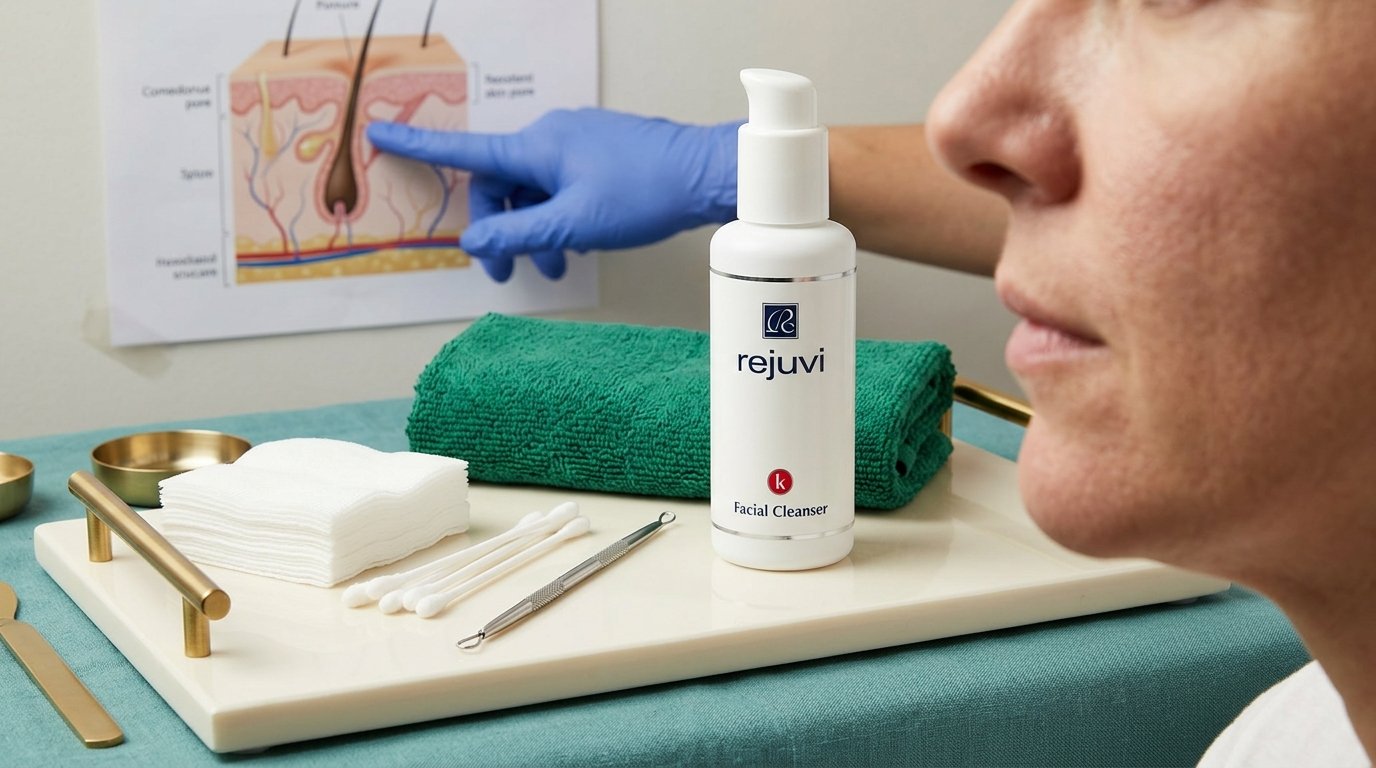
Extraction is a precision step, not a contest to empty every pore.
The practitioner identifies open comedones that are likely to release
with limited pressure. Gloves, clean materials, appropriate
disinfection, and controlled technique reduce contamination and trauma.
Pressure is distributed around the follicle rather than driven straight
down into it. If a lesion does not release easily, escalating force can
rupture tissue, provoke inflammation, or cause a mark. The professional
should stop.
Sebaceous filaments may express during the process, but routinely
chasing them across the entire nose is unnecessary. Their physiological
role continues, so they will refill. Selected expression may create a
temporarily cleaner appearance, but long-term control comes from a
tolerable maintenance routine rather than repeated aggressive
emptying.
Step 5: calm, protect, and
plan
After extraction, the priorities are comfort, barrier support, and
sun protection. Products should be chosen for the person rather than
layered for display. A bland moisturising step may reduce tightness,
while broad-spectrum sunscreen helps protect recently manipulated skin
from ultraviolet exposure. Strong actives are often paused for a short
interval depending on the intensity of the session and the person’s
baseline tolerance.
The appointment ends with a plan: what to use, what to pause, how
often to review, and what signs require medical evaluation. Without that
plan, a dramatic one-day result can be followed by irritation or rapid
recurrence.
What
professional cleansing can realistically do
Remove selected open
comedones
A mature, superficial open comedone may be removed mechanically when
the skin and lesion are suitable. This can immediately reduce a dark
plug and improve local texture. The benefit is visible but not
permanent. A new plug can form if the follicular environment remains
comedogenic, if acne is undertreated, or if irritating habits
continue.
Reduce superficial
congestion
Appropriate cleansing and exfoliation can remove accumulated surface
cells and product residue. The face may feel smoother and reflect light
more evenly. This effect is useful, but it should not be confused with
shrinking sebaceous glands or changing genetic pore size.
Make
sebaceous filaments less conspicuous for a time
Some filament contents can be loosened and expressed, producing a
temporary visual change. Because the filaments refill, maintenance
focuses on moderating visibility rather than promising elimination.
Gentle cleansing, a suitable retinoid or salicylic-acid product when
appropriate, moisturiser, and sunscreen may provide a more sustainable
result than frequent squeezing.
Clarify the diagnosis and
routine
One of the greatest benefits of a professional visit is not
extraction; it is classification. A practitioner can spot when the issue
is mainly normal anatomy, when acne lesions predominate, when the
barrier is compromised, or when a medical diagnosis should be
considered. Product rationalisation often helps people who have
accumulated several cleansers, scrubs, acids, masks, and spot
treatments.
Support adherence
A written, simple routine is easier to follow than a shelf of
contradictory products. The professional can explain expected timelines,
normal adjustment, and stop signs. This reduces the urge to change
products every few days or judge treatment under magnification.
What professional
cleansing cannot do
It cannot
permanently remove sebaceous filaments
Filaments are part of normal follicular anatomy. Emptying them does
not switch off sebum production. Claims of permanent removal create an
impossible standard and encourage over-treatment.
It cannot
permanently close or erase pores
Pore visibility is influenced by follicle size, sebum, elasticity,
surface hydration, colour contrast, and lighting. Cleansing can improve
the contents and surface appearance, but it cannot make follicles cease
to exist. Procedures that remodel skin texture may change how pores
appear in selected patients, yet even those do not turn skin into a
poreless surface.
It cannot
cure moderate or severe acne on its own
When acne includes numerous inflammatory lesions, nodules, pain,
widespread disease, or scarring, medical assessment matters.
Professional cleansing may be an adjunct, but it is not a replacement
for evidence-based medical therapy. Delaying care while repeatedly
extracting lesions can allow inflammation and scars to progress.
It cannot
guarantee that a blackhead will not return
Removal treats the present plug. Prevention depends on ongoing
follicular turnover, product selection, acne therapy when needed, and
individual biology. Even excellent care cannot promise zero
recurrence.
It cannot safely extract
every bump
Closed comedones, milia, inflamed lesions, folliculitis, sebaceous
hyperplasia, and other bumps can resemble one another. Some require
different techniques; some should not be manipulated in a cosmetic
setting. Uncertainty is a reason to pause, not a reason to press
harder.
A closer look at extraction
safety
Manual extraction is deceptively simple to watch and easy to perform
badly. Tissue injury can occur when nails pinch the skin, tools are
placed at the wrong angle, pressure is repeated, or the target is not a
comedone. Immediate redness may be expected after limited manipulation,
but marked swelling, bleeding, bruising, broken skin, or persistent pain
indicates excessive trauma.
Risk is higher when the person has recently used strong retinoids,
undergone a peel or laser procedure, waxed the area, developed sunburn,
or has an impaired barrier. People who form hypertrophic or keloid
scars, or who develop persistent post-inflammatory hyperpigmentation,
require particularly conservative decisions. Anticoagulant medicines,
active infection, immune suppression, and certain medical conditions
also change the safety conversation and should be disclosed.
Tool hygiene is essential. Reusable implements require appropriate
cleaning and sterilisation processes; single-use items should be
discarded correctly. Gloves do not replace hand hygiene. Extraction over
active herpes lesions, bacterial infection, open wounds, or undiagnosed
dermatitis is inappropriate.
Why “if it
will not come out, stop” is a valuable rule
A comedone that is ready to release generally responds to controlled,
correctly positioned pressure after suitable preparation. Resistance may
mean the plug is deeper, the opening is too small, the lesion is closed,
or the diagnosis is wrong. More force increases injury faster than it
increases benefit. Deferring the lesion and adjusting the home routine
is often the professional choice.
Lancets and needles
Opening a closed lesion with a sharp instrument is an invasive act
with scope-of-practice, training, consent, and infection-control
implications. Rules vary by jurisdiction and professional role. A person
should not assume that a facial automatically includes this step. If a
lesion requires incision, medical evaluation may be the safer route.
At-home needles are especially risky because depth, angle, sterility,
and diagnosis are uncontrolled.
Home care after
professional cleansing
The first goal after a session is to avoid converting a controlled
procedure into an irritated barrier. Follow the specific instructions
given for the actual treatment. In general, use lukewarm water, a gentle
cleanser, a familiar moisturiser, and broad-spectrum sunscreen. Avoid
picking, scrubs, cleansing brushes, pore strips, and unplanned acids
while the skin is tender.
If the session involved significant exfoliation or extraction, a
practitioner may advise pausing retinoids, benzoyl peroxide,
alpha-hydroxy acids, beta-hydroxy acids, or strong vitamin C for a short
period. The interval depends on intensity and tolerance; there is no
universal number. Reintroduce products one at a time so that irritation
can be traced.
Makeup use depends on skin integrity and the products applied. When
there are open or weeping areas, postponing makeup reduces contamination
and friction. Clean brushes and sponges matter. Exercise, sauna, and
heat may intensify redness immediately after a more active treatment, so
timing can be adjusted.
A simple maintenance
framework
Morning: gentle cleanse or water rinse as
appropriate, targeted treatment if prescribed and tolerated,
moisturiser, and broad-spectrum sunscreen.
Evening: remove makeup and sunscreen thoroughly,
cleanse without scrubbing, apply a comedone-preventive active on the
schedule recommended for the individual, and moisturise.
Weekly or periodic: assess tolerance rather than
adding automatic “deep-clean” days. If skin is comfortable and
congestion is improving, there may be no need for extra exfoliation. If
it is tight, stinging, or flaky, simplify before adding another
active.
Ingredients
that may help—and how to use them intelligently
Salicylic acid
Salicylic acid is a beta-hydroxy acid used in many acne and pore-care
products. Its oil affinity and keratolytic action make it useful for
comedonal congestion. Concentration, vehicle, frequency, contact time,
and the rest of the routine all affect tolerance. A wash-off cleanser is
not equivalent to a leave-on product. Daily use is not mandatory for
everyone; sensitive skin may need a lower frequency or a different
approach.
Avoid stacking multiple salicylic-acid products without a reason. A
cleanser, toner, serum, mask, and spot treatment containing the same
active can create cumulative irritation. If the skin becomes
persistently red, tight, itchy, or scaly, reduce exposure and seek
guidance.
Topical retinoids
Retinoids help normalise follicular keratinisation and are central to
many comedonal acne plans. Over-the-counter availability and
prescription options vary by country. They work over weeks to months,
not overnight. Early dryness and irritation can be managed with gradual
introduction, moisturiser, and dose adjustments, but severe reactions
require reassessment. Pregnancy and pregnancy planning require specific
medical advice because retinoid recommendations differ and some are
contraindicated.
Benzoyl peroxide
Benzoyl peroxide is most relevant when inflammatory acne is present.
It is not primarily a tool for making normal sebaceous filaments
disappear. It can cause dryness, irritation, and fabric bleaching.
Combination regimens should be planned to avoid excessive irritation and
to address the actual lesion pattern.
Alpha-hydroxy acids
and polyhydroxy acids
AHAs such as glycolic or lactic acid act mainly at the skin surface
and may improve rough texture and uneven shedding. PHAs are often
marketed as gentler because of their larger molecular structure,
although any exfoliant can irritate. These ingredients may complement
care but are not automatically superior to salicylic acid for oily
follicular congestion.
Niacinamide and
moisturising ingredients
Niacinamide can support barrier function and may help with
oil-control appearance in some formulations. Humectants and barrier
lipids reduce the tightness that drives over-cleansing. A moisturiser
does not necessarily clog pores; formulation and individual response
matter more than the word “cream” or “gel.” Products labelled
non-comedogenic reduce, but do not eliminate, the chance of breakouts
for every user.
Clay masks and charcoal
products
Clay can absorb surface oil temporarily. Charcoal products may
provide a clean feel, but marketing often outruns evidence for
“detoxifying” follicles. Masks can be an optional cosmetic step, not a
cure. Letting clay crack completely and repeatedly may increase dryness
without improving comedone biology.
Why pore
strips and suction devices give mixed results
Pore strips can lift surface material, fine hairs, and portions of
plugs. The immediate strip display is visually persuasive, but it does
not prove that follicles are permanently cleared. Frequent use may
irritate sensitive skin and cannot prevent refill. Strips should not be
used over broken, sunburned, inflamed, or recently treated skin.
Home suction devices create negative pressure. At a low setting they
may remove surface oil, but excessive suction can cause bruising, broken
capillaries, or inflammation. The device cannot reliably distinguish a
blackhead from normal filament contents. Stronger suction is not a
deeper cleanse; it is more mechanical stress.
Ultrasonic spatulas and similar devices may assist surface cleansing
when used correctly, but they do not replace diagnosis or long-term acne
management. Technique, pressure, sanitation, and skin condition still
determine risk.
Myths vs Facts
Myth: Blackheads are trapped
dirt
Fact: A blackhead is an open comedone. The dark
surface results largely from oxidation of material in the follicle, not
from inadequate washing. Hygiene can remove surface debris, but repeated
scrubbing cannot correct follicular plugging.
Myth:
Sebaceous filaments should be extracted until the pore is empty
Fact: Filaments are normal structures and refill as
sebum moves toward the surface. Attempting to keep them permanently
empty invites irritation and repeated trauma.
Myth: Steam
opens pores and cold water closes them
Fact: Follicles do not have muscles that open and
close on command. Warmth may soften surface material, and cool water may
feel soothing, but neither permanently changes pore anatomy.
Myth: A
painful extraction means it is working deeply
Fact: Increasing pain may signal tissue trauma,
inflammation, or an unsuitable target. Effective extraction should be
selective and controlled. Resistance is a reason to stop.
Myth: Oily skin does
not need moisturiser
Fact: Oily skin can still have a disrupted or
dehydrated barrier. A suitable moisturiser may improve comfort and
tolerance of acne treatments without necessarily increasing
comedones.
Myth: Natural scrubs are
always gentle
Fact: Particle shape, pressure, frequency, and skin
condition determine abrasion. Kernels, salt, sugar, and brushes can all
irritate. “Natural” does not describe safety.
Myth: One facial can detox
the skin
Fact: The liver, kidneys, lungs, and other systems
handle metabolic waste. A facial can cleanse the surface and address
selected comedones; it does not draw systemic toxins through pores.
Myth: Darker dots mean worse
acne
Fact: Colour alone does not measure severity. A dark
open comedone may be noninflamed, while a skin-coloured nodule can be
medically important. Lesion type, number, inflammation, pain,
distribution, and scarring are more meaningful.
Myth:
If pores look larger after cleansing, the treatment damaged them
Fact: Once dark material is removed, the opening may
be temporarily more visible because contrast has changed. Swelling or
trauma can also alter appearance, which is why gentle technique matters.
A single observation immediately after treatment does not establish
permanent enlargement.
Myth:
Professional extraction prevents every future breakout
Fact: Extraction removes selected existing plugs.
New lesions can form unless the biological drivers and routine are
addressed. Maintenance and medical treatment, when indicated, matter
more than repeated emergency squeezing.
When the concern is
more than congestion
Seek medical evaluation when lesions are deep, painful, widespread,
rapidly worsening, or leaving scars. Also seek help for sudden
adult-onset acne with other symptoms, a rash that burns or itches,
recurrent cyst-like lumps, or acne associated with significant distress.
The same applies if over-the-counter care has been used consistently
without improvement.
Nodules and cysts should not be extracted in a routine facial. They
are deeper inflammatory lesions with a higher risk of scarring. Picking
can rupture the follicular wall and spread inflammation into surrounding
tissue. A dermatologist can diagnose the pattern and discuss
prescription options.
Persistent redness around the nose and central face may represent
rosacea rather than simple congestion. Uniform itchy bumps can suggest
folliculitis. Firm white papules may be milia. Yellowish or
skin-coloured papules with a central depression can be sebaceous
hyperplasia. These examples illustrate why visual similarity does not
equal identical care.
Building a long-term
plan for blackheads
A sustainable plan has four parts: remove current obstruction when
appropriate, reduce formation of new microcomedones, protect treatment
tolerance, and review response over time. The exact combination
varies.
First, simplify the baseline. Use a cleanser that removes the day’s
products without leaving persistent tightness. Choose one principal
comedone-focused active rather than several overlapping exfoliants. Add
moisturiser and sunscreen. Maintain the routine long enough to judge it,
unless side effects require an earlier change.
Second, look for avoidable contributors. Heavy hair products can
transfer to the forehead. Occlusive makeup or balm may worsen congestion
in some users. Helmets, masks, straps, and phone contact can add
friction. This does not mean eliminating every product; it means
adjusting one variable at a time and watching the pattern.
Third, use professional extraction strategically. An appointment may
accelerate improvement by clearing selected mature comedones, especially
when the person is tempted to pick. It should complement—not
replace—preventive care.
Fourth, document with realistic photography. Use the same lighting,
distance, and camera settings every few weeks. Do not compare a
magnified, side-lit image taken before treatment with a soft, front-lit
image afterward. Honest comparison prevents unnecessary escalation.
Building
a long-term plan for visible sebaceous filaments
The goal is management, not eradication. Begin with a gentle cleanser
and consistent sunscreen. If tolerated and appropriate, a salicylic-acid
or retinoid product may reduce the accumulation that makes filaments
stand out. Moisturiser can improve surface smoothness and reduce the
contrast created by flaky skin.
Avoid daily squeezing. The temporary satisfaction is followed by
refill, and repeated manipulation may create redness that makes the area
more conspicuous. Consider how closely you are viewing the skin. Normal
facial texture is visible at conversational distance and under ordinary
light; a ten-times magnifying mirror is not a clinical standard.
Professional cleansing can be scheduled when surface roughness and
true comedones justify it, rather than whenever filaments reappear. If
the only concern is a regular pattern of tiny dots on the nose,
education and home care may be the most skin-preserving plan.
Special
considerations for different skin contexts
Sensitive or rosacea-prone
skin
Heat, friction, strong acids, essential oils, and repeated passes can
provoke flushing and sting. The professional may prioritise a short,
gentle cleanse and omit extraction. If persistent central facial
redness, burning, or visible vessels are present, medical evaluation can
prevent misclassification.
Skin prone to
post-inflammatory hyperpigmentation
Any inflammation can leave a dark mark, especially in medium-to-deep
skin tones. Aggressive extraction may trade one small blackhead for
weeks or months of pigment. Conservative pressure, strict stop rules,
sun protection, and inflammation prevention are crucial.
Dry or barrier-impaired skin
Dryness does not rule out comedones. A person can have flaky surface
skin and follicular obstruction at the same time. Treating every dot
with more exfoliant may worsen the barrier and make texture appear
rougher. Repair may come before active intensification.
Teen skin
Hormonal changes often increase sebum and comedone formation. A
simple routine, non-judgmental education, and early medical care for
inflammatory or scar-forming acne are more valuable than repeated
punishment of the skin. Parents and caregivers should discourage picking
rather than framing acne as a cleanliness failure.
Adult acne
Adult acne can involve the lower face, hormonal patterns, cosmetics,
stress, medication effects, or other factors. New or severe acne
deserves assessment, especially with menstrual irregularity, excess hair
growth, or other systemic symptoms. Professional cleansing may help
surface comedones but should not obscure the need for diagnosis.
Pregnancy and breastfeeding
Ingredient choices change during pregnancy and breastfeeding. Do not
assume that a product is safe because it is topical or sold without
prescription. Discuss retinoids, salicylic acid use, and other active
treatments with the relevant medical professional. A gentle cleansing
appointment can be adapted, but the product list should be reviewed.
Choosing a
professional cleansing provider
Look for a provider who takes a history, explains what they see,
describes alternatives, obtains consent, and sets limits. The room and
equipment should support hygienic practice. The practitioner should be
comfortable saying that a lesion is unsuitable for extraction or that a
dermatologist should assess it.
Ask what the service includes and how the plan changes for sensitive,
pigmented, or acne-prone skin. Be cautious with guaranteed pore closure,
permanent filament removal, instant acne cures, or claims that visible
debris proves toxins were extracted. Before-and-after images should use
comparable lighting and should not be treated as a prediction for every
person.
Aftercare should be specific enough to follow but not designed to
sell an unnecessarily complex routine. A professional may recommend
products, yet should explain the function of each step, potential
irritation, and what to do if the skin reacts.
A decision pathway before
booking
- Describe the pattern. Are the dots uniform and
concentrated on the nose, or are there scattered rough plugs across
acne-prone areas? - Check inflammation. Pain, swelling, pustules,
nodules, or broken skin raise the need for medical or modified
care. - Review the routine. List every cleanser, acid,
retinoid, scrub, mask, and treatment used during the previous two
weeks. - Define one realistic goal. For example: remove
selected blackheads, reduce surface roughness, or learn whether the dots
are normal filaments. - Choose a conservative first session. A practitioner
can always add intensity later; healing from excessive trauma takes
longer. - Plan maintenance. Decide which home step will
reduce recurrence and when results will be reviewed.
This pathway keeps the appointment outcome-focused. It also prevents
a common error: booking the most aggressive menu item before anyone has
examined the skin.
Frequently asked questions
1. Are blackheads
caused by not washing enough?
No. Blackheads form when sebum and keratin plug a follicle and the
exposed surface oxidises. Cleansing removes surface soil and products,
but over-washing does not correct the full process and can irritate the
skin.
2. Are sebaceous
filaments a type of acne?
No. They are normal structures within follicles. They may be more
visible in oily areas and can coexist with acne, but their presence
alone is not a disease.
3. How can I tell
the difference on my nose?
Sebaceous filaments usually appear as many small, evenly distributed
grey, tan, or yellowish dots. Blackheads tend to be darker, more
isolated, and irregular. A mixed pattern is common, so professional
assessment is more reliable than squeezing as a test.
4. Why do
sebaceous filaments return so quickly?
They refill because sebaceous glands continue producing sebum and the
follicles continue transporting it. Refill is normal physiology, not
proof that cleansing failed.
5.
Can professional cleansing remove all my blackheads in one visit?
Not safely in every case. Mature superficial comedones may release,
while deep, closed, inflamed, or resistant lesions should be deferred. A
staged plan protects the skin and often produces a better long-term
result.
6. Does extraction make
pores larger?
Careful extraction does not literally create a new pore, but trauma
and swelling can temporarily change appearance. Excessive pressure can
damage tissue. After a plug is removed, the opening may also look more
visible because the dark material no longer fills it.
7.
Should sebaceous filaments be extracted during every facial?
Usually not. Selected expression may improve appearance temporarily,
but trying to empty every filament is unnecessary and can irritate the
skin. Maintenance should focus on tolerable cleansing and turnover
support.
8.
Is salicylic acid good for both blackheads and sebaceous filaments?
It can help reduce comedonal build-up and make oily follicular
contents less conspicuous in some people. It does not permanently remove
normal filaments. Strength and frequency should match tolerance.
9. Can I use
a retinoid and salicylic acid together?
Some people can, but simultaneous use can increase irritation. A
clinician may alternate them, use one in a wash-off form, or choose a
single principal active first. Do not add both aggressively without
considering the rest of the routine.
10. Are pore strips safe?
Occasional use on intact, non-sensitive skin may lift surface
material, but results are temporary. Avoid them on irritated, sunburned,
recently peeled, or broken skin. Frequent use can cause redness and does
not prevent refill.
11.
What should I avoid before a professional cleansing appointment?
Tell the provider about retinoids, acids, acne medicines, recent
waxing, peels, lasers, sunburn, and skin reactions. They may ask you to
pause specific products, but follow their individual instructions rather
than a generic timetable.
12. What should I avoid
afterward?
Avoid picking, abrasive tools, unplanned exfoliation, and products
that sting. Depending on the session, you may need to pause strong
actives briefly. Use sunscreen and keep the routine simple until the
skin is comfortable.
13. Is steaming
necessary for extraction?
No. Controlled warmth or hydration may soften superficial material,
but steam is not mandatory and can aggravate reactive or rosacea-prone
skin. Technique and target selection matter more than dramatic heat.
14. Why does my
skin look red after extraction?
Mild, short-lived redness can follow pressure and increased local
blood flow. Marked swelling, bruising, broken skin, increasing pain, or
redness that worsens rather than settles should be assessed.
15. Can blackheads
become inflamed pimples?
An obstructed follicle can develop inflammation, although not every
blackhead will. Picking and rupture may increase local inflammation. A
prevention plan aims to reduce new plugs before they progress.
16. Is oil
cleansing useful for sebaceous filaments?
An oil-based first cleanse can help dissolve sunscreen and makeup,
but prolonged rubbing to produce “grits” can irritate. It does not pull
out the entire follicle or permanently remove filaments. Follow with an
appropriate cleanser if needed.
17. Do clay masks remove
blackheads?
Clay primarily absorbs surface oil and may make skin feel less greasy
for a time. It does not reliably remove deep plugs or prevent them from
reforming. Use it as an optional cosmetic step, not a substitute for
comedonal acne care.
18. Can moisturiser worsen
blackheads?
Any individual formula can be unsuitable, but moisturiser as a
category does not cause blackheads. A well-chosen product supports the
barrier and may improve tolerance of effective acne treatments.
Introduce one product at a time if you are prone to congestion.
19. How
often should professional cleansing be done?
There is no universal interval. Frequency depends on lesion type,
skin tolerance, home care, medical treatment, and the intensity of the
session. Booking whenever normal filaments refill is usually
unnecessary.
20.
When should I see a dermatologist instead of booking extraction?
Seek medical assessment for painful nodules, cysts, widespread
inflammatory acne, scarring, sudden severe onset, uncertain rashes,
recurrent infection, or inadequate response to a consistent routine.
Extraction should not delay diagnosis.
21. Can
professional cleansing help acne scars?
It can prevent some picking-related injury and reduce selected active
comedones, but it does not remodel established scars. Scar treatment is
a separate decision made after active acne is controlled. Our guide to
acne-scar
treatment when active acne is present explains why sequencing
matters.
22. Why
do my dots look worse under a magnifying mirror?
Magnification and side lighting increase contrast around normal
follicles, fine hair, and surface flakes. They reveal detail that is not
noticeable at ordinary viewing distance. Use consistent, non-magnified
photographs to judge change more fairly.
23. Can sunscreen clog pores?
Some individuals break out from a particular formula, but sunscreen
is essential for protecting irritated or acne-marked skin. Choose a
comfortable, acne-prone-skin-friendly formula and remove it thoroughly
at night rather than abandoning sun protection.
24.
Are blackhead vacuum tools better than manual extraction?
They are not automatically safer or more precise. Excess suction can
bruise skin or break small vessels, and the device cannot diagnose each
dot. A trained professional using controlled technique can select
targets and stop when resistance appears.
25. Can diet cause
blackheads?
Acne is multifactorial. Some dietary patterns may influence acne in
susceptible people, but a single food rarely explains a patch of
blackheads. Avoid restrictive diets based on pore appearance alone;
discuss persistent acne with a qualified professional.
26. Will washing
with hot water dissolve sebum?
Hot water may remove surface oil temporarily but can increase redness
and barrier disruption. Lukewarm water and an effective cleanser are
usually more comfortable. Follicular plugs are not simply melted away by
heat.
27. Can
I squeeze a blackhead if it has a clear opening?
At-home squeezing still risks wrong-angle pressure, incomplete
removal, inflammation, and pigment. If the lesion is persistent,
numerous, or tempting you to pick repeatedly, professional assessment
and preventive care are safer.
28.
What if a spot thought to be a blackhead bleeds easily?
Stop manipulating it. Bleeding may result from trauma, but a
persistent or unusual lesion deserves medical assessment. Do not
repeatedly test it by squeezing.
29. Do blackheads smell
when extracted?
Follicular material can have an odour after being retained, but smell
is not a diagnostic test. Strong odour, drainage, pain, warmth, or
swelling may suggest infection and requires appropriate evaluation.
30.
What result should I expect the day after professional cleansing?
Selected plugs may be gone and the surface may feel smoother. Mild
transient redness is possible. Normal filaments may begin refilling
quickly, and deeper congestion will not disappear overnight. Worsening
pain, swelling, crusting, or spreading redness is not a routine cosmetic
result and should be reported.
A
realistic professional-cleansing consultation, from start to finish
Many disappointing facial experiences begin with a mismatch between
the client’s request and the biological problem. “Clean my pores” may
mean several things: remove a few obvious blackheads, make nose
filaments less visible for an event, reduce a rough layer caused by
product build-up, calm inflammatory acne, or simply obtain reassurance
that normal texture is not disease. The practitioner should translate
the request into an observable goal before choosing products or
devices.
Establish the baseline
The consultation should document current lesions and symptoms without
relying on a beauty filter or magnifying mirror. Useful baseline
observations include the number and distribution of open comedones, the
presence of closed comedones, inflammation, tenderness, flaking,
oiliness, and visible manipulation marks. Standardised photographs can
help if the person consents. They should use the same light, angle,
distance, and camera for later comparison.
The product inventory is equally important. Write down brand, product
name, active ingredient when known, frequency, and application order. A
person may say they use “a gentle routine” but then reveal a salicylic
cleanser, glycolic toner, retinol serum, exfoliating mask, cleansing
brush, and weekly peel. Each item may be tolerable alone; together they
can create continuous low-grade irritation that exaggerates texture and
makes extractions harder to heal.
Medication and procedure history changes the plan. Prescription
retinoids, isotretinoin history, topical antibiotics, hormonal
treatments, recent peels, microneedling, laser procedures, waxing, and
injectables all deserve discussion. The point is not to exclude everyone
using an active; it is to understand vulnerability and coordinate
timing.
Agree on the endpoint
A useful endpoint is measurable and limited. Examples include “remove
the five mature open comedones on the chin if they release without
force,” “reduce removable surface build-up and assess the remaining nose
dots,” or “design a home plan for comedonal acne and refer if
inflammation is more extensive than expected.” An endpoint such as
“empty every pore” is not biologically sustainable.
Consent should cover expected redness, the possibility that some
targets will be left alone, and the difference between temporary visual
refinement and disease treatment. A client who understands that
sebaceous filaments refill is less likely to interpret normal recurrence
as negligence.
Reassess at every stage
Skin can look different after makeup removal, after hydration, and
after a small test area. A professional should adjust the plan rather
than mechanically completing a menu. If gentle cleansing reveals
widespread irritation, the extraction phase may be reduced or cancelled.
If a supposed blackhead wipes away as oxidised product, no further
intervention is needed. If a lesion becomes painful under minimal
pressure, it should be abandoned.
Close the feedback loop
At the end, compare the skin with the baseline under the same light.
Record what was done, which areas were intentionally avoided, products
used, immediate response, and aftercare. The follow-up question is not
only “Are the pores clear?” but also “Is the skin comfortable, and is
the preventive routine tolerable?” A plan that looks impressive for six
hours but causes a week of peeling is not a successful plan.
Comparing common treatment
routes
The best route depends on whether the dominant issue is true
comedonal acne, normal filaments, surface roughness, or inflammation.
The following comparison is a decision aid rather than a
prescription.
Manual extraction
Best suited to: selected mature open comedones that
can release with controlled pressure.
Immediate effect: removal of a visible plug and
local texture improvement.
Limitations: does not prevent new microcomedones;
unsuitable for many inflamed or resistant lesions; results depend
heavily on technique.
Main risks: bruising, broken skin, infection,
post-inflammatory colour change, and scarring if excessive force is
used.
Manual extraction is most valuable when it is selective. Ten
thoughtful extractions can be more appropriate than fifty attempts. The
number completed is not a quality metric.
Salicylic-acid care
Best suited to: oily, comedone-prone skin when the
ingredient is tolerated.
Immediate effect: usually modest; a smoother feel
may develop before a visible change in comedones.
Limitations: requires consistency and may not
address inflammatory or hormonal acne alone.
Main risks: dryness, sting, dermatitis, and
cumulative irritation when combined with other exfoliants.
Salicylic acid is often more useful as prevention than as a dramatic
one-time treatment. The vehicle matters: a brief-contact wash and a
leave-on liquid do not deliver the same exposure. A professional peel is
also not equivalent to a home product and requires different screening
and aftercare.
Retinoid-based care
Best suited to: prevention and treatment of
comedonal acne, often within a broader acne plan.
Immediate effect: none expected; improvement
develops over repeated skin cycles.
Limitations: adherence can be challenging, and
medical advice may be required depending on the product and the
person.
Main risks: dryness, irritation, sun sensitivity in
practice because irritated skin tolerates sun poorly, and inappropriate
use in pregnancy without medical guidance.
Retinoids address the process that leads to microcomedones, which
makes them fundamentally different from emptying visible pores. A small
amount used consistently can be more effective than frequent high doses
that trigger repeated stop-start cycles.
Enzyme or superficial
acid exfoliation
Best suited to: selected surface roughness and
dullness, with formulation chosen for tolerance.
Immediate effect: smoother surface and more even
light reflection.
Limitations: may not clear deep plugs; cannot
permanently reduce pore anatomy.
Main risks: over-exfoliation, unexpected
sensitivity, and pigment change after inflammation.
Professional strength is not synonymous with superior outcome. A
milder treatment completed without injury often permits a consistent
home routine, while an overly strong session can force all active care
to stop during recovery.
Hydrating and
barrier-focused treatment
Best suited to: tight, flaky, sting-prone skin in
which texture is being amplified by barrier impairment.
Immediate effect: improved comfort and surface
smoothness.
Limitations: does not extract true comedones
directly.
Main risks: usually low when products are well
chosen, although any formula can trigger an individual reaction.
This route is sometimes dismissed as “not doing enough,” yet
restoring tolerance may be the step that allows evidence-based comedonal
therapy to continue. Barrier care and acne care are not opposites.
Medical acne treatment
Best suited to: persistent comedonal acne,
inflammatory lesions, nodules, cysts, scarring, or inadequate response
to over-the-counter care.
Immediate effect: varies; many treatments require
weeks or months.
Limitations: requires diagnosis, adherence,
monitoring, and sometimes combination therapy.
Main risks: depend on the prescribed treatment and
should be reviewed with the clinician.
Professional cleansing may accompany medical care if the treating
clinician agrees, but the cosmetic session should not disrupt the
medical plan. Clear communication about products and procedure dates
helps avoid unnecessary irritation.
Why
recurrence happens even after a careful session
Recurrence is not one single process. A removed blackhead can be
replaced by a new plug because the follicle continues producing sebum
and shedding cells. Sebaceous filaments refill because that is their
function. Product residue can collect again if cleansing is incomplete.
Inflammation can create swelling that makes nearby openings more
prominent. Understanding which process is recurring prevents the wrong
response.
Biological drivers
Sebum output is influenced by hormones, genetics, age, environment,
and medication. Follicular keratinisation determines how readily cells
separate and exit. Acne-associated inflammation can begin before a
lesion appears obviously red. These processes cannot be scrubbed away
from the surface.
Routine drivers
Using rich occlusive products is not universally harmful, but a
particular formula may be too occlusive for a particular area. Hair
pomades can contact the forehead. Makeup may remain around the nose
creases if removal is rushed. Conversely, over-cleansing creates flaking
and irritation that people mistake for more congestion, prompting even
harsher treatment.
Behavioural drivers
Touching and squeezing are common because a visible dot provides an
immediate target. Stress and close inspection can make the habit
repetitive. Covering the mirror, shortening bathroom time, keeping nails
short, or using a hydrocolloid patch over a picked lesion may interrupt
the cycle. When picking feels compulsive or causes significant distress,
mental-health support can be an important part of skin care.
Expectation drivers
Online images often use strong lighting changes, pore-blurring
makeup, filters, or short-term post-extraction results. Comparing
ordinary skin to those images creates a false definition of success. The
realistic aim is fewer inflamed or obstructed lesions, smoother texture,
and a comfortable routine—not the absence of visible follicles.
Reading the skin after
treatment
The first 24 to 72 hours provide useful safety information. Mild
pinkness at carefully extracted points may settle quickly. The skin
should generally become more comfortable, not progressively hotter,
tighter, or more painful.
Small flat red marks can follow manipulation, especially in reactive
skin. They should fade. Darkening in pigment-prone skin may represent
post-inflammatory hyperpigmentation and reinforces the need for
sunscreen and reduced trauma. Tiny crusts indicate that the surface was
broken; they should be left to detach naturally rather than scrubbed
away.
Contact the provider or an appropriate medical professional if
redness spreads, swelling increases, pain worsens, pus develops,
blisters form, or systemic symptoms occur. These are not goals of a
“purging” process. Purging is an overused explanation and should not be
applied to signs of injury or infection.
What a good result
looks like at four weeks
A four-week review should look beyond the photographs. Has the person
picked less? Is the routine comfortable enough to use consistently? Are
fewer new blackheads forming? Is inflammatory acne stable, improving, or
worsening? Have normal filaments become less emotionally urgent even if
still visible? These measures reflect whether education and prevention
are working.
If there is no improvement, verify adherence before escalating.
“Using salicylic acid” may mean once in four weeks, or it may mean twice
daily plus an acid mask. Both are mismatches, but in opposite
directions. Correct frequency and simplify first. If a well-designed
routine has been used consistently and acne persists, medical evaluation
becomes more important.
Product and
device claims: how to evaluate them
Pore-care marketing often relies on words such as deep, vacuum,
detox, melt, erase, close, and permanent. Translate each claim into a
testable action. Does “deep clean” mean removing makeup, exfoliating the
stratum corneum, expressing a plug, or treating acne biology? Does
“tighten pores” mean temporary astringency, optical blurring, reduced
oil shine, or actual structural remodelling?
Look for an ingredient list, instructions, contraindications, and a
realistic time horizon. Be cautious when the proof is limited to debris
photographed on a strip or in a suction chamber. Seeing material is not
the same as showing that the skin will be healthier or clearer over
time.
Devices deserve the same scrutiny. A glowing tip, vibration, steam
plume, or strong suction can make a procedure feel advanced, but the key
questions remain: what does it do to the target, what evidence supports
that use, what training is required, what are the risks, and what
happens when the skin reacts?
Brand placement should also be transparent. The Rejuvi cleanser shown
in this article’s editorial imagery is included because it is an
approved brand and its packaging can be checked against the
manufacturer’s official image. It is not represented as the sole or
mandatory product for blackheads. A provider should recommend a formula
based on skin need, not because the bottle appears in a photograph.
Professional
boundaries and informed consent
Cosmetic professionals and medical clinicians have different scopes
that vary by country and credential. A responsible provider knows where
their role ends. Diagnosing an uncertain lesion, prescribing medicine,
incising deep lesions, or managing severe acne may require a physician.
Referral is not a failure of service; it is evidence of sound
judgment.
Informed consent is an ongoing conversation. It includes what will be
done, why it is being proposed, reasonable alternatives, expected
discomfort, common side effects, meaningful risks, aftercare, and the
person’s right to stop. Consent to cleansing is not automatic consent to
aggressive extraction, photography, or marketing use of images.
The client also has responsibilities: provide an accurate history,
disclose medicines and recent procedures, report pain, and follow
aftercare. When either party feels uncertain, postponing a step is safer
than proceeding for the sake of completing a package.
An
eight-week example plan for mixed blackheads and filaments
This example illustrates pacing; it is not an individual
prescription.
Weeks 1–2: stabilise and
observe
Use a gentle evening cleanse that removes sunscreen and makeup. Apply
a simple moisturiser and daily broad-spectrum sunscreen. Stop unplanned
scrubs, pore strips, and repeated squeezing. Photograph the nose and
chin once under standard light. If the skin is already comfortable,
introduce one comedone-focused active at a low frequency appropriate to
the product and professional advice.
The purpose of this phase is to establish tolerance and separate
normal filaments from lesions that persist as discrete plugs. Rapidly
switching products would obscure that distinction.
Weeks 3–4: build consistency
Continue the same baseline. Increase active frequency only if the
skin remains comfortable. Do not use visible peeling as proof of
effectiveness. Review whether new inflammatory lesions are appearing. If
acne is worsening or scarring, arrange medical assessment rather than
waiting for a facial to solve it.
Week 5:
consider selective professional cleansing
If mature blackheads remain and the barrier is intact, a professional
may cleanse, reassess, and extract selected lesions. The session should
record areas treated and avoided. Normal filaments can be left alone or
gently addressed for temporary cosmetic refinement, with clear
expectation of refill.
Weeks 6–8: recover and
prevent
Follow aftercare, then resume the preventive routine gradually.
Compare standardised photographs only at the end of the interval.
Success may mean fewer discrete plugs, smoother texture, less picking,
and a routine that does not sting. If progress is limited despite good
adherence, adjust with professional or medical guidance rather than
simply increasing pressure or product count.
Preparing for a
consultation: a checklist
Bring or photograph all products used on the face, including makeup,
sunscreen, hair products that touch the skin, and prescription items.
Note the last use of retinoids, acids, scrubs, waxing, peels, lasers, or
other procedures. Mention pregnancy, breastfeeding, allergies,
medication changes, a tendency to scar or pigment, and any history of
cold sores or skin infection.
Write down what bothers you most and what outcome would be
acceptable. If the issue is mainly visibility in close-up photographs,
say so. If lesions hurt or leave scars, say that first. Bring prior
medical advice if relevant. Do not extract the area immediately before
the appointment; fresh swelling makes assessment less reliable.
After the consultation, ask for the plan in writing. It should
identify the morning and evening steps, frequency of active products,
pause rules, sunscreen, follow-up timing, and reasons to seek medical
care. A clear plan reduces accidental over-treatment.
The practical bottom line
The most useful way to compare blackheads and sebaceous filaments is
to ask whether the dot represents obstruction or normal oil transport.
Blackheads are open comedones that may benefit from comedone-preventive
care and selective extraction. Sebaceous filaments are normal and can be
made less conspicuous, but not permanently erased.
Professional cleansing works best when it is conservative, hygienic,
and connected to a realistic maintenance plan. It can remove selected
plugs, reduce superficial build-up, and clarify what the skin needs. It
cannot close pores forever, cure all acne, or stop normal filaments from
refilling. If inflammation, scarring, pain, or diagnostic uncertainty is
present, medical assessment comes before extraction.
For an individual evaluation, bring your current product list and
describe what you have tried, how often you squeeze or exfoliate, and
whether the area becomes painful or leaves marks. That information is
often more valuable than a magnified photograph. The goal is not
poreless skin; it is comfortable, healthy-looking skin managed with the
least unnecessary trauma.
Sources and medical
review references
- American Academy of Dermatology Association, Acne Resource Center:
https://www.aad.org/public/diseases/acne - National Institute of Arthritis and Musculoskeletal and Skin
Diseases, Acne Types, Causes & Risk Factors: https://www.niams.nih.gov/health-topics/acne - DermNet, Acne: https://dermnetnz.org/topics/acne
- Cleveland Clinic, Acne: https://my.clevelandclinic.org/health/diseases/12233-acne
- Mayo Clinic, Acne overview: https://www.mayoclinic.org/diseases-conditions/acne/symptoms-causes/syc-20368047
- MedlinePlus, Acne: https://medlineplus.gov/acne.html
- Rejuvi Laboratory, ‘k’ Facial Cleanser official product page: https://shoprejuvi.com/products/rejuvi-k-facial-cleanser
Last evidence check: 10 October 2026. This article is educational
and does not replace diagnosis or treatment by a qualified healthcare
professional.