Can You Treat Acne Scars With Active Acne? Start With the Right Sequence
Can you treat acne scars with active acne? You can start planning acne-scar care while active acne is present, and some low-trauma supportive steps may overlap. However, active inflammatory acne usually deserves priority because each new deep lesion can create another mark or scar. Procedures that puncture, heat, abrade, peel, release, or otherwise remodel the skin should be considered individually and are often postponed, limited to stable areas, or modified until inflammation is better controlled. The right sequence depends on lesion type and location, scar type, skin tone, barrier condition, medicines, healing history, and the exact procedure—not on a single universal waiting period.
This distinction matters because “treat acne scars with active acne” can describe very different situations. One person may have a few closed comedones and old rolling scars. Another may have painful nodules, pustules, broken skin, and rapidly developing depressions. A third may have no true scars at all, but flat red or brown marks that remain after spots heal. Those three people should not receive the same advice.
The safest plan is staged but active. Stage one reduces ongoing inflammatory injury and protects the skin barrier. Stage two confirms that the acne pattern and treatment tolerance are stable enough to assess old damage accurately. Stage three matches each established scar to an appropriate option. Planning, photography, scar classification, sun protection, and behavior changes can begin during stage one; invasive scar correction is considered when its expected benefit outweighs the added risk.
Why Active Acne Usually Comes First
Acne is an inflammatory disorder of the pilosebaceous unit. Plugging of the follicle, sebum, immune signaling, microbial factors, and individual susceptibility all contribute. The process is not simply “dirty pores” or a surface infection. Deep inflammation can damage supporting tissue; healing then produces too little collagen in atrophic scars or, less commonly, too much collagen in raised scars. Preventing new inflammatory injury is therefore part of scar prevention.
The 2024 American Academy of Dermatology clinical guideline recommends established acne treatments including benzoyl peroxide, topical retinoids, selected topical and oral antibiotics, and oral isotretinoin in appropriate severe, scarring, treatment-resistant, or high-burden disease. It also emphasizes combination therapy and responsible antibiotic use. The exact regimen belongs to a qualified prescriber, but the larger lesson is clear: active acne has evidence-based medical treatment and should not be ignored while attention shifts to old scars. See the 2024 acne guideline indexed in PubMed.
Prioritizing active acne does not mean a person must accept the scars or wait without a plan. It means preventing new injury before exposing the skin to another controlled injury. It also creates a more reliable baseline. Inflamed, swollen, or recently healed skin can change the way shadows fall across a depression. Once activity settles, standardized photographs and examination make scar type and severity easier to judge.
If acne is painful, nodular, widespread, worsening quickly, leaving new scars, or causing substantial distress, seek dermatologic assessment promptly. A cosmetic service should not diagnose or promise to cure that disease. It may provide supportive care only when the skin is suitable and when its role is clearly separated from medical management. For a detailed explanation of that boundary, read when professional care may support acne-prone skin and when dermatology comes first.
First Separate Active Lesions, Marks, and Scars
Active lesions
Blackheads and whiteheads are non-inflammatory comedones. Papules and pustules are inflamed surface lesions. Nodules and cyst-like lesions are deeper and more likely to be painful and to scar. Open, picked, draining, or crusted areas add a barrier and infection-control concern. A procedural decision should describe which of these is present and where, rather than recording only “acne: yes.”
Flat post-acne marks
Post-inflammatory erythema is persistent red or pink color; post-inflammatory hyperpigmentation is brown, grey, or darker discoloration. Both are flat. They can last for months and may coexist with scars, but they do not represent a loss of tissue. Their plan focuses on preventing fresh inflammation, photoprotection, time, and selected medical or cosmetic options appropriate to skin tone and pregnancy status.
Atrophic scars
Ice-pick scars are narrow and deep. Boxcar scars are broader depressions with more defined edges. Rolling scars create shallow, wave-like shadows and may be held down by fibrous bands. These patterns respond differently: a surface treatment cannot reliably release deep tethering, while a focal technique designed for narrow pits is not a full-face answer to rolling scars.
Raised scars
Hypertrophic scars and keloids are elevated, firm growths of scar tissue. They require a different medical assessment from atrophic scars. A history of raised scars after piercings, surgery, or minor wounds should be disclosed before any elective procedure that intentionally injures skin.
If you are unsure whether the main concern is color or texture, compare the area in neutral light and side light, and let a clinician examine it. Our guide to the difference between acne scars and post-acne marks explains why the distinction changes treatment options.
What Can Overlap While Acne Is Still Active?
The overlap phase should focus on actions that prevent new damage and improve readiness. It may include a clinician-directed acne regimen, gentle cleansing, non-comedogenic moisturization, broad-spectrum sun protection, avoiding picking, and reviewing irritants. Some acne treatments may also help flat post-inflammatory color or support gradual collagen organization, but they are not substitutes for scar-specific procedures when true depressions are present.
Topical retinoids are recommended for acne and can improve epidermal turnover and some aspects of photoaged or uneven skin over time. They can also irritate, especially when started too quickly or combined with multiple acids. Retinoids require pregnancy-related caution and should be used according to professional advice. Benzoyl peroxide can be useful in acne regimens and helps reduce antibiotic resistance when used with topical antibiotics, but it can cause dryness and bleach fabrics. Azelaic acid may help acne and post-inflammatory hyperpigmentation in some patients. These are examples of medical or skincare tools, not a personalized prescription.
Superficial professional care may sometimes support comfort, hydration, or carefully selected cleansing. It should avoid aggressive extraction of inflamed lesions and should not claim to treat nodulocystic disease. If the skin is burning, extensively peeling, open, hot, very tender, or reacting to a new medicine, postponement and medical review are safer than adding a procedure.
Sun protection is especially valuable during this phase. Sun exposure can worsen post-acne dark marks, and some acne medicines increase sensitivity to sunlight. Sunscreen will not lift a tethered scar, but it can reduce contrast from dark marks and protect a future treatment result. Choose a formula the skin can tolerate and use shade, hats, and timing in addition to reapplication.
Which Scar Procedures Often Need a Calmer Baseline?
Many scar procedures work by producing a controlled injury. That is why active lesions, barrier damage, current medicines, and infection risk matter. “Often needs a calmer baseline” is more accurate than “always forbidden,” because the same name can cover different devices and intensities, and active lesions may be confined to a separate area. The procedure clinician must examine the actual treatment field.
Microneedling and radiofrequency microneedling
Needling devices create channels in the skin; radiofrequency systems also deliver energy at selected depths. They should not be passed casually over pustules, open wounds, or suspected infection. The U.S. Food and Drug Administration lists potential risks of microneedling devices such as bleeding, infection, and pigment changes and advises patients to discuss suitability with a healthcare provider. Review the FDA’s microneedling device safety information.
A provider may postpone, avoid active areas, select a test spot, or choose a different strategy. Sterile single-use components, device legitimacy, operator training, and aftercare are essential. Home rollers are not a safe workaround for active acne.
RF microneedling adds a distinct energy-related risk. In its October 15, 2025 RF microneedling safety communication, the FDA describes reports of burns, scarring, fat loss, disfigurement, and nerve damage. These reports do not provide an individual complication rate, but they underline why RF and conventional needling should not be treated as interchangeable. A U.S. safety notice is not evidence of authorization for a particular device or provider in Türkiye.
Fractional and ablative lasers
“Laser” is not one treatment. Wavelength, pulse structure, fractional density, ablation, fluence, cooling, and operator technique affect the target and risk. Fully ablative resurfacing creates a different wound from a non-ablative fractional treatment. Active inflammation in the field, recent tanning, pigment history, isotretinoin use, and skin tone must all be considered. A device should never be selected from a social-media before-and-after photograph alone.
Subcision and focal scar methods
Subcision releases selected tethered scars below the surface. TCA CROSS and punch techniques are focal methods for particular scar shapes. They are not routine facials, and their suitability depends on anatomy. Active lesions near entry or treatment points may lead to deferral or a limited field. Bruising, swelling, pigment change, infection, and the need for combination treatment should be discussed.
Chemical peels
A superficial peel used in an acne plan is not equivalent to a medium or deep scar procedure. Acid type, concentration, pH, preparation, contact time, number of layers, and aftercare determine effect. Home use of multiple acids before a professional peel can increase cumulative irritation. Deep or tethered scars will not be corrected simply by using a stronger surface acid.
For a broader comparison of scar types and professional options, see acne scar treatment planning in Istanbul. This article focuses specifically on sequencing when breakouts continue.
How Long Should Acne Be Controlled Before Scar Treatment?
There is no single waiting period that can be applied to every person, every scar, and every procedure. A rigid “four weeks,” “three months,” or “six months” can be misleading when separated from clinical context. The relevant signs are sustained reduction in inflammatory lesions, intact skin in the treatment field, stable tolerance of the acne regimen, no evolving infection or severe irritation, and a sufficiently stable baseline to measure scars.
The required interval may be shorter for a low-trauma, focal action away from active lesions and longer for aggressive full-field resurfacing. It may also change when a medicine is started or adjusted. The clinician performing the procedure and the clinician managing acne should share relevant information; neither should assume the other’s plan.
What About Isotretinoin?
Historic advice often required a six- to twelve-month delay after isotretinoin before almost every cosmetic procedure. A systematic review with expert consensus found insufficient evidence to require a blanket delay for several procedures, including superficial chemical peels, cutaneous surgery, and fractional ablative and non-ablative laser treatment, while mechanical dermabrasion and fully ablative laser remained unsupported during isotretinoin treatment. See the systematic review and consensus recommendations.
This does not mean all procedures are safe for every person taking isotretinoin. Evidence quality, dose, dryness, scar tendency, the exact device or technique, and clinician experience still matter. Do not stop isotretinoin, change the dose, or book a procedure without coordinating with the prescriber and procedure clinician.
The FDA’s current microneedling suitability information still flags current isotretinoin use or use within the preceding six months as a reason the procedure may not be suitable. This device-focused caution must be considered alongside the broader review. Follow the specific device labeling and a coordinated clinician assessment; do not use a general consensus statement to disregard a device-specific precaution.
Treatment Sequencing in One View
- Classify what is present: active lesions, flat marks, atrophic scars, raised scars, and areas of broken skin.
- Control current injury: obtain appropriate medical care for inflammatory or scarring acne and stop picking or over-exfoliation.
- Stabilize the barrier: use a tolerable routine and allow reactions from recent product or medication changes to settle.
- Document the baseline: standardized photographs and scar mapping help separate stable scars from changing inflammation.
- Match anatomy to method: choose focal, release, resurfacing, pigment, or combination approaches according to scar type.
- Start conservatively: consider a test area or lower-intensity first session when pigment or healing response is uncertain.
- Review before repeating: wait for the true response, check for new acne and pigment change, and adjust rather than following an automatic package.
A Deeper Planning Framework: Treating the Present Without Losing Sight of the Scars
The most useful way to think about active acne and acne scars is not as two unrelated problems competing for attention. They are two points on the same timeline. Active inflammation can create new marks and new scars; established scars reflect earlier injury; and the skin’s current tolerance determines what can be done safely today. A good plan therefore has three simultaneous goals: reduce the chance of fresh injury, protect the barrier while medical treatment works, and collect enough information to choose a scar strategy later. This is why “acne first, scars second” is a sensible headline but an incomplete clinical plan. The better question is which parts of scar care can begin now, which should wait, and what evidence will show that the sequence is ready to advance.
That sequence begins with an accurate inventory. Count not only visible spots but also the kinds of lesions that are appearing, how quickly they heal, whether they leave color change, and whether any are deep or painful. Then separate those findings from established texture. A red or brown flat area after a blemish may be post-inflammatory color change rather than a depression in the skin. A rolling shadow, narrow pit, or sharply edged depression is a different target. Raised, firm scars require another pathway again. Treating all of these as one category called “acne scars” leads to mismatched expectations and unnecessary irritation.
The plan also needs a time axis. One quiet week does not necessarily mean that inflammatory acne is controlled, just as one new blemish does not automatically cancel every supportive appointment. Clinicians look for a pattern: fewer new inflammatory lesions, less lesion depth and tenderness, less picking or drainage, stable medication tolerance, and a barrier that is no longer persistently burning or peeling. The decision is not made by a universal waiting period. It is made by combining disease activity, procedure intensity, healing risk, skin tone, medication history, and the location and type of the scars.
The three-lane model
A practical plan can be organized into three lanes. Lane one is active-acne control. It may involve evidence-based topical or systemic treatment directed by an appropriate clinician, gentle cleansing, non-comedogenic moisturization, sun protection, and behaviors that reduce mechanical injury. Lane two is supportive cosmetic care. Its role is comfort, hydration, barrier support, or carefully selected cleansing—not diagnosing acne or replacing medical treatment. Lane three is definitive scar correction. That lane may include procedures chosen for specific scar types, but it usually becomes more prominent after active inflammation is better controlled and the skin’s response is predictable.
The lanes can run at different speeds. Someone with a few superficial comedones, a stable routine, and old rolling scars may have a different plan from someone with frequent nodules, open lesions, excoriations, and a recently changed prescription. The second person has more reasons to prioritize medical control and delay elective resurfacing. The first may be assessed for selected options sooner, although suitability still depends on examination. The framework avoids two unhelpful extremes: promising that every scar procedure can proceed during a flare, or insisting that no aspect of scar planning can begin until the skin is flawless.
What “control” usually means in real life
Control does not have to mean a lifetime guarantee that acne will never recur. Acne is often chronic and relapsing. In practice, control means that the current regimen has reduced inflammatory activity enough for the next intervention to have a favorable risk–benefit balance. Signs may include a sustained reduction in new papules, pustules, nodules, or cysts; fewer lesions in the area to be treated; less spontaneous bleeding or crusting; and stable tolerance of the daily regimen. A dermatologist may also consider whether the current treatment is still being adjusted, whether a course of systemic therapy is underway, and whether recent flares suggest that the disease remains unstable.
It is equally important to define what control does not mean. It is not the absence of every blackhead. It is not a photograph filtered to remove redness. It is not a rigid number of days taken from a social-media protocol. And it is not permission to ignore medication-specific precautions. A person using isotretinoin, for example, needs an individualized procedural discussion; modern evidence has challenged blanket delays for every procedure, but that does not make all energy devices, depths, or surgical techniques interchangeable. The treating clinicians must know the medication, dose history, healing history, and proposed intervention.
How Active Lesions Change Procedure Risk
Procedures for atrophic scars commonly work by creating a controlled injury, releasing tethered tissue, stimulating remodeling, or removing precise layers of skin. Active inflammatory lesions are uncontrolled injuries occurring in the same field. When those processes overlap, the clinician must think about bacterial spread, additional inflammation, unpredictable pigment response, discomfort, wound care, and the possibility of treating skin whose texture is still changing. The concern is not that a device somehow “awakens” acne in every person; it is that the treatment field may be less stable and the healing burden may be higher.
Open, crusted, or infected-looking lesions raise a particularly clear safety question. Passing needles, abrasive tips, or other instruments across compromised skin can be inappropriate. The U.S. Food and Drug Administration’s patient information on microneedling devices lists risks that include infection, pigment changes, bleeding, and other adverse effects and stresses discussion with a healthcare provider. This does not establish a universal rule for every cosmetic technique, but it supports the principle that barrier integrity, infection risk, and professional device use matter.
Inflammation also complicates outcome measurement. Swelling can temporarily soften shadows, while redness can make depressions look deeper in some lighting. A newly healed lesion may still remodel. If a clinician plans an aggressive correction based on a fluctuating baseline, the endpoint can be difficult to judge. Standardized photographs after a calmer interval are often more useful than hurried treatment during a flare.
Needling and fractional procedures
Microneedling and fractional energy treatments are not single standardized experiences. Needle depth, energy density, treatment passes, device design, operator training, and aftercare all influence risk. Even when a technology is commonly used for atrophic acne scars, it does not follow that it should be applied directly over inflamed pustules or nodules. A clinician may avoid active areas, postpone the session, reduce intensity, or choose another step. The choice should be based on examination rather than a generic online timetable.
For people prone to post-inflammatory hyperpigmentation, the discussion includes more than scar depth. Any controlled injury can trigger excess pigment, particularly when inflammation is intense, sun protection is inconsistent, or aftercare is irritating. Device selection and settings require experience with the individual’s skin tone and history. Pretreatment or aftercare products may be considered by a qualified clinician, but they should not be improvised from another person’s prescription.
Peels, exfoliation, and the “more is more” trap
Superficial chemical exfoliation may sometimes be part of acne care, and certain peels may also improve selected superficial textural or pigment concerns. But a peel is not automatically a bridge between active acne and deep scar correction. Strength, acid type, contact time, skin preparation, and concurrent products matter. Combining home acids, retinoids, scrubs, and a professional peel can produce cumulative irritation even when each step sounds mild by itself. Burning, persistent tightness, shiny sensitivity, or widespread scaling are signals to reassess rather than add another active.
Deep ice-pick scars, broad rolling scars, and tethered depressions generally do not respond to surface exfoliation in the same way. Marketing language that presents one peel as a universal solution can obscure scar anatomy. A responsible consultation explains what a procedure can realistically target, what it cannot, and whether pigment change rather than texture is the main visible concern.
Subcision, focal reconstruction, and lesion location
Subcision is designed for selected tethered scars; focal chemical reconstruction techniques target selected narrow scars; punch methods address particular sharply defined defects. These are not interchangeable with facials or generalized resurfacing. If active lesions occupy the intended treatment field, they can affect entry points, sterility, swelling, and aftercare. The clinician may plan around them, treat a limited stable area, or defer. The important point is that “I have acne” is not enough information: the type, number, depth, distribution, and current condition of lesions determine whether a focal approach is reasonable.
Medication and Timing Questions That Need Individual Answers
Medication history is part of scar-treatment history. Topical retinoids, benzoyl peroxide, azelaic acid, antibiotics, hormonal therapies, and isotretinoin can affect dryness, irritation, photosensitivity, or procedural planning in different ways. None should be stopped or altered solely because an internet checklist says so. The professional performing a procedure needs a complete list, including non-prescription acids, exfoliating pads, acne patches, supplements, and any recent steroid injections.
Isotretinoin deserves special nuance. Older teaching often required a fixed delay before nearly all procedures. Later systematic reviews and expert consensus found insufficient evidence to mandate that blanket delay for several less aggressive interventions, while still urging caution for fully ablative resurfacing and mechanical dermabrasion. This evolving evidence is not a do-it-yourself green light. It means decisions should be procedure-specific and patient-specific, coordinated with the prescriber and the clinician performing the intervention. The safest sentence is neither “never during isotretinoin” nor “everything is safe during isotretinoin.” It is “the exact procedure and healing risk must be reviewed.”
Pregnancy or pregnancy planning changes the medication conversation and may change elective-procedure timing. Some established acne medicines are contraindicated, and even products that seem routine should be reviewed with the appropriate healthcare professional. A cosmetic clinic should not independently redesign a medical acne regimen. When treatment choices are narrowed, the priority may shift toward gentle barrier support, sun protection, and postponing elective scar procedures until the medical context is clearer.
Skin Tone, Pigment Risk, and Why Assessment Matters
The AAD discusses addressing acne and dark marks together in darker skin tones. Preventing fresh inflammation and evaluating existing color are compatible goals; neither automatically establishes readiness for an invasive scar procedure.
People with medium to deep skin tones may experience long-lasting post-inflammatory hyperpigmentation after acne and after procedures. That does not mean they cannot receive scar treatment. It means the plan should recognize pigment as an outcome that matters, choose technology and intensity thoughtfully, and build in sun protection and gentle aftercare. A scar can improve in depth while the treatment area temporarily becomes darker; if this possibility is not discussed, even a technically successful texture treatment may feel disappointing.
Color can also mask anatomy. Brown or red marks create visual contrast that makes the surface look more uneven than it is. Side lighting and palpation help distinguish true depressions from flat discoloration. Treating pigment first may reveal that fewer textural procedures are needed. Conversely, treating only color will not release tethered scars. The sequence should follow the dominant finding rather than the most emotionally charged label.
A history of keloids or raised scars, especially after piercings or minor injuries, needs explicit disclosure. Raised scars follow a different biology from common atrophic acne scars. Elective injury in a person with keloid tendency requires careful medical assessment. The same applies to a history of poor wound healing, immune suppression, recurrent herpes in the treatment area, uncontrolled diabetes, or recent tanning. These details are not bureaucratic obstacles; they change risk.
A Twelve-Week Observation Plan Before Major Scar Work
The following is an optional record-keeping example, not a validated readiness test or a reason to delay medical assessment. The review interval should be set with your clinician. During weeks one to four, document the baseline: consistent photos in the same light, the number and type of new inflammatory lesions, products used, medication changes, picking episodes, menstrual or other recurring patterns, and irritation. The goal is not obsessive tracking; it is to replace memory bias with a simple record.
During weeks five to eight, look for trend rather than perfection. Are new lesions less frequent or less deep? Are old lesions flattening without manipulation? Is dryness manageable? Are there fewer emergency product changes? If inflammation is worsening, deep, painful, or scarring, medical review should move earlier rather than waiting for the observation period to end.
During weeks nine to twelve, repeat standardized photographs and separate remaining concerns into active lesions, flat color, atrophic texture, and raised scars. Bring that inventory to the consultation. The clinician can then discuss whether to continue acne stabilization, start a conservative test area, address color, or plan scar-specific treatment. The value of the window is the quality of information it produces—not the calendar itself.
Five Common Scenarios and How the Priorities Differ
Scenario 1: Frequent painful nodules plus old rolling scars
The immediate priority is the active disease because deep inflammatory lesions carry ongoing scar risk. The person should seek dermatologic assessment rather than relying on repeated extraction or aggressive resurfacing. Scar mapping can still occur, photographs can be taken, and future options can be explained, but a major full-field procedure is unlikely to be the first logical step while painful nodules continue to appear.
Scenario 2: Occasional small blemishes plus stable old scars
This is not automatically equivalent to uncontrolled severe acne. A clinician may consider the number and location of lesions, the skin’s tolerance, and the proposed procedure. Selected areas might be treatable, or the appointment might be timed for a calmer interval. The decision cannot be reduced to whether there is literally one spot on the face.
Scenario 3: Mostly flat dark marks mistaken for scars
Here the main target may be pigment rather than structural remodeling. Gentle acne control and photoprotection can prevent new marks, while a clinician evaluates pigment-safe options. Jumping to an aggressive scar device may add inflammation without addressing the dominant problem. The distinction between marks and scars is therefore a treatment decision, not vocabulary trivia.
Scenario 4: Clear skin after a recent medication change
A short calm interval is encouraging but may not yet show the regimen’s stable effect or the skin’s full tolerance. The prescriber and procedure clinician should know about the change. Planning can proceed, but timing and intensity may be adjusted. If the skin is peeling, burning, or unusually sensitive, barrier recovery may be more urgent than resurfacing.
Scenario 5: Picking-driven wounds with mild acne
Even limited acne can create significant injury when lesions are squeezed or picked. Open excoriations are a reason to pause procedures across those areas and address the behavior compassionately. Practical barriers to picking, reduced mirror checking, and professional support when needed can help address an important source of ongoing injury. Shame is not useful; practical friction and support are.
Consultation Checklist: What to Bring and What to Ask
Bring a complete product and medication list, not just the items you consider “strong.” Include cleansers, exfoliants, spot treatments, prescription creams, oral medicines, supplements, sunscreen, and products used only weekly. Note allergies, prior procedures, cold sores, keloids, pigment changes after injury, delayed healing, and upcoming travel or sun exposure. If possible, bring photographs showing a typical flare rather than only the calmest day.
Ask the clinician to name the dominant scar types and show which areas each recommendation is intended to treat. Ask whether the plan targets active acne, color, texture, or more than one of these. Ask what signs would lead them to postpone, reduce intensity, or choose a test spot. Ask how they account for your skin tone and pigment history. Ask what medication changes, if any, must be coordinated with the prescriber. Ask what downtime means in practical terms: cleansing, makeup, exercise, work, travel, and sun exposure.
For devices, ask who will perform the procedure, what type of device is proposed, whether it is authorized for the intended use in the relevant jurisdiction, and how settings are individualized. A responsible provider can explain the purpose without promising a guaranteed percentage improvement. For needling procedures, ask about sterile single-use components and infection-control practice. For peels, ask about the agent, depth, preparation, and what products must be paused. For subcision or focal methods, ask why the scar anatomy fits that approach.
Finally, ask how progress will be measured. Standardized photography, consistent lighting, and interval review are more reliable than memory or promotional before-and-after images. Agree on a stopping rule: what response, irritation, flare, or pigment change would trigger reassessment? A plan with checkpoints is safer than a prepaid sequence treated as inevitable.
What You Can Do While Waiting for Definitive Scar Treatment
Waiting does not mean doing nothing. The most valuable action is reducing new inflammatory injury through appropriate acne care. Follow the agreed regimen consistently enough to judge it. Use a gentle cleanser, an acne-compatible moisturizer, and broad-spectrum sun protection. Avoid stacking scrubs, brushes, peels, and multiple acids in an attempt to accelerate texture change. Protect healing lesions from picking. Seek earlier medical review for painful nodules, rapidly worsening acne, extensive involvement, scarring, or significant emotional distress.
You can also build a useful scar record. Photograph the same areas every four weeks with the same camera, distance, neutral expression, and side lighting. Note whether a visible mark is flat or indented. Record previous procedures and outcomes. This information helps a clinician identify stable targets and prevents unnecessary repetition.
Supportive professional care may be considered only within a clear cosmetic boundary. A gentle session might focus on comfort, hydration, or non-traumatic surface care when the skin is suitable. It should not claim to cure inflammatory acne, replace prescription care, or mechanically attack deep lesions. If the skin is hot, painful, actively infected-looking, extensively broken, or reacting to medication, postponement and medical assessment are more appropriate.
How to Judge Claims About Simultaneous Acne and Scar Treatment
Be cautious when a provider promises to “clear acne and erase scars in one session.” Different lesion types have different mechanisms, and scar remodeling takes time. A credible explanation names the target, the limits, and the reason for the sequence. It does not hide behind a proprietary package name. It distinguishes temporary glow or swelling from structural change and acknowledges that new acne can create new marks even after older scars improve.
Also question universal prohibitions. Statements such as “one pimple means no procedure anywhere” may be unnecessarily rigid, while “active acne does not matter” ignores obvious safety variables. Good clinical reasoning is conditional: this lesion type, in this location, with this medication history, for this procedure, at this intensity. Nuance is not indecision; it is what individualized risk assessment looks like.
Before-and-after photographs are useful only when lighting, angle, expression, and timing are comparable. Ask whether the images show one treatment or a combination and whether active acne was present. Be wary of images with makeup, altered contrast, or different shadows. Outcomes from another person’s skin do not predict yours.
When to Seek Medical Help Promptly
Arrange medical assessment promptly for deep, painful nodules or cysts; rapidly worsening inflammation; acne that is already producing scars; widespread chest or back involvement; signs of infection such as expanding redness, warmth, pus with increasing pain, or fever; or a severe reaction to a treatment. Sudden acne with other systemic symptoms, significant menstrual or hormonal changes, or medication-related onset also deserves evaluation. Urgent care may be needed for facial swelling, breathing difficulty, extensive blistering, or severe systemic symptoms after a product or procedure.
Emotional impact matters too. Acne and scarring can affect confidence, social life, and mood. If distress is intense, daily functioning is impaired, or there are thoughts of self-harm, seek professional support urgently. These concerns are legitimate parts of acne care, not cosmetic side notes.
Turn the Sequence Into a Written Agreement
A recommendation such as “clear the acne first” can sound reasonable and still leave you unsure what to do next. A useful consultation turns that sentence into an agreement you can understand. It names the current problem, the action being taken, the person responsible for reviewing it, and the finding that would allow the next stage to begin. This is especially helpful when one professional manages the acne and another discusses scar procedures. Neither person should have to reconstruct your treatment history from a list of package names.
Start with one sentence about the immediate goal. For example, “We are reducing recurring inflammatory lesions before deciding whether the old cheek depressions need a procedure.” That sentence does not promise a date or a result. It helps you judge whether a proposed addition serves the current stage. If someone suggests a new peel, ask how it advances that goal, what it adds to the existing medical plan, and how its effect will be distinguished from the other changes already underway.
Separate a review date from permission to have a procedure
A review appointment is a time to make a decision, not a promise that a particular procedure will happen. Write “review treatment-area readiness” rather than “start resurfacing” when readiness is uncertain. At that visit, the clinician can reassess new lesion activity, irritation, medication changes, and your priorities. A plan that permits postponement is more useful than one that treats the next booking as inevitable. Ask how a flare affects deposits or a prepaid course before buying it, so financial pressure does not become a reason to proceed.
It can help to divide the plan into decisions that can be made now and decisions that require another examination. The type and location of established scars may be documented now. The precise field or intensity for a later procedure may remain provisional. Your tolerable recovery time can be discussed now, while a medicine-specific preparation plan may need confirmation near the appointment. This separation reduces uncertainty without pretending that future skin conditions are already known.
| Part of the agreement | Useful wording to request | Why it matters during ongoing acne |
|---|---|---|
| Present priority | Identify the lesions causing current injury and who is treating them. | Old scars do not distract attention from new inflammation. |
| Provisional scar target | Name the scar and the area being considered, rather than a whole-face promise. | The proposed intervention has a specific anatomical purpose. |
| Readiness review | Describe which findings must improve and which would cause a delay. | A calendar date cannot substitute for examining the skin. |
| Medication coordination | Identify the professional who will confirm any preparation changes. | Conflicting advice is resolved before treatment day. |
| Unexpected flare | Explain how to send an update and whether an in-person review is needed. | You have a route for reassessment instead of guessing. |
| Outcome review | Separate acne activity, color, texture, comfort, and unwanted effects. | Improvement in one feature is not mistaken for improvement in all of them. |
Use a short handover when two providers are involved
You do not need to become the coordinator of two competing treatment philosophies. You can, however, bring a concise factual handover. Include the names and strengths of current medicines, when each was started, recent changes, known allergies, and the last procedure performed. Record the actual date rather than “a few weeks ago.” If you do not know a device or peel name, ask the provider who used it for the treatment record instead of supplying a guess.
A good handover also distinguishes what was observed from what was concluded. “Three painful lesions appeared on the jaw this week” is an observation you can report. “My hormones are definitely causing it” is a diagnosis that requires appropriate assessment. Similarly, “the brown areas look darker in this photograph” is different from “the procedure permanently damaged my skin.” Clear observations help professionals investigate concerns without prematurely deciding the explanation.
Before a scar appointment, check that the procedure provider has received material medication changes. A new prescription, a significant reaction, or a recent acne intervention may make an older preparation sheet inappropriate. If the instructions conflict, seek clarification from the professionals rather than choosing whichever is easier. The goal is one coherent plan for the same skin, not two complete routines layered together.
Where Moisturizers and Professional Brands Fit
A moisturizer can have a useful supporting role even when the main concern is acne scarring. Its job is to help make daily care tolerable, not to mechanically release a rolling scar or fill an ice-pick depression. The American Academy of Dermatology explains that moisturization can help people tolerate acne treatments that cause dryness or irritation. Its guidance on moisturizer use with acne treatment is a helpful starting point for discussing that role. It does not endorse a particular product for every person with acne.
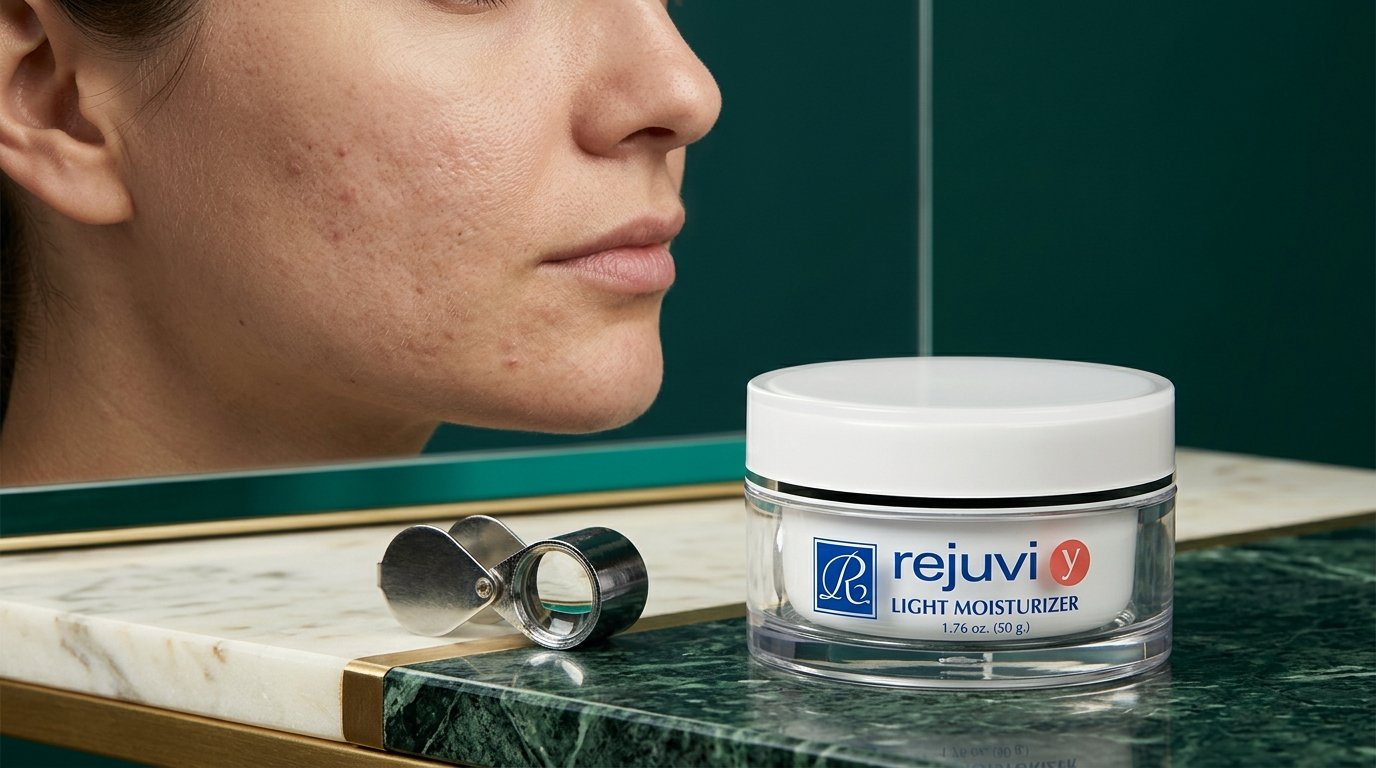
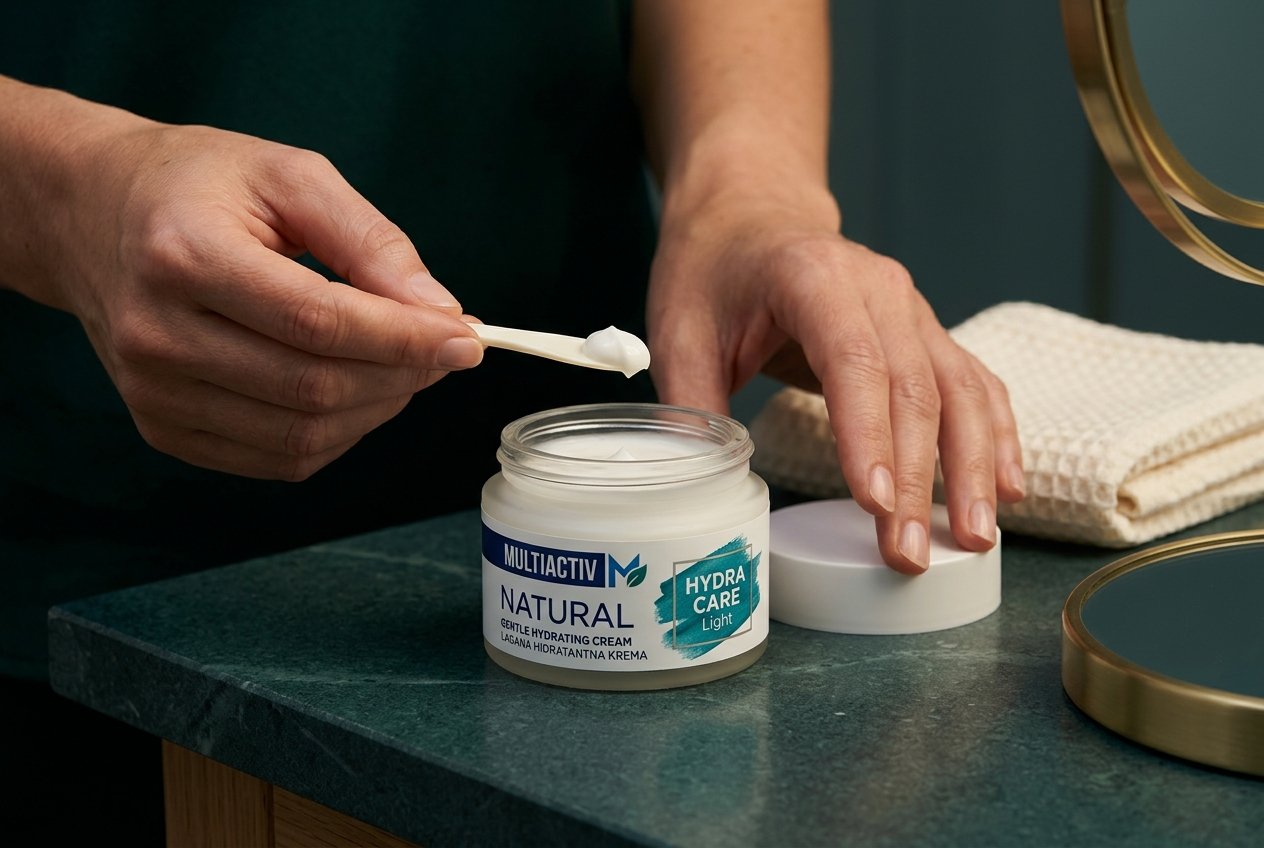
The two product photographs in this guide illustrate that supportive category. Rejuvi’s official product page identifies Rejuvi y Light Moisturizer, while London Multiactiv’s official catalogue lists Natural Hydra Care Light moisturizing cream. These examples should not be read as a prescription, proof of current clinic stock, or evidence that either product treats established scars. A manufacturer’s description establishes product identity; it is not a clinical trial showing scar correction.
When discussing a moisturizer, bring the actual formulation you own. Similar packaging, product names, regional versions, or a remembered recommendation may not identify exactly the same formula. Ask whether it fits your current medicines and your history of irritation. A rich texture is not automatically unsuitable and a light texture is not automatically suitable. How the finished formula behaves on your skin is more useful than assuming that one descriptive word settles the question.
Keep the purpose of a product trial modest and observable. You might be looking for less tightness after cleansing or a routine you can follow without discomfort. These are different endpoints from a change in scar depth. Introduce changes according to professional advice and avoid adding several new products immediately before an elective procedure. Otherwise, if irritation develops, you may not know which change needs attention.
Product familiarity is also not permission to apply a cosmetic formula to freshly needled or resurfaced skin. A cream sold for normal topical use should not be assumed suitable for delivery into channels or use on an open treatment surface. Ask the procedure clinician what is appropriate after that specific intervention. A luxury brand, professional line, or familiar ingredient does not remove the need to follow the device’s instructions and the clinician’s aftercare plan.
Nexja Select and the boundary of cosmetic support
Within the Nexja approach, Nexja Select describes the selection of professional products, protocols, and technologies. For someone with continuing breakouts, the useful expression of that idea is a clear reason for each proposed step. A product can be selected for comfort or daily care while medical acne management remains with a qualified clinician. Selection should never be presented as a substitute for diagnosis or as proof that a scar procedure is appropriate during a flare.
The site’s Rejuvi Advanced Acne Care in Istanbul page describes a professional support service for acne-prone skin. Read it in that cosmetic context. Painful nodules, worsening inflammation, open lesions, or acne producing new scars need medical assessment. A booking enquiry should explain the current condition and medicines so suitability can be considered before any supportive appointment. Mentioning the service here is not a recommendation to have it while the skin is actively irritated.
Nexja Experience frames the journey from consultation and assessment through planning and aftercare. In this particular situation, a useful experience includes an honest postponement when needed, understandable reasons for the sequence, and a clear next contact. It does not require every visit to end in a treatment. The question is whether the next action fits today’s skin and the longer-term goal, not whether the appointment can be filled with another procedure.
Plan for Changes Between the Consultation and Treatment Day
Acne does not always follow a booking calendar. A consultation may happen during a calm interval and the intended procedure day during a flare. Agree beforehand how to report that change. Ask whether the clinic wants a telephone update, a photograph through its approved channel, or another examination. Photographs can help communicate what changed, but they do not establish medical suitability on their own. Do not conceal a flare because you have arranged time off or travelled to the appointment.
If a procedure is postponed, ask which parts of the plan remain useful. The acne regimen may still need to continue as prescribed; a consultation or record review may still be worthwhile; an invasive intervention may need a new date. Postponement should produce a concrete next step rather than a vague instruction to return when the skin looks better. The provider can explain whether the next review depends on symptoms, a medication milestone, or a planned assessment interval.
Changes can also occur in your practical circumstances. You may have less time for aftercare than expected, an unavoidable outdoor commitment, or difficulty obtaining the recommended products. Raise those issues before treatment. They are relevant to the decision because a plan must be feasible after you leave the room. An option with a manageable recovery burden may suit you better, or waiting may be the more sensible choice. This is a shared decision rather than a test of commitment.
Keep a contingency for a flare after a scar procedure
Ask the clinician how to respond if new acne appears during recovery. The answer may differ from your usual spot-treatment routine because recently treated skin has different needs. Avoid automatically restarting an exfoliant, applying a new acne product, squeezing the area, or treating every bump as a normal purge. Follow the procedure-specific instructions and contact the provider when the reaction is outside the expected pattern.
Useful information for that contact includes when the change began, where it is, whether it is painful or spreading, and which products have actually been used since the procedure. Keep photographs factual, with similar lighting and no filters. Describe symptoms clearly rather than trying to identify the complication yourself. Increasing pain, spreading redness, fever, blistering, or eye symptoms warrants prompt medical advice; severe swelling or breathing difficulty requires urgent care.
Once the problem has been assessed, the next scar session should be reconsidered in light of the new information. A booked series is not a reason to repeat a procedure before the response is understood. Ask whether the plan needs a different field, intensity, preparation, interval, or a return to acne stabilization. The purpose of a staged approach is that later decisions improve as more is learned about your individual response.
Understand What the Evidence Can and Cannot Tell You About Timing
A study of people with established acne scars does not automatically answer whether the same treatment is suitable while inflammatory lesions continue. Look at who was included. Were participants’ breakouts already controlled? Were people using particular medicines excluded? Which skin tones and scar patterns were represented? These questions help explain why a positive scar study may be relevant to the future plan without providing permission to begin today.
The comparison matters as well. An improvement after several combined interventions does not show which individual step produced it. A study comparing two scar techniques is different from a study testing whether either should be performed over active lesions. Promotional summaries sometimes collapse these questions into one claim. During a consultation, ask the professional to connect the evidence to your actual treatment field and current acne activity, rather than simply naming a successful technology.
Guidance can also address different clinical questions. NICE’s recommendations on management of acne-related scarring include specialist referral for severe scarring that persists a year after acne has cleared. Its supporting evidence review discusses the opportunity for tissue remodeling during that period. That is a specific severe-scarring pathway; it should not be converted into a claim that everyone must postpone every consultation, supportive step, or procedure for exactly one year. It also does not justify delaying care for ongoing acne that is creating scars now.
Similarly, a review challenging a blanket delay after isotretinoin is not equivalent to approval for every device during isotretinoin use. Device labeling can retain specific precautions even where broader research has become more nuanced. Ask which guidance applies to the exact proposed intervention, what uncertainty remains, and whether its expected benefit is worth the burden now. Different recommendations can sometimes be reconciled by noticing that they concern different procedures, patient groups, or goals.
Finally, distinguish evidence of possible benefit from a personal forecast. An average result across a study does not tell you how much an individual scar will change, whether your acne will stay controlled, or whether the same treatment schedule fits your life. The useful outcome of reading evidence is a better set of questions and a more realistic plan. It is not a guaranteed percentage improvement or a reason to bypass an examination.
From Evidence to Action: A Step-by-Step Decision Path
Evidence-based planning starts by asking what is causing harm now. If new inflammatory lesions are appearing, preventing additional scars has a higher priority than polishing old ones. The 2024 American Academy of Dermatology guideline strongly supports several established acne therapies and recommends isotretinoin for severe acne, acne causing scarring or psychosocial burden, or disease that has not responded to standard treatment. That guideline does not prescribe one scar procedure for everyone; it reinforces why active disease deserves proper medical management rather than being treated as an inconvenience before a cosmetic appointment.
Next, identify the treatment field. Active acne on the jaw does not necessarily create the same procedural problem as pustules scattered through both cheeks where full-face needling is planned. A focal scar on the temple may be physically separate from current lesions. Location, density, and skin integrity matter. The clinician may narrow the field, use a test area, change the technique, or defer. This is safer than a binary rule based only on the words “active acne.”
Then identify the proposed mechanism. A soothing, non-invasive support session places a different burden on the skin from subcision, fractional laser resurfacing, deep chemical peeling, or microneedling. The more an intervention disrupts the barrier or creates controlled injury, the more carefully current inflammation, infection risk, pigment response, and wound care must be considered. Even within the same named procedure, intensity changes risk. A superficial pass and an aggressive session are not equivalent simply because both are marketed as microneedling.
Finally, define what success would look like at this stage. During active-acne control, success may mean fewer deep lesions and no new scars—not immediate elimination of old texture. During a pigment-focused phase, success may mean fewer new dark marks and more even color. During scar correction, success may mean softened edges or shallower depressions across several sessions, not poreless skin. Stage-specific goals protect people from abandoning an effective plan because it has not yet addressed a later target.
A practical green–amber–red framework
Green does not mean automatically approved. Relatively favorable features may include stable or infrequent superficial lesions, intact skin in the proposed treatment area, a consistent regimen, manageable sensitivity, and no recent history suggesting impaired healing. These features support assessment, not self-treatment. The procedure still has to fit the scar type and the person’s medical context.
Amber means slow down and clarify. Examples include a recent medication change, occasional pustules in the treatment field, significant dryness, a recent tan, a history of dark marks after minor irritation, an upcoming flight or sunny holiday, or uncertainty about whether the concern is pigment or texture. Amber often leads to better preparation, a smaller test area, lower intensity, a changed date, or a different first step.
Red means postpone elective scar work and seek appropriate assessment. Examples include widespread painful nodules, open or crusted lesions across the treatment field, suspected infection, a severe product reaction, active herpes in the area, uncontrolled picking with wounds, significant barrier breakdown, or systemic symptoms. A red flag is not a judgment about the person; it is a reason to protect healing and address the immediate problem.
Myths vs Facts About Active Acne and Scars
Myth: You must wait until you never get another pimple
Fact: Acne can recur, so “never another pimple” is not a realistic universal threshold. Clinicians look for meaningful control, treatment-area safety, and a stable enough baseline. A single superficial blemish may be handled differently from ongoing nodulocystic disease.
Myth: Scar procedures will automatically cure active acne
Fact: A procedure selected for scar remodeling is not automatically an evidence-based acne treatment. Some technologies may influence both concerns in selected settings, but active disease still requires a deliberate treatment plan. The indication, device, settings, and evidence must be clear.
Myth: Every red or brown spot is a scar
Fact: Flat post-inflammatory color changes are different from depressed or raised scars. They may coexist, but they respond to different strategies. Side lighting, touch, and clinical examination help separate color from structure.
Myth: Stronger treatment prevents more scars
Fact: Excess irritation can worsen inflammation, prolong pigment change, and disrupt adherence. Preventing new scars depends on controlling acne effectively and avoiding injury, not maximizing procedure intensity.
Myth: Darker skin cannot have laser or needling treatments
Fact: Many people with darker skin tones can be treated, but device choice, settings, pretreatment, aftercare, and practitioner experience are especially important because post-inflammatory pigment change may be more likely or more persistent.
Myth: A facial can replace dermatologic treatment for painful acne
Fact: Cosmetic care may support comfort or barrier care in suitable skin, but it does not replace assessment and evidence-based treatment for deep, painful, scarring, or widespread inflammatory acne.
Myth: Isotretinoin always forbids every procedure for six months
Fact: Evidence has moved beyond a blanket rule for all procedures, but the exact intervention still matters. Fully ablative resurfacing and mechanical dermabrasion raise different concerns from less aggressive procedures. Decisions must be coordinated with clinicians who know the medication and the procedure.
Myth: If a procedure does not bleed, it cannot cause pigment change
Fact: Pigment can follow inflammation without visible bleeding. Heat, chemical irritation, friction, and barrier disruption may all provoke color change in susceptible skin.
Myth: Home rollers are a safer way to start
Fact: Home needling introduces questions about sterility, depth, pressure, repeated passes, and use over active lesions. The FDA notes risks associated with microneedling devices, including infection and pigment change. At-home experimentation is not a substitute for assessment.
Myth: One procedure should fix every scar type
Fact: Ice-pick, boxcar, rolling, and raised scars differ in shape and biology. Combination planning is common because one method rarely addresses every feature equally.
Building an Aftercare Plan Before You Book
Aftercare should be discussed before treatment, not improvised after the skin is already inflamed. Ask when cleansing can resume, which moisturizer is suitable, how sun protection should be applied, and when prescription or over-the-counter actives can restart. The answers depend on the intervention. A person using a retinoid and benzoyl peroxide cannot assume the same restart schedule after every peel, laser, or needling session.
Plan around behavior and environment. Sweating, swimming, sauna, hammam, dusty work, mask friction, makeup, and direct sun may affect the early recovery period. Istanbul travel can add long outdoor days, flights, and schedule pressure. An elective scar procedure immediately before sightseeing or a major event may create avoidable stress. The safest calendar includes recovery time and access to follow-up.
Know the expected response and the warning signs. Temporary redness, tightness, swelling, or flaking may be anticipated after some procedures, but the expected intensity and duration should be explained specifically. Increasing pain, spreading redness, pus, fever, blistering, eye symptoms, or a severe allergic reaction requires prompt professional advice. Do not attempt to “push through” a worsening reaction with more acids or occlusive home remedies.
Sun protection is part of outcome protection, particularly when pigment is a concern. That means more than applying sunscreen once. Use shade, hats, and timing strategies; reapply an appropriate broad-spectrum product; and avoid deliberate tanning. If upcoming sun exposure cannot be controlled, changing the procedure date may be wiser than relying on perfect aftercare.
Frequently Asked Questions
1. Can a dermatologist treat a large acne cyst and an old scar at the same appointment?
Potentially, but these are separate decisions. A clinician may address a large inflammatory lesion medically and discuss or treat an old scar elsewhere, depending on location, infection risk, medication, and the planned scar technique. Sharing the same appointment does not mean the same procedure is used for both.
2. How many acne-free weeks are needed before microneedling?
There is no universally valid number of acne-free weeks. The relevant questions are whether lesions remain inflammatory in the treatment field, whether the barrier is intact, whether acne treatment is stable, and what needling depth and device are proposed. The treating professional should set the timing after examination.
3. Can microneedling spread acne?
Passing a device over active pustules or compromised skin raises legitimate concerns about irritation and infection. This is one reason professional assessment and sterile technique matter. It is too simplistic to say microneedling always spreads acne or never does; lesion activity, field selection, and technique change risk.
4. Should I stop retinoids before a scar procedure?
Do not stop a prescription automatically. Some procedures require a temporary pause in irritating topicals, while others may have different preparation. Ask both the prescriber and procedure clinician for a coordinated plan that names the product, strength, stop date, and restart criteria.
5. Is salicylic acid enough for pitted scars?
Salicylic acid can be useful in acne care and superficial exfoliation, but established pitted scars involve structural changes that usually need scar-specific assessment. Stronger or repeated acid use at home does not convert a superficial product into a safe treatment for deep depressions.
6. Can I treat dark acne marks while breakouts continue?
Often the plan addresses both prevention and existing color, but product and procedure choices must respect irritation and skin tone. The highest-value step is reducing new inflammatory lesions so fewer new marks form. Sun protection and selected topical options may be discussed with a clinician.
7. Does sunscreen improve scars?
Sunscreen does not release tethered tissue or fill a depression, but it helps reduce ultraviolet-driven contrast and protects against worsening post-inflammatory pigment. It also supports safer use of many acne and pigment treatments. It is a foundation, not a standalone scar cure.
8. Is extraction a scar treatment?
No. Careful extraction may address selected comedones when appropriate, but it does not remodel established atrophic scars. Aggressive squeezing of inflamed lesions can increase injury. Scar treatment should follow scar anatomy, not the assumption that every irregularity is trapped material.
9. Can active acne make laser results worse?
Active inflammation may complicate field selection, recovery, and measurement, and some lasers or settings may be inappropriate during a flare. “Laser” covers many technologies, so the answer depends on wavelength, delivery, intensity, indication, lesion activity, and skin tone. Assessment is essential.
10. What if only my chin is breaking out but my cheeks are scarred?
A clinician may consider separate treatment zones because the stable scarred cheeks and active chin present different conditions. However, acne pattern, medication, healing risk, and the full-face nature of the proposed procedure still matter. Do not assume geographic separation alone guarantees suitability.
11. Will treating scars cause a purge?
“Purging” is often used loosely. A scar procedure may trigger irritation, occlusion-related breakouts, or an acne flare, but that is not automatically a normal cleansing process. Ask what reactions are expected and report worsening inflammatory acne rather than assuming it must be endured.
12. Can I combine a peel and microneedling to save time?
Combining controlled injuries may increase irritation and pigment risk. Some clinicians use combination protocols in selected patients, but sequence, strength, and interval are deliberate. Combining home peels with professional needling without disclosure is especially risky.
13. Are shallow scars safe to treat earlier?
Depth is only one variable. Shallow scars may need less aggressive treatment, but active lesions, skin sensitivity, pigment history, medication, and treatment location still matter. Earlier is not automatically safer; it becomes reasonable when the total risk profile supports it.
14. Why do my scars look worse during a breakout?
Redness, swelling, dehydration, and harsh overhead light can increase contrast and shadows. New lesions can also temporarily distort nearby texture. Standardized photographs taken after inflammation settles provide a better basis for judging established scars.
15. Can professional skincare prevent all future scars?
No service can guarantee prevention. Timely evidence-based acne treatment, avoiding picking, and appropriate follow-up can reduce risk, but genetics, lesion severity, delay to treatment, and individual healing all contribute. Guarantees are a warning sign.
16. Should I wait for every dark mark to fade before texture treatment?
Not necessarily. Color and texture may be managed in sequence or sometimes in a coordinated plan. The important step is identifying which concern dominates, how the proposed procedure affects pigment, and whether active inflammation is stable enough.
17. What is the safest first scar procedure?
There is no safest procedure independent of the person and scar type. A conservative option for one patient may be ineffective or risky for another. Safety comes from correct diagnosis of scar anatomy, appropriate technology, trained performance, sterile practice, and realistic intensity.
18. Can I have a facial the week before scar treatment?
Possibly, but avoid uncoordinated exfoliation, extraction, or new products that could leave the skin irritated. Tell both providers what is planned. A calm barrier on procedure day is more useful than squeezing in an extra treatment.
19. What if my acne is controlled but I keep picking?
Picking can create wounds, pigment, and scars even when lesion count is low. Addressing triggers and barriers to picking is part of procedural readiness. Treating scars while new excoriations continue may undermine healing and outcomes.
20. How do I know whether a clinic is staying within cosmetic scope?
A responsible cosmetic provider does not diagnose complex disease, promise to cure acne, or tell you to ignore a prescriber’s plan. They screen for contraindications, explain limits, refer inflammatory or scarring disease when appropriate, and document the exact cosmetic goal of any supportive service.
Plain-Language Glossary for a Better Consultation
Active acne means lesions that are currently forming or inflamed, including papules, pustules, nodules, and cyst-like lesions. Comedones such as blackheads and whiteheads are active acne too, but they do not carry the same immediate procedural concerns as widespread tender nodules or open pustules. Describing the lesion type is more informative than saying only that acne is “active.”
Atrophic scar is a depression caused by loss or rearrangement of dermal support. Ice-pick scars are narrow and deep; boxcar scars have more defined edges; rolling scars create broad undulating shadows and may be tethered. A person can have several types at once, which is why combination planning is common.
Post-inflammatory erythema is persistent red or pink color after inflammation, while post-inflammatory hyperpigmentation is brown, grey, or darker color caused by increased pigment after injury. Both are flat. They can be distressing and may last for months, but they are not the same as a textural scar.
Barrier impairment means the outer protective layer is not functioning comfortably. Clues include burning with bland products, persistent tightness, diffuse scaling, cracking, or unusual sensitivity. An impaired barrier may result from acne itself, medication, over-exfoliation, or a recent procedure and can change procedural timing.
Controlled injury describes the deliberate, measured stimulus used by many scar procedures to trigger remodeling. The phrase does not mean risk-free. Depth, heat, sterility, treatment density, operator technique, and aftercare determine whether the injury remains appropriately controlled.
Remodeling is the gradual biological process through which collagen and surrounding tissue change after injury or treatment. Visible improvement may continue over weeks or months. Immediate swelling can make texture look temporarily smoother, so early photographs should not be mistaken for the final result.
Downtime is not only the number of days redness is visible. It includes wound-care needs, sensitivity, swelling, peeling, limits on makeup and exercise, sun avoidance, and the possibility that pigment change lasts longer than surface recovery. Ask for a practical description rather than a single number.
Test spot is a deliberately limited treatment area used to observe response before treating a larger field. It may be useful when pigment response, sensitivity, or device settings are uncertain, but it cannot guarantee that the full procedure will behave identically.
Shared decision-making means the clinician contributes diagnosis, evidence, procedural skill, and risk assessment while the patient contributes goals, tolerance for downtime, budget, schedule, and personal priorities. A strong plan is not simply the most aggressive option; it is the option whose expected benefits and burdens fit the individual.
A Clear Answer to the Main Question
Yes, it is possible to plan—and in selected circumstances begin parts of—scar care while some acne remains active. However, active inflammatory acne usually changes the priority, the treatment field, and the acceptable intensity. Deep, painful, widespread, open, or rapidly scarring acne should prompt medical management before elective full-field scar procedures. Supportive barrier care, documentation, pigment prevention, and consultation can continue in the meantime.
The safest plan is staged rather than delayed without purpose: control active injury, verify stability, distinguish marks from scars, match each scar type to an appropriate option, and review the plan at every step. That approach protects the future result because it prevents today’s inflammation from creating tomorrow’s scars.